Best Charge Controller for Solar System: Reliable PWM and MPPT Options for Your Setup
Choosing the right solar charge controller is essential for protecting your battery bank and maximizing energy harvest. This article highlights five dependable models suited for 12V and 24V systems, including PWM and MPPT options. Each section provides key features, suitability notes, and a quick buying guide to help you compare performance, protection, and compatibility.
Summary of Selected Products
| Product | Brand | Voltage | Type | Key Benefit |
|---|---|---|---|---|
| Renogy Wanderer 10A | Renogy | 12/24V | PWM | Advanced load management with LCD display |
| ACEIRMC 30A Solar Charge Controller (2-pack) | ACEIRMC | 12/24V | PWM | Dual USB outputs and automatic parameter memory |
| Depvko 30A Solar Charge Controller | Depvko | 12/24V | PWM | Auto parameter memory; USB charging; broad protection |
| Anern 30A PWM Solar Charge Controller | Anern | 12/24V | PWM | LCD display with adjustable cutoffs; multiple protections |
| AeternaSol PWM Solar Charge Controller | AeternaSol | 12V | PWM | 20A output; USB-C/PD and high-contrast monitoring |
Renogy Wanderer 10A PWM Charge Controller
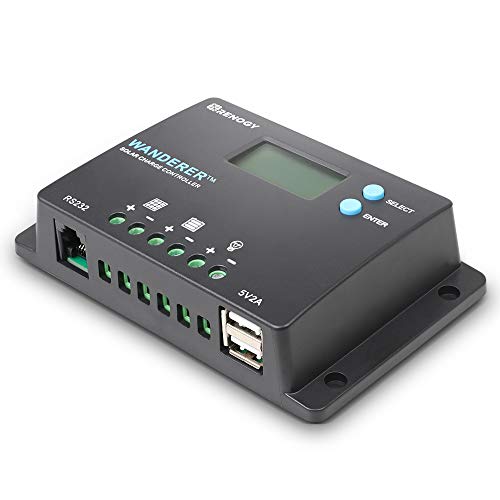
The Renogy Wanderer 10A is a compact PWM controller designed for 12V and 24V systems. It uses a four-stage charging process (Bulk, Boost, Float, Equalization) to optimize battery health for AGM, Gel, Flooded, and Lithium batteries. Its negative-ground design enhances safety for RVs and marine setups. The LCD provides clear charging status and system protections including overcharge and short-circuit safeguards. With a compact footprint (about 5.2 x 3.1 inches) and robust protection features, it suits small to mid-size off-grid installations.
ACEIRMC 30A Solar Charge Controller (2-Pack)

These ACEIRMC controllers provide 30A discharge capacity with 12V/24V compatibility and dual USB outputs. They feature a built-in microcontroller that memorizes user settings so data persists after battery discharge. The three-stage PWM regulation (direct charge, lifting charge, float) aims to improve charging efficiency and battery life. The intuitive LCD displays status and data; the device supports adjustable cut-off levels to protect lead-acid batteries from over-discharge, making them suitable for home, industrial, and commercial use.
Depvko Upgraded 30A Solar Charge Controller
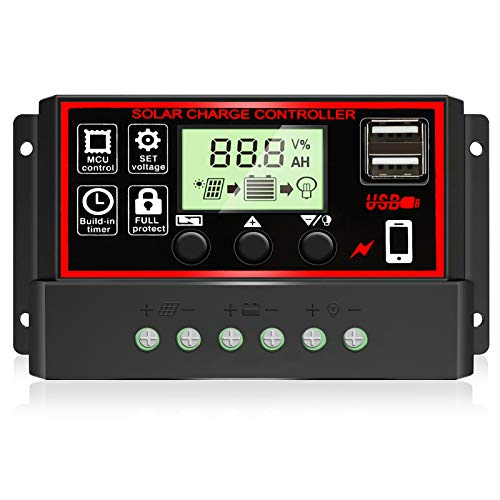
The Depvko 30A controller supports 12V/24V systems with a 3-stage PWM charging process and dual USB output for charging devices. It memorizes user-set parameters and offers broad protection including overcurrent and short-circuit protection. The device is designed to be easy to install and operate, with a wide protection profile intended to safeguard lead-acid batteries. While it does not support lithium batteries, it is a solid option for many traditional solar setups and mobile applications.
Anern 30A PWM Solar Charge Controller

The Anern PWM controller offers a 30A capacity with full 3-stage PWM charging (direct, boost, float). It includes built-in protections such as overcurrent, overload, open circuit, and reverse polarity. The LCD display makes mode switching and parameter configuration straightforward, with adjustable cut-off levels to prevent over-discharge. It is suitable for a wide range of applications in homes, small businesses, and industrial setups where lead-acid batteries are used and simple, reliable control is desired.
AeternaSol PWM Solar Charge Controller 12V

The AeternaSol controller targets 12V systems with upgraded 20A PWM charging. It emphasizes precise charging algorithms to minimize energy loss, supporting lead-acid and lithium battery profiles. The LCD screen provides real-time data on battery level, charging mode, and voltage/current, with user-adjustable charging parameters and a USB-C output option for quick device charging. It is designed for easy installation and reliable night-time protection through its anti-reverse diodes and secure connections.
Buying Guide: Key Considerations for Selecting a Solar Charge Controller
- System voltage and battery type: Confirm compatibility with 12V or 24V systems and the battery chemistry you use (lead-acid, AGM, gel, flooded, or lithium).
- Controller type and efficiency: PWM controllers are simple and affordable but less efficient than MPPT controllers, which excel in higher panel voltages and variable conditions. For smaller systems, PWM may be sufficient; for larger or multi-panel setups, MPPT is often worth the investment.
- Current rating: Choose a controller with a current rating that exceeds your solar array’s maximum output to avoid overheating and ensure reliable charging.
- Protection features: Look for overcharge, over-discharge, short circuit, reverse polarity, and temperature compensation. These protect both battery health and equipment.
- Display and usability: An LCD or clear indicators help monitor status, verify settings, and adjust parameters without tools.
- Load control and USB/output options: Some models include load control modes and USB ports for charging devices, which can simplify RV or marine installations.
- Physical footprint and mounting: Consider dimensions, mounting method, and weather rating if the controller will be outdoors or in an enclosure.
- Longevity and warranty: Check manufacturer support, warranty length, and availability of replacement parts or upgrades.