Best Charge Controller and Inverter Solutions for Solar Power Systems
Investing in a reliable charge controller and inverter combo is essential for efficient, safe, and continuous solar power. This article highlights five top-rated all-in-one or hybrid inverters with integrated MPPT charge controllers, designed for battery-based and battery-less setups. Each option supports 24V systems and offers pure sine wave output, with varying MPPT amperage and PV input capabilities. Read on to compare features, compatibility, and performance to help choose the right system for home, RV, or remote-site use.
| Product | Key Feature | PV Input Range | Output Power |
|---|---|---|---|
| SUMRY 3600W Inverter Charger | 120A MPPT, 100A AC charger | 60-500VDC | 3600W / 7200W peak |
| SUMRY 4000W Hybrid Inverter | 140A MPPT, LCD display | Up to 350VDC | 4000W / 8000W peak |
| Giandel 1200W inverter | Remote control, 20A solar charge controller | Direct panel connection | 1200W / 2400W peak |
| Rolokit 30A PWM Controller | LCD readout, adjustable modes | 12V/24V | 30A output (controller only) |
| Renogy Wanderer 10A | 4-stage charging, negative ground | 12V/24V | 10A |
The following sections present detailed product profiles to help you assess how well each option meets your power needs, whether you prioritize higher PV input capacity, battery flexibility, or a convenient display and control interface. All products are designed to operate with a range of battery chemistries, including AGM, Gel, Flooded, and Lithium types, and many support operation with or without a connected battery for greater system versatility.
SUMRY Solar Inverter Charger, 3600W Hybrid MPPT Controller

This all-in-one unit combines a 3600W pure sine wave inverter with a built-in 120A MPPT solar charge controller and a 100A AC battery charger. It accepts a wide PV input range of 60 to 500 VDC, with maximum PV input power around 4200W at 18A, enabling flexible solar array configurations. It can operate with a variety of 24V battery types, including AGM, Gel, Lead-Acid, Lithium, and LiFePO4. The inverter can also function battery-less by drawing from PV power when PV voltage exceeds 120V, making it suitable for both battery-backed and battery-less setups. Output stability and grid-like sine wave performance help protect sensitive devices while powering typical household appliances.
Key considerations: Ensure your PV array can deliver the required voltage and current to match the MPPT controller’s input, and verify that your critical loads fit within the 3600W continuous rating. The unit’s versatility makes it a practical choice for small homes, cabins, or off-grid installations where space and simplicity matter, though configuration requires attention to battery compatibility and PV array sizing.
SUMRY Hybrid Solar Inverter, 4000W with LCD and 140A MPPT

This SUMRY model delivers 4000W continuous power with an authoritative 8000W peak, backed by a 140A MPPT charge controller. The tempered glass top and a large 6.25-inch LCD display with touch controls provide a modern, easy-to-read interface for real-time monitoring. With a maximum PV input of up to 5600W and a PV input voltage up to 350VDC, it supports robust solar arrays and rapid charging. The inverter emphasizes a pure sine wave output, ensuring compatibility with sensitive electronics, and includes multiple operating modes to prioritize solar or grid inputs as needed.
Buying considerations: If you anticipate heavy daytime solar production and multiple large loads, this model’s higher MPPT rating and efficient conversion can improve overall system performance. The glass cover design is aesthetically pleasing and functional, but ensure the installation area accommodates its size. Compatibility with both battery-less and battery-based configurations provides flexibility for expanding or downsizing a system over time.
Giandel 1200W Inverter With 20A Solar Charge Controller

This 1200W DC-12V to AC-120V inverter focuses on portability and basic off-grid capability. It includes a 20A solar charge controller, remote control, and USB port, designed for RVs, campers, boats, or emergency power. With two AC outlets and a USB charger, it supports common devices and adds convenience with remote monitoring. It’s designed for direct connection to a solar panel and a battery, with a battery voltage indicator to track charging status. This option is ideal for smaller systems with modest power requirements where a compact, easy-to-set-up solution is preferred.
Guidance: This model is suited for personal travel power kits or small, energy-conscious setups. It may not meet heavy load demands or large appliances for extended periods, but its simplicity and integrated controller streamline basic off-grid operation.
Rolokit 30A PWM Solar Charge Controller

The Rolokit PWM solar charge controller offers automatic 12V/24V recognition and a user-friendly LCD for status updates. It is primarily compatible with lead-acid batteries (OPEN, AGM, GEL) and provides dual USB 5V/3A outputs for charging mobile devices. While PWM technology is less efficient than MPPT in certain conditions, PWM controllers are cost-effective and straightforward, making them a practical option for simple solar setups, hobby projects, or where budget constraints are a priority. The device emphasizes battery protection features to prevent over-discharge and optimize overall system health.
Important note: This controller is not suitable for Lithium batteries, so ensure your battery chemistry aligns with its specifications. For larger or more complex systems with mixed battery chemistries, MPPT-based controllers may offer better energy capture, particularly in fluctuating light conditions.
Renogy Wanderer 10A PWM Solar Charge Controller
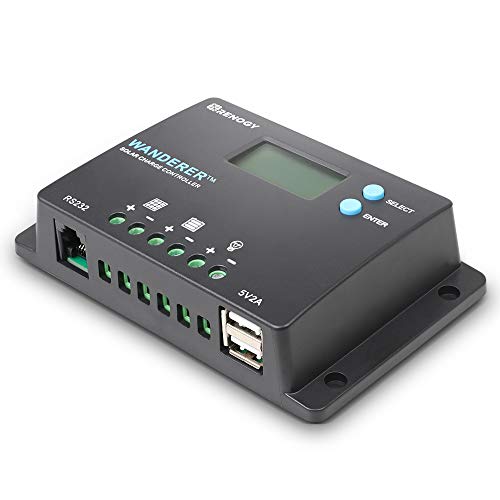
The Renogy Wanderer 10A PWM controller features smart four-stage charging to boost battery life for AGM, Gel, Flooded, and some Lithium batteries, along with a negative ground design suitable for RV and marine installations. Its compact form factor and LED/LCD indicators offer clear visibility of charging status and system health. Renogy emphasizes efficiency, flexible mounting options, and reliability for smaller solar installations, including portable systems and small off-grid cabins.
Considerations: While PWM controllers are reliable and affordable, ensure your system’s solar array and battery bank align with the Wanderer’s 10A rating. For larger arrays or higher charging demands, MPPT controllers may provide better energy harvest, particularly in variable sun exposure.
Buying Guide: Key Purchase Considerations For Solar Inverter Chargers
- System architecture: Decide between an all-in-one inverter charger (inverter + MPPT + battery charger) and a standalone inverter with a separate MPPT controller. All-in-one units simplify wiring, while separate components offer modular scalability.
- Voltage and battery compatibility: Ensure the device supports your battery chemistry (AGM, Gel, Lead-Acid, Lithium) and the system voltage (commonly 12, 24, or 48V). Check that MPPT or PWM controllers match your battery type and desired charging strategy.
- PV input and output rating: Higher PV input power and a broader voltage range enable more flexible solar array configurations. Verify continuous and peak output ratings to cover your anticipated load at peak demand.
- Efficiency and harmonic performance: Pure sine wave output is essential for sensitive electronics. MPPT controllers typically yield higher real-world efficiency than PWM, especially with larger arrays and variable shading.
- Display, control, and monitoring: LCD or touchscreen interfaces improve real-time monitoring and ease configuration. Look for remote monitoring options if remote system visibility matters.
- Battery-free operation: Some units can run loads directly from PV power when sunlight is sufficient, reducing battery cycling. Assess whether this mode aligns with your usage patterns.
- Protection features: Overcharge, over-discharge, short-circuit, reverse polarity, and temperature protections safeguard both batteries and appliances.
- Physical footprint and installation: Consider size, mounting orientation, and enclosure requirements. Glass covers or premium housings add durability but require more space.
- Future upgradability: If you plan to expand solar capacity or add more loads, choose a system with higher MPPT amperage or modular components to accommodate growth.
In summary, the right charge controller and inverter combination depends on your load profile, battery strategy, and available solar capacity. For larger homes or cabins with substantial daytime generation, models with higher MPPT ratings and robust PV input support can maximize energy harvest. For simpler or budget-conscious setups, PWM-based options paired with compact inverters may suffice, especially when combined with a thoughtful battery strategy. Always verify compatibility with your specific batteries and appliances before purchase.