Best Cat 6 Underground Cable for Outdoor Networking and Direct Burial
The following Cat 6 outdoor and underground cables are designed to withstand harsh conditions while delivering reliable high-speed networking. This guide highlights five options with direct burial capability, UV resistance, and weatherproof jackets to support gardens, backyards, IP cameras, and outdoor workspaces.
| Product | Length | Jacket Type | Key Benefit |
|---|---|---|---|
| GEARit RJ45 Cat-6 200 ft | 200 ft | Direct Burial UV-Resistant | Durable outdoor burial with 10 Gbps capability |
| GEARit Cat6 Outdoor 250 ft | 250 ft | Direct Burial UV-Resistant | Rugged outdoor cable with shielded design options |
| TRUE CABLE Cat6A Direct Burial 500 ft | 500 ft | Outdoor CMX UV Jacket | Highest frequency (750 MHz) and PoE support |
| CENTROPOWER Cat6 Outdoor Direct Burial 1000 ft | 1000 ft | Weatherproof UV Jacket | Long-run direct burial with PoE compatibility |
| VOIETOLT Cat6 Outdoor 100 ft | 100 ft | LLDPE UV Jacket | Compact underground-ready option with 10 Gbps potential |
GEARit RJ45 Cat-6 200 Ft Direct Burial Cable

GEARit offers a rugged Cat 6 direct burial cable intended for outdoor routers, backyard offices, and installations that require long-run reliability. The jacket is designed to withstand burial and harsh conditions. It uses copper clad aluminum (CCA) conductors that balance performance and value, delivering Cat 6 speeds up to 10 Gbps and 550 MHz bandwidth. This option emphasizes ease of installation without conduits, making it suitable for homeowners and IT professionals alike.
GEARit Cat 6 Outdoor 150 Ft Direct Burial Cable

This outdoor Cat 6 cable from GEARit is built for direct burial with a UV-resistant jacket. It uses shielded foil twisted pairs with oxygen-free copper conductors in some models, helping to reduce interference and sustain strong performance across longer runs. It supports 10 Gbps speeds up to 550 MHz and is designed for both home and professional installations.
TRUE CABLE Cat6A Direct Burial Bulk Cable (500 ft)

TRUE CABLE’s Cat6A direct burial bulk cable emphasizes extreme performance with 750 MHz bandwidth, ideal for 10 Gigabit Ethernet over longer distances. It uses pure 23 AWG solid bare copper conductors and a CMX outdoor jacket that is UV- and moisture-resistant. This option suits outdoor installations that demand high reliability in challenging environments, including direct burial, conduit, or aerial use.
CENTROPOWER Cat6 Outdoor Direct Burial Cable 1000 ft
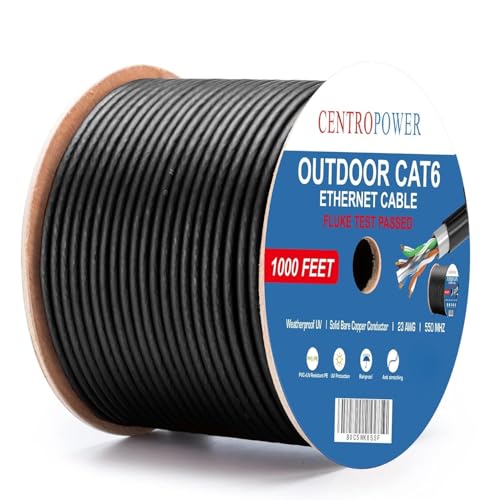
CENTROPOWER offers a long-run Cat 6 cable with a UV-resistant jacket suitable for direct burial. With 23 AWG solid bare copper conductors and PoE++ (4PPoE) compatibility, this option supports gigabit and 10-gigabit ethernet. The flexible design is suitable for burying underground or using in conduit, expanding its utility for professional and residential projects alike.
MEIPEK Cat 6 Outdoor Direct Burial Cable 500 ft

MEIPEK’s bulk Cat 6 shielded (FTP) cable is designed for outdoor use with a direct burial-ready jacket. The shielded pairs help reduce EMI and RFI for stable transmission across longer distances. It uses 23 AWG conductors and provides reliable performance for outdoor networks, including PoE and high-bandwidth streaming in exterior installations.
VOIETOLT Cat6 Outdoor 100 Ft Ethernet Cable

VOIETOLT provides a compact 100 ft Cat 6 outdoor cable with direct burial capability and a UV-, water-, and temperature-resistant jacket. Its 24 AWG core and copper-clad aluminum conductors aim to balance performance and price, offering up to 10 Gbps speeds with 550 MHz bandwidth. The package emphasizes easy burying and durable, long-term outdoor operation.
Buying Guide: Key Purchase Considerations
- Direct burial compatibility: Confirm the jacket is rated for direct burial and outdoor exposure (UV, moisture, temperature variations). This prevents the need for conduits in simple trench installations.
- Conductor material: Pure copper offers the best performance but typically costs more than copper clad aluminum (CCA). For longer runs or higher reliability, look for OFC (oxygen-free copper) or solid copper conductors.
- Bandwidth and speed: Cat 6A and higher are better for 10 Gbps and higher bandwidth needs over longer distances. For typical backyard setups, Cat 6 or Cat 6A with 550–750 MHz is usually sufficient.
- Jacket and insulation: UV resistance, moisture resistance, and abrasion resistance are essential for outdoor use. Check jacket material (LLDPE/CMX) and compatibility with burial methods.
- Shielding: Shielded (STP/FTP) cables reduce EMI/RFI in electrically noisy environments. Consider shielded options if you have nearby power lines or other EMI sources.
- Length and run planning: Plan the total run length including future expansions. Bulk spools or long reels reduce joins, but ensure the length matches your installation plan.
- PoE support: If you’re powering devices like cameras or access points, ensure the cable supports PoE/PoE++ standards within the desired power range and distance.
- Certifications and safety: Look for ETL or UL listings and ensure the product meets applicable standards for outdoor use and direct burial installations.
- Cost vs. value: While higher-grade copper and shielding add cost, they provide better signal integrity for longer runs. Weigh budget against future-proofing needs.
- Installation considerations: Direct burial requires digging and trenching; verify ease of burial with your soil conditions and local regulations.
All selected products share the core attributes needed for reliable outdoor networking: direct burial capability, weather-resistant jackets, and Cat 6 or higher performance. When choosing, consider your total run distance, device power needs, local climate, and whether shielding is necessary for EMI-heavy environments.