Best Cast-in Heating Element Industrial Heat Guns for Pros
Answering the needs of professionals who demand durable, high-performance tools, the top picks below leverage cast-aluminum housings and rugged components to withstand demanding environments. These heat guns are best for automotive work, shrink tubing, paint removal, wiring projects, and heavy-duty fabrication. The buyers most suited are shop technicians, fabricators, and professionals requiring reliable, long life tools with consistent heat and robust construction.
Summary of selected products:
- Master Appliance HG-301D Industrial Heat Gun — 800°F, 1440W, 120V, heavy duty with quick-change plug-in heating element
- Master Appliance VT-751D Industrial Heat Gun — 130°F to 1200°F, 1740W, 120V, variable temperature
- Master Appliance HG-801D Industrial Heat Gun — 1440°F, 2220W, 120V, requires 20A outlet
- Master Appliance HG-302D Industrial Heat Gun — 800°F, 1320W, 220V, solid bench-top stand
- Master Appliance HG-502D Industrial Heat Gun — 1200°F, 1980W, 220V, powerful airflow
Master HG-301D Industrial Heat Gun

Best for: Professionals who need a rugged, steady-performing heat gun for wire connectors, paint stripping, and heat shrink tubing. The HG-301D uses a die-cast aluminum housing and a long-life universal motor to deliver up to 800°F with 1440 watts of power. The fixed air intake improves temperature consistency for more predictable results.
Why chosen: This model emphasizes durability and stability in demanding production settings. It is engineered in the USA and has a proven track record among industrial users. The 800°F ceiling is ample for common HVAC, automotive, and electronics work.
Caution: Works on standard 120V outlets; ensure electrical supply matches the 1440W requirement to avoid underpowered operation.
Master VT-751D Variable-Temp Heat Gun

Best for: Shops needing precise temperature control across multiple tasks, from decal removal to epoxy work. The VT-751D offers a lockable temperature range from 130°F to 1200°F and a robust 1740W output at 120V.
Why chosen: The variable temperature dial enables tailoring heat output to the material, reducing the risk of scorching or damage. The design prioritizes reliability in industrial environments.
Caution: Higher heat and power require careful handling; verify a suitable outlet and workspace ventilation when operating at maximum temperatures.
HG-801D Industrial Heat Gun

Best for: Heavy-duty environments needing maximum heat with sustained use, such as heavy paint stripping or thick plastic work. The HG-801D reaches up to 1440°F with 2220 watts of power.
Why chosen: It represents the high-end end of the line with robust build, a 20-amp capability, and a 90-degree stand for hands-free operation. This makes it suitable for bench-top tasks and continuous use in busy shops.
Caution: Requires a 20-amp outlet (NEMA 5-20P); using a standard 15-amp outlet may limit performance or trip breakers.
HG-302D Industrial Heat Gun
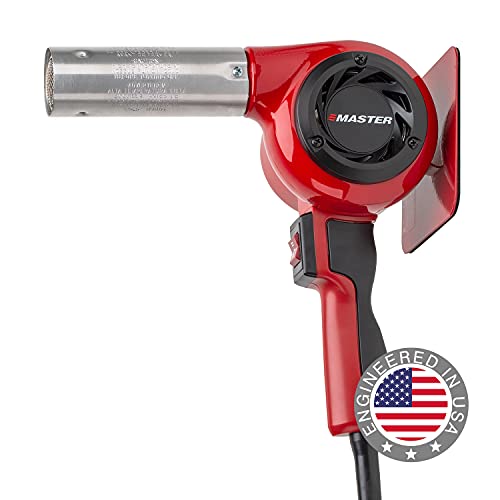
Best for: Fabrication and assembly lines requiring consistent 800°F performance on 220V systems. The 1320W rating and 27 CFM airflow help projects move faster.
Why chosen: The HG-302D combines a heavy-duty die-cast housing with a 90-degree stand, enabling ergonomic, hands-free operation for extended tasks. A strong choice for shop floors needing reliable, repeatable heat output.
Caution: Designed for 220V operation; ensure electrical compatibility before use in mixed-voltage environments.
HG-502D Industrial Heat Gun
Best for: High-output tasks where 1200°F is needed with steady power on 220V networks. The 1980W rating and 9 amps provide strong heat for demanding jobs.
Why chosen: This model is aimed at users requiring robust heating capacity for materials like thick plastics, urethanes, or heavy-duty shrink applications. Its power and airflow keep pace with fast production lines.
Caution: Like other high-temperature tools, maintain ventilation and avoid overheating sensitive components or wiring near the nozzle.
Buying Guide: Cast-In Heating Elements For Heat Guns
- What temperature range do I need? Choose a model with your target max temperature. For standard shrink-wrapping and paint removal, 800–1000°F is often sufficient. For heavy plastics or thick coatings, consider models reaching 1200–1440°F.
- Power and outlet compatibility: 120V tools are common for lighter work, while 220V units deliver more sustained heat. If you must run on a 15A outlet, avoid models requiring 20A or 30A circuits.
- Airflow and efficiency: Higher CFM supports faster workflow. Look for machines with solid airflow specs (e.g., 27 CFM) when you need speed on tough jobs.
- Durability and build: Cast-aluminum housings and sturdy stands improve longevity on busy shop floors. A fixed stand helps with long project runs.
- Temperature control: Variable temperature or fixed settings influence precision. Lockable temperature controls reduce drift during critical tasks.
- Idle safety and usability: Consider ergonomic design, heat-shielded nozzles, and protective features for frequent use in assembly or repair lines.
- Size and weight: Heavier guns endure longer but may fatigue users. Balance weight with reach and control for comfort during extended sessions.
Frequently Asked Questions
- What is a cast-in heating element heat gun? It describes a heat gun built with a durable aluminum housing and a robust internal heater that lasts in industrial settings.
- Do all these heat guns require the same electrical outlet? No. Some models are 120V and others require 220V; some also need a 20A outlet for maximum performance.
- Is a built-in stand important? Yes for hands-free operation on benches, which improves safety and efficiency during long tasks.
- Can these heat guns be used for automotive work? Yes. They are suitable for wire insulation work, paint stripping, and automotive sleeve and decal removal when used within rated temperatures.
- Which model is best for budget-conscious shops? The HG-301D offers solid industrial performance at a practical price point, with reliable 800°F capability.
- How do I choose between 120V and 220V models? Choose based on available outlets and required sustained power. 220V units deliver higher power and are better for continuous use in professional settings.