Best Carbon Pile Battery Load Tester Guide for Smart Diagnostics
Discover how carbon pile battery load testers help diagnose battery health, charging systems, and alternator performance. This guide highlights top models, practical testing tips, and how to choose the right unit for cars, motorcycles, boats, and more. Each product section includes key features to compare at a glance, helping you decide which tester fits your workshop or home garage needs.
| Product | Brand | Max Load | Battery Coverage | Key Benefit |
|---|---|---|---|---|
| Clore Automotive Solar 1876 | Clore Automotive | 1000 Amps | 2000 CCA | Starter and alternator assessment |
| Clore Automotive Solar 1874 | Clore Automotive | 500 Amps | 1000 CCA | Compact carbon pile testing |
| OEMTOOLS 24336 | OEMTOOLS | 500 Amps | Up to 1000 CCA | Dual gauges for clear results |
| ESI 710 | ES | 500 Amps | Up to 1000 CCA / 160 Ah | Tests regulators, starters, alternators |
| FJC 45118 | FJC | 1000 Amps | 6V/12V/24V | Versatile voltage compatibility |
Clore Automotive Solar 1876 — 1000 Amp Carbon Pile Tester
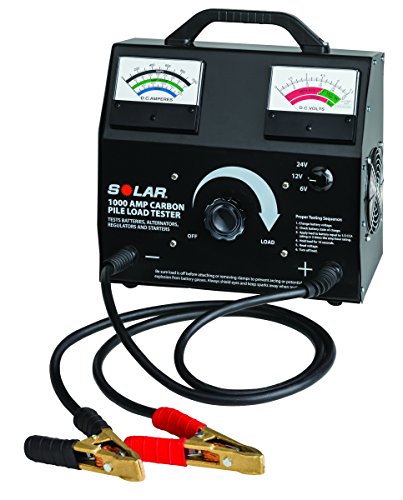
The Clore Solar 1876 provides variable load up to 1000 amps, enabling comprehensive testing of 12-volt automotive batteries. It supports tests up to 2000 CCA and includes both starter and alternator assessment capabilities. The unit is designed for professional-grade diagnostics, offering precise load control and straightforward operation for frequent use in shops or service bays.
Features include precise 1000-amp load capability and an emphasis on accurate readings during starter and alternator tests. The tester is suited for higher-capacity batteries found in trucks, diesel vehicles, and equipment where reliable performance matters. Proper use requires caution to avoid overloading sensitive battery systems.
Clore Automotive Solar 1874 — 500 Amp Carbon Pile Tester

Powered by a 500-amp carbon pile, the Solar 1874 is designed for mid-range battery testing and diagnostics. It supports testing up to 1000 CCA and allows both starter and alternator assessments. This model emphasizes portability without sacrificing diagnostic clarity, making it suitable for mobile technicians and home garages with limited space.
Operators benefit from a straightforward gauge display and reliable load control. It’s a balanced option for most 12-volt battery systems, including some recreational and small commercial applications, where a compact yet capable tester is preferred.
OEMTOOLS 24336 — 500 Amp Battery Load Tester

This carbon pile tester tests battery load, condition, and starter current draw, covering 12V systems and up to 1000 CCA in various vehicles. Dual gauges improve visibility of results, aiding quick assessments. The 500-amp capacity supports standard automotive batteries, while the heavy-duty design helps maintain clamp contact and accuracy in routine service workflows.
Key advantages include precise load control, easy-to-read gauges, and versatile testing for batteries across cars, motorcycles, golf carts, and more. The device is especially useful for technicians who need clear, fast verdicts on battery health and charging system integrity.
ESI 710 — 500 Amp Carbon Pile Tester

The ES I710 offers a 500-amp adjustable load with testing support for up to 1000 CCA and 160 ampere-hour batteries. It also tests alternators, regulators, and starters, making it a comprehensive diagnostic tool. Heavy-duty side-terminal clamps and copper cables contribute to durable performance and secure connections during testing.
Designed for workshop environments, this tester emphasizes robust construction and reliable readings. It is suitable for a mixed fleet, including passenger cars, light trucks, and equipment with higher electrical demands, where accurate load testing is essential for preventive maintenance.
FJC 45118 — 1000 Amp Carbon Pile Tester

The FJC 45118 supports up to 1000 amps and can perform load tests on 6V, 12V, and 24V batteries. It also facilitates testing of alternators, regulators, and starters. This model is versatile for various voltage systems and is well-suited for hobbyists and professional technicians who require a high-capacity tester with broad compatibility.
Its user-oriented features include a clear display and dependable load control, enabling rapid diagnostics across a broad range of battery types used in automotive and small industrial settings. It’s a practical option for service shops that encounter diverse battery configurations.
Auto Meter AMR-SB-5/2 Sb-5/2 — 800 Amp Variable Load Tester

The Auto Meter Sb-5/2 offers an 800-amp variable load capability, designed to handle a range of battery sizes commonly found in performance vehicles and commercial fleets. It provides controlled load application for consistent test results and is built to withstand regular workshop use. The user interface centers on dependable, repeatable readings for accurate assessments.
Ideal for technicians who require a robust, high-visibility tester with strong clamps and reliable electrical contact. It supports quick checks of battery health and charging system performance across a variety of 12-volt configurations and some 6-volt systems.
Schumacher BT-100 — 100A Battery Load Tester

The Schumacher BT-100 tests up to 1000 cranking amps with 6V and 12V batteries, offering charging system diagnosis and a starter motor test. It’s designed for a range of applications from motorcycles to marine batteries, with straightforward operation and versatile compatibility for common power sports and automotive batteries.
Features include multiple test modes and compatibility with 6V/12V systems, enabling efficient evaluation of battery health, alternator output, and charging performance in various environments and vehicle types.
OTC 3181 — 130 Amp Heavy-Duty Battery Load Tester

The OTC 3181 provides a 130-amp heavy-duty load test with a fast 10-second testing window and ergonomic clamps for reliable contact with top and side post batteries. Its large display covers a 0-16 volt range with a zero adjustment, supporting precise battery and charging system diagnostics in demanding environments.
Suitable for professional shops that require rapid, repeatable results on heavier battery systems, including fleet vehicles and commercial equipment. The unit emphasizes durability and ease of use under daily service workloads.
Buying Guide: Key Purchase Considerations
- Load range and battery type: Choose a tester that covers your typical batteries (CCA ratings, 6V/12V/24V). Higher amperage is needed for larger or high-performance batteries, while compact models suffice for standard passenger vehicles.
- Test scope: Consider whether you need to test only the battery, or also the starter, alternator, and regulator. Some models offer broad diagnostics, while others focus on battery health alone.
- Gauges and readability: Dual gauges or large digital readouts can improve readability and interpretation of results during busy shop times or outdoor work.
- Clamp design and durability: Clamps should resist corrosion and maintain solid contact on both top-post and side-post batteries. Heavy-duty cables ensure consistent readings.
- Portability and build: If you work in the field, weigh portability, weight, and ruggedness. For a fixed shop, a heavier unit with a stable base may be preferred.
- Voltage compatibility: Ensure compatibility with your common battery voltages (6V, 12V, and 24V) to maximize utility across different vehicle types.
- Safety and usage: Look for safe operating features, clear instructions, and protective housings. Proper training helps prevent misreads or unsafe handling during high-load tests.
- Price and warranty: Compare warranties and total cost of ownership, including clamps, cables, and gauges. A longer warranty often reflects build quality and service support.
- Maintenance needs: Some testers require more frequent calibration or clamp maintenance. Consider how this aligns with your workshop schedule.