Best Carbon Monoxide Detector Meter Options for Safety
Indeed, the best carbon monoxide detector meter choices provide fast, reliable CO readings with clear alarms. This guide highlights five top options for home, work, and travel—each centered on accurate detection, user-friendly displays, and dependable alarms. Ideal buyers include homeowners upgrading safety gear, professionals needing precise monitoring, and travelers seeking portable protection. Below is a quick summary table of the selected products to help you compare at a glance.
| Product | Type | Best For | Key Feature |
|---|---|---|---|
| TOPTES CT-580 Portable CO Detector | Portable Detector | Individuals and small businesses needing portable depth | 0-1000 PPM, TFT color display, vibration alarm |
| KLEIN TOOLS ET110 CO Meter | Meter with Safety Alarms | Fieldwork and quick checks on the go | STEL alarm, dual low/high alarms |
| FORENSICS DETECTORS FD CO Meter | High-Accuracy CO Meter | Industrial and professional monitoring | USA NIST calibration, 0-1000 ppm, adjustable alarms |
| Kidde AA Battery Powered CO Detector (3rd Edition) | Portable Battery-Operated Detector | Travel or rough power environments | 85 dB alarm, LED status indicators |
| Kidde Plug-in CO Detector with AA Backup | Plug-in with Backup | Home safety with backup during outages | Backlit display, rotating plug, 85 dB alarm |
TOPTES CT-580 Portable CO Detector

The TOPTES CT-580 offers fast CO detection with a high-sensitivity DDS sensor and a 0-1000 PPM range. It features a TFT color display for easy reading, plus three simultaneous alert modes: visual, audible, and vibration. This model is well-suited for individuals who need a portable, ready-to-use detector for homes, travel, or light industrial settings. A key limitation is that the device may require occasional calibration in professional environments to maintain peak accuracy.
KLEIN TOOLS ET110 CO Meter

The Klein Tools ET110 provides accurate CO measurements with a compact form and a built-in short-term exposure limit (STEL) alarm for safety. It is portable and ideal for on-site checks, especially for trades or safety inspections. It uses a dual-alarm system with low and high CO level alerts, helping users act quickly. A potential limitation is that it may require more frequent battery checks during extended use in the field.
Carbon Monoxide CO Meter by Forensics

The Forensics CO Meter emphasizes high accuracy with USA NIST calibration and a 0-1000 ppm range. It uses an electrochemical sensor with low error (<±5% F.S.) and offers adjustable alarms with visual, audible, and vibration alerts. This model is best for professionals requiring traceable calibration and robust alarm options. A caveat is that it may have a steeper learning curve for non-technical users due to its calibration features.
Kidde Carbon Monoxide Detector AA Battery Powered
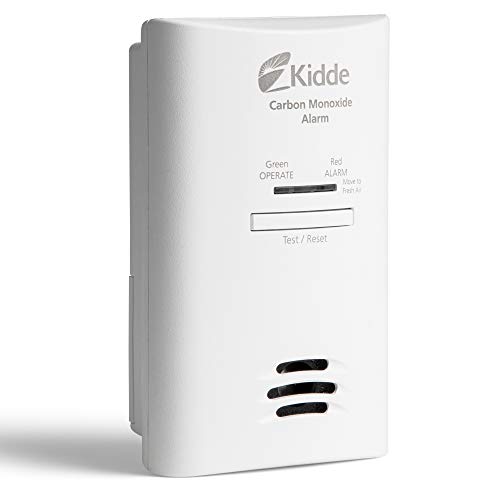
This Kidde model runs on AA batteries and provides a simple, reliable CO detection option suitable for travel or backup safety. It features an 85 dB alarm and LED indicators for clear status signals. It is best for users who want a lightweight, portable option with straightforward operation. A limitation is that battery dependence may require vigilance during long-term use without frequent replacements.
Kidde Plug-in CO Detector With Backup

The Kidde plug-in CO detector combines wall-powered detection with AA battery backup for continued protection during outages. Its backlit digital display shows CO levels for quick assessment, and the rotating plug design fits most outlets. This option is ideal for home use, especially where continuous power is expected. A potential drawback is its reliance on wall outlets, making it less portable than battery-only models.
Buying Guide
- Accuracy and calibration: Consider devices with proven calibration standards (e.g., NIST) for professional use, or user-friendly sensors for home monitoring.
- Display and alerts: Look for clear displays (color TFT, backlit), and multi-modal alarms (visual, audible, vibration) that suit your environment.
- Power source: Decide between battery-powered, plug-in with backup, or portable formats based on where you’ll use the detector most.
- Response time and range: Faster response times are preferable in high-risk areas; consider 0-1000 PPM ranges for comprehensive monitoring.
- Portability vs. permanence: Portable meters suit travels and fieldwork; plug-in models excel in homes and offices with constant power.
- Alarms and indicators: Dual alarms (low and high) help in catching rising CO early and enabling timely action.
FAQ
- What is a carbon monoxide detector meter?
A device that measures CO concentration, displaying levels and emitting alerts when CO is detected. - What does 0-1000 ppm mean?
It indicates the detectable range of CO concentration, from undetectable to high exposure levels. - Which detector is best for travel?
A portable, battery-powered model with a clear alarm is typically best for travel needs. - Do I need calibration?
Some models offer factory calibration or user calibration; professional settings may require regular calibration checks. - How loud should the alarm be?
Most detectors use at least an 85 dB alarm to ensure audible warnings in typical home environments.