Best Car Electrical Test Equipment for Quick, Accurate Diagnostics
Quickly diagnose automotive electrical issues with reliable test tools designed for 6V–48V systems. This guide highlights five top options that cater to varying skill levels—from DIY at-home repairs to professional troubleshooting. Best for drivers handling basic circuit checks, automotive hobbyists needing clear readouts, and technicians chasing accurate pinpointing of shorts, opens, and wiring faults.
| Product | Voltage Range | Best For | Why It Stands Out |
|---|---|---|---|
| WINAMOO Automotive Test Light | 3–48V | Everyday car owners | Clear digital readout and polarity indicators |
| Ansbell 6–42V Circuit Tracer | 6–42V | Professional & DIY | Tone generator with visual guidance for wiring faults |
| SHIELDIX Power Circuit Probe Tester | 6–24V | Fleet maintenance | All-in-one tester with overload protection |
| EM415Pro Circuit Breaker Finder | 6–42V | Home & shop | Open/short tracing with flexible probe |
| VDIAGTOOL V210 Wire Tracer | 6–42V | Professional diagnostics | Open/short finder with tone and 7″ probe |
WINAMOO Automotive Test Light With LED Display

Best for: everyday vehicle owners who need quick voltage readings and polarity checks in tight spaces. The 0.1V resolution provides precise readings, and the red/green polarity indicators aid fast interpretation during diagnostics. The device supports 3V–48V circuits, including alternator tests for typical cars, trucks, and SUVs.
Why selected: Its bright digital display remains readable in daylight or darkness, and the dual-color polarity indicator helps confirm wiring orientation without a secondary meter. The sharp stainless probe facilitates insulation piercing and access to hard-to-reach points.
Caution: The probe is sharp; handle with care to avoid skin contact or damage to delicate wiring nearby. Store with the protective sleeve to prevent accidental spear injuries or damage.
Ansbell Power Circuit Probe Tester

Best for: DIYers and professionals who need a combined fuse, voltage, and continuity tester with audible alerts. It quickly checks power delivery, detects shorts, open circuits, and grounding issues, helping identify trouble spots without disassembly.
Why selected: The built-in backlit LCD provides real-time voltage readings with tight accuracy (±0.2V). The tester’s ability to indicate polarity and continuity in dark or cramped spaces makes it a versatile general-purpose automotive tester.
Caution: The device relies on clip connections to the battery; ensure proper clip placement to avoid incorrect readings or shorting if misused.
Ansbell Automotive Circuit Tracer & Short Finder

Best for: professionals or informed DIYers tackling complex wiring with hidden faults. This tracer helps locate short circuits, broken wires, and bad connections across multi-branch systems and hidden wiring paths.
Why selected: It uses green and red indicators to signify open versus short circuits, with adjustable sensitivity to suit different wiring conditions. The tool reduces guesswork in diagnosing where faults originate within intricate circuits.
Limitation: In very dense or shielded wiring environments, signal strength may vary with wiring layout; adjust sensitivity and follow stepwise testing for best results.
SHIELDIX Power Circuit Probe Tester
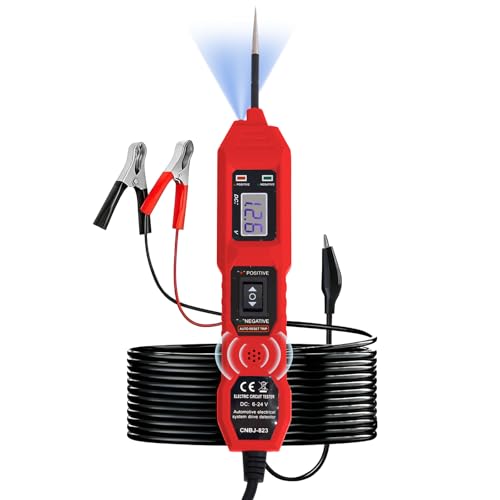
Best for: fleets and shops needing a robust, all-in-one system for testing 6V–24V automotive circuits. The long 14.7-foot cable and thin probes give access to hard-to-reach locations while protecting circuits with overload protection.
Why selected: It offers multiple detection capabilities in a single unit, including voltage checks, continuity, diode testing, and short-circuit tracing. The device’s broad vehicle compatibility makes it a flexible tool for diverse fleets.
Caution: The extended cable length may require careful handling to avoid snagging or tangling during use. Ensure proper storage to prevent probe damage when not in use.
EM415Pro Automotive Circuit Breaker Finder

Best for: technicians seeking a dedicated wire tracer capable of locating open wires and circuit breakers behind walls or within harnesses. Suitable for car repairs and home diagnostics where wiring is concealed.
Why selected: The transmitter/receiver setup provides audible feedback to locate issues without damaging insulation. The tester supports a broad 6–42V range and is designed to work with typical vehicle electrical systems.
Limitation: Tracing behind walls or dense insulation may require multiple passes and careful step-by-step testing for accurate results.
VDIAGTOOL V210 Wire Tracer

Best for: professional electricians or serious DIYers who need reliable open/short finding with a 7″ flexible probe. It helps pinpoint fault points across 6–42V circuits with a tone-based signal.
Why selected: The dual-function tester locates breaker points and traces wiring without removing insulation. The tone generator and adjustable sensitivity support accurate detection in various wiring configurations.
Caution: Battery-powered transmitter and receiver require proper handling to maintain signal clarity; avoid strong interference sources that could affect readings.
Buying Guide: Key Purchase Considerations
- Voltage range: Match the device to your vehicle fleet (cars, trucks, motorcycles, boats) and typical tasks (shorts, opens, polarity checks).
- Display and readout: Prefer units with clear digital displays and audible cues for dark or cramped environments.
- Probes and reach: Long, sharp probes and flexible cables expand testing reach in tight spaces.
- Special features: Look for polarity indicators, backlit screens, toner tracing, and overload protection for safer testing.
- Ease of use: Choose tools with straightforward connections (clips, probes) and simple indicators to minimize misreads.
- Compatibility: Ensure the tool supports 6–42V or 6–48V systems common in modern vehicles.
Frequently Asked Questions
- What is the main purpose of a car circuit tester?
– To identify voltage, continuity, shorts, and opens in automotive electrical circuits, aiding quick fault isolation. - Can these testers work on motorcycles or boats?
– Yes, many models support 6–42V or 6–48V systems common to motorcycles and boats. - Should I rely on a single tester for all diagnostics?
– A single tester is helpful for basic checks; for complex wiring or professional work, a combination of testers provides better coverage. - Are there safety concerns when using test probes?
– Yes. Use insulated gloves when necessary, avoid contact with live terminals, and store probes safely after use. - What’s the difference between a probe tester and a tracer?
– Probe testers check circuit status and voltage; tracers locate hidden faults and breakpoints in wiring. - Do these tools require batteries or power?
– Many are battery-powered or plug into machine circuits; check each product’s power requirements before use.