Best Car Battery Testing Equipment for Quick, Accurate Diagnostics
Finding the right car battery tester can save time, money, and hassle. This guide highlights five reliable 12V and multi-volt testers that cover lead-acid, AGM, GEL, and some lithium checks, along with cranking and charging system assessments. Each option aims to deliver clear readings, quick results, and practical features for DIY enthusiasts and professional technicians alike.
| Product | Brand | Battery Types | Key Benefit |
|---|---|---|---|
| TOPDON BT100 | TOPDON | 12V lead-acid (100-2000 CCA) | User-friendly health, charge, and cranking insights |
| ANCEL BA101 | ANCEL | 12V 100-2000 CCA | Clear readings with robust build and quick tests |
| KONNWEI KW208 | KONNWEI | 12V (100-2000 CCA) | High accuracy with durable clamps |
| TOPDON BT50 | TOPDON | 12V lead-acid | Fast, lab-grade diagnostics and history tracking |
| Acclope BT60 PRO | Acclope | 6V, 12V, 24V lead-acid; some Li checks | Versatile multi-volt testing with comprehensive data |
Below are five top-rated options, spanning mainstream convenience to professional-grade diagnostics. Each product section includes a concise feature reference, performance notes, and practical usage guidance for a broad American audience.
TOPDON BT100 Car Battery Tester 12V Load Tester

The TOPDON BT100 is a 12V load tester designed to analyze standard flooded, AGM, EFB, and GEL batteries within a broad 100-2000 CCA range. It reports SOH (State of Health), SOC (State of Charge), voltage, current, and multiple other metrics in a user-friendly format, helping users decide when to recharge or replace a battery. Safe passive testing ensures the device powers on after proper connection, enabling testing across cars, motorcycles, trucks, RVs, boats, and even lawn equipment. The device supports cranking and charging system tests, plus a health check to prevent roadside battery failures during peak travel seasons.
Usage notes include ensuring compatibility with your battery type and rating on the label, following the included safety precautions, and interpreting results within the context of vehicle electrical systems. The BT100 is constructed for dependable field use and is suitable for home garages and automotive service shops seeking quick, actionable data without lengthy setups.
ANCEL BA101 Car Battery Tester

The ANCEL BA101 focuses on practical diagnostics with clear readouts for SOH, SOC, voltage, current, CCA, cranking, and charging system tests. It emphasizes accuracy through copper crocodile clips and a precision smart chip. To optimize readings, users should select the correct battery type and input rating and temperature as shown on the battery label. The BA101’s bright display and straightforward controls support fast, one-handed operation, making it accessible for DIYers while offering the reliability needed to prevent unexpected battery failures on the road. Multi-language support broadens its usability for diverse users.
KONNWEI KW208 12V Car Battery Tester

The KW208 is positioned as a cost-effective yet capable tester for 12V batteries (100-2000 CCA). It provides comprehensive analysis of voltage, internal resistance, CCA, and AH capacity, along with health and charge status. Its updated galvanized alloy battery clips improve contact safety and accuracy, with a simple user interface that supports glancing readings in busy workshops or home garages. It also delivers cranking and charging system tests to evaluate the alternator and starter, helping users anticipate failures before they occur. The device is designed for quick storage in a glove box or tool cabinet for on-the-go use.
TOPDON BT50 Car Battery Tester

The TOPDON BT50 targets comprehensive 12V battery analysis, offering insights into health, cranking capability, and charging system efficiency. It stands out for data review capabilities that let users track historical test results, supporting maintenance planning and trend monitoring. Its rapid, conductance-based testing yields accurate results quickly, which is valuable for pre-road-trip checks and routine diagnostics. Safety features such as spark-free testing, reverse polarity protection, and anti-overheating safeguards contribute to reliable operation in various environments, from home garages to professional shops, across cars, trucks, motorcycles, boats, and more.
Acclope BT60 PRO Car Battery Tester
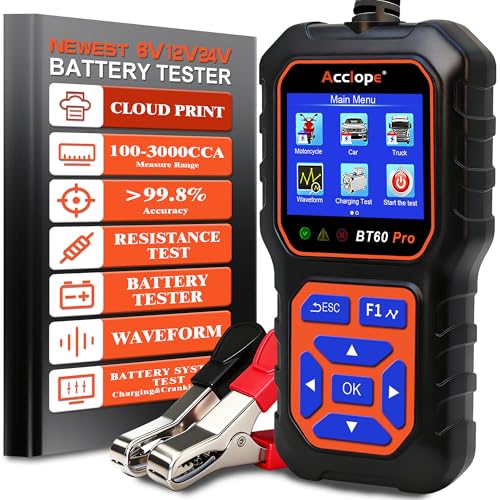
The Acclope BT60 PRO supports 6V, 12V, and 24V batteries, including lead-acid variants, AGM, GEL, EFB, and certain lithium checks. This tester emphasizes comprehensive diagnostic data, including accurate SOH, SOC, voltage, resistance, and CCA for supported battery chemistries. It is especially suitable for professionals and DIY users handling a mix of vehicles from motorcycles to trucks and marine applications. While LiFePO4 checks are present, Celsius-based interpretation and CCA applicability for li-ion types should be considered, and it’s not an OBD2/code reader. Its versatility makes it a robust choice for diverse testing needs.
Buying Guide: Key Purchase Considerations For Car Battery Testing Equipment
- Battery types supported: Choose a tester that matches your typical batteries (12V lead-acid, AGM, GEL, EFB, and some lithium checks). If you own a fleet with mixed chemistries, consider a multi-chemistry model.
- Test parameters: Look for readings such as State of Health (SOH), State of Charge (SOC), voltage, current, cold-cranking amps (CCA), and full system charging diagnostics. A three-in-one diagnostic (battery health, cranking, and charging) is highly convenient.
- Accuracy and speed: AI or advanced conductance methods improve accuracy; faster tests reduce downtime. Compare stated accuracy percentages and test times when possible.
- Safety features: Spark-free testing, reverse polarity protection, and over-voltage or over-temperature safeguards help prevent damage to both the tester and vehicle electronics.
- Clamps and contacts: Durable, corrosion-resistant clamps with full contact coverage improve measurement reliability, especially for high-CCA batteries.
- Portability and storage: Glove-box-friendly or compact designs are ideal for field work, roadside testing, or small garages.
- Readability and UI: Clear displays, backlighting, and intuitive menus minimize errors, particularly in bright sun or dim shop lighting.
- Data retention and history: Some models save previous test results to monitor degradation trends and maintenance needs over time.
- Output options: Printed receipts or downloadable reports can help with service records and warranty claims; consider whether you need an integrated printer.
- Vehicle range compatibility: If you service boats, motorcycles, or heavy equipment, ensure the tester supports those voltage ranges and battery types.
When selecting, align the device’s capabilities with your typical maintenance workflow. For casual use or home garages, a user-friendly tester with strong readings and clear results may suffice. For professional shops or fleet maintenance, prioritize accuracy, data logging, durability, and faster diagnostics. Always verify compatibility with your most common battery models and vehicle types to maximize return on investment.