Best Car Battery Group 86 Options for Reliability and Power
If you’re shopping for a Group 86 car battery, you want dependable starting power, long life, and clear fit guidance. This guide highlights five top Amazon options that cover traditional flooded, AGM, and lithium chemistries. It helps you pick the right fit for your vehicle’s climate, start-stop needs, and maintenance preferences. The list includes both Group 86 specific models and strong alternatives that closely match Group 86 dimensions or performance profiles.
| Product | Best For | Chemistry | CCA Range |
|---|---|---|---|
| TET Car Start-Stop Lithium Battery For Car BCI Group 86 | Start-stop vehicles, extreme climates | LiFePO4 (Lithium) | 1200 CCA |
| Interstate Batteries Group 86 Car Battery Replacement (MT-86) | Dependable everyday driving in moderate climates | Flooded Lead-Acid | 525 CCA |
| Weize Platinum AGM Battery BCI Group 24F | Equipped for AGM needs, versatile fit | AGM | 710 CCA |
| Daakmax Platinum AGM Car Battery Group Size 94R H7 | Start-stop capable, high power | AGM | 850 CCA |
| Daakmax Platinum AGM Car Battery Group Size 48 H6 | Compact fit, strong cold starts | AGM | 760 CCA |
TET Car Start-Stop Lithium Battery For Car Group 86

Best for start-stop vehicles and extreme climates, this LiFePO4 battery delivers high cold start power and stability. It uses a built-in BMS to guard against overcharge, overdischarge, and temperature fluctuations. The 12.8V system with a 40Ah capacity provides 512Wh and up to 1200 CCA. The device is designed for easy maintenance by avoiding regular fluid checks and minimizing energy loss. It is best for drivers seeking long life, reliable cold-weather starts, and reduced maintenance. Limitations include ensuring connector positions and dimensions align with your specific vehicle’s layout, and it requires compatible charging practices for lithium chemistries.
Who it’s best for: Start-stop vehicle owners, drivers in extreme heat or cold, and those who want a maintenance-free lithium option. Why selected: high CCA performance and robust BMS for reliability in adverse climates.
Weize Platinum AGM Battery Group 35

This AGM option is best for drivers who want a maintenance-free flood-protected design with strong cycle life. It provides 650 CCA and 55Ah, offering reliable starts in varied climates. The dimensions (9.06″ L x 6.89″ W x 8.82″ H) and the left negative/ right positive tapered terminals require verification against your vehicle’s battery tray and terminal layout. It’s a practical substitute when OEM specs call for an AGM battery and you want improved heat resistance over flooded types. Caution: confirm fitment, especially if your car requires a different Group 86 profile or non-AGM technology.
Interstate Batteries Group 86 Car Battery MT-86

Best for dependable everyday driving in moderate climates, this flooded lead-acid Group 86 battery offers robust CCA at 525 and a 90-minute reserve capacity. It’s a widely compatible choice across many vehicle makes and models. This is a solid option when OEM recommendations favor a traditional flooded design and you want a balance between cost and performance. Limitation: not ideal for vehicles with start-stop systems or extreme temperatures without an appropriate alternator support or climate control, as cycle life may be lower than AGM or lithium alternatives.
Daakmax Platinum AGM Car Battery Group Size 94R H7

Best for start-stop capable vehicles requiring high power, this AGM battery delivers 850 CCA and 140 RC. It has a 12.4″ length and compatible terminal layout (Left negative, Right positive). It’s selected for its high CCA and improved cycle life, which helps with cold starts and faster recharge times. Caution: verify that your vehicle’s Group 94R fitment aligns with the 94R H7 sizing and terminal orientation to avoid fit issues.
Daakmax Platinum AGM Car Battery Group Size 48 H6
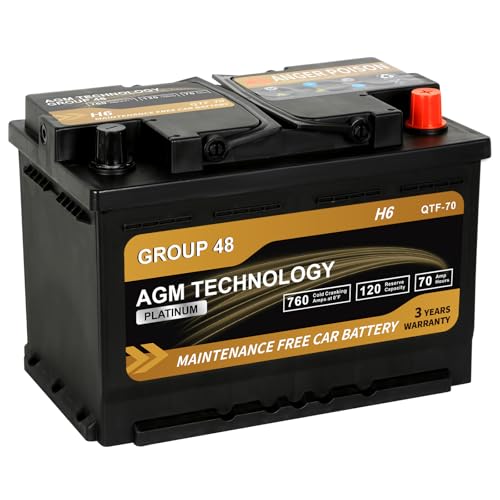
Best for compact fits and strong starting capability in a Group 48 H6 footprint, this AGM battery offers 760 CCA and 120 RC. It shares AGM benefits like maintenance-free operation and resistance to vibration and temperature swings. It’s suitable when a smaller Group 48 or H6 size matches your vehicle demands. Limitation: check that the Group 48 fitment corresponds with your vehicle’s battery tray, terminal arrangement, and space constraints.
Buying Guide
Key purchase considerations help you pick the right Group 86 option:
- Vehicle type and start-stop system: Start-stop vehicles often benefit from AGM or lithium chemistry due to higher cycling needs. If your car does not require start-stop support, a high-CCA flooded or AGM battery can be adequate.
- Climate and temperature: Extreme heat or cold affects performance. Lithium LiFePO4 offers excellent resilience in temperature fluctuations, while AGM and flooded designs balance heat resistance and cost.
- Fitment and terminals: Confirm Group 86 dimensions, terminal positions, and mounting orientation before purchase to avoid fitment issues.
- Maintenance needs: AGM and lithium batteries are maintenance-free; flooded batteries require water checks and more regular maintenance in some climates.
- Cycle life and warranty: AGM and lithium options generally provide longer cycle life than conventional flooded batteries. Warranty terms indicate manufacturer confidence in longevity.
- Compatibility with vehicle electronics: Some vehicles require specific chemistry or CCA ranges to support optimized performance and electronics functioning.
FAQ
- Q: What is the difference between Group 86 and other groups?
- Q: Should I choose AGM or flooded for Group 86?
- Q: Is a lithium battery a good replacement for a Group 86 car battery?
- Q: How important is CCA for cold starts?
- Q: Do these batteries require special charging?
- Q: How can I verify fitment for my vehicle?
A: Group size defines fitment dimensions. Group 86 is a common size for several mid-size vehicles, with specific length, width, height, and terminal layouts that must match your battery tray and cable connections.
A: AGM offers better vibration resistance, longer life, and maintenance-free operation, while flooded types tend to be cheaper but require more maintenance and can have shorter cycle life in hot climates.
A: Lithium LiFePO4 can provide high CCA and long life with a built-in BMS, but ensure compatibility with your vehicle’s charging system and space. Fitment and charger compatibility are essential checks.
A: CCA indicates starting power in cold conditions. Higher CCA helps immediate starts in cold weather, but overall reliability also depends on reserve capacity and cycle life.
A: Lithium options require lithium-compatible chargers to optimize charging profiles. AGM and flooded batteries typically accept standard automotive charging voltages, but always follow manufacturer guidelines.
A: Use the vehicle’s owner manual or the OEM battery specifications, compare exact Group size, dimensions, terminal layout, and confirm with the retailer’s fitment guidance if available.