Best Car Battery Chargers for Every Garage or Warehouse Setup
Answer: These top car battery chargers are designed to power up, maintain, and repair a wide range of 12V and 6V batteries, ideal for home workshops, rental fleets, automotive bays, or small warehouses. The best picks balance automatic safety features, fast charging, and versatile battery compatibility. This guide highlights five solid options and explains which buyers they’re best for—whether you need compact maintainers, high-current fast chargers, or battery repair modes. A quick buying table is provided below to compare key specs at a glance.
Quick comparison table
| Product | Best For | Voltage/Battery Types | Notes |
|---|---|---|---|
| NOCO GENIUS1 | Small spaces and multi-battery use | 6V/12V Lead-Acid, LiFePO4 | Desulfator, temperature compensation |
| TowerTop 2/10/25A | Faster charges for larger batteries | 12V | Auto-desulfator, multiple current settings |
| YONHAN 20A | Winter storage and long-term maintenance | 12V/24V Lead-Acid, LiFePO4 | Repair mode, smart protections |
| NOCO GENIUS10 | Higher power, wider battery range | 6V/12V Lead-Acid, LiFePO4 | Greater power, temperature sensing |
| Schumacher SC1280 | Everyday automotive and marine use | 6V/12V, AGM/Gel/Deep-Cycle | Auto voltage detection, float maintain |
NOCO GENIUS1: Compact 1A Smart Charger

The GENIUS1 is a versatile, compact charger suitable for 6V and 12V batteries, including lead-acid variants and LiFePO4. It functions as a charger, maintainer, trickle charger, and desulfator with overcharge protection and temperature compensation. This makes it a practical option for tight workspaces or warehouse bays where space is at a premium. Best for small fleets or individual battery upkeep where a lightweight, automatic unit is preferred.
Who this is best for: small shops or enthusiasts who need a multi-function, space-saving solution that safely maintains a range of battery chemistries. Why selected: its size and feature set deliver reliable, low-heat charging with protection features in a compact form. Caution: limited high-current charging makes it less suitable for quickly refurbishing large batteries.
TowerTop 2/10/25A 12V Smart Charger

The TowerTop charger provides adjustable current settings (2A, 10A, 25A, AUTO) with a 25A max claim, and a 3.5-hour charge time for a 100Ah battery. It emphasizes efficiency—claimed higher charging efficiency than typical chargers—and full automation that starts charging when a battery is detected and resumes maintenance after a full charge. This is a strong choice for warehouse bays needing faster replenishment of larger batteries and where auto-restart after outages is valued.
Best for: workshops or fleets needing faster replenishment of mid-to-large 12V batteries. Why selected: supports multiple battery types and remembers settings, ensuring continuity after power interruptions. Caution: real-world efficiency and speed depend on battery condition; some users may not achieve the peak claimed times with older cells.
YONHAN 20A 12V/24V Battery Maintainer

The YONHAN charger is a 20A unit designed for rapid charging and maintenance across 12V and 24V systems. It supports lead-acid types and LiFePO4, offering a 7-stage charging process and a high-efficiency pulse repair mode. It includes winter mode for cold-weather storage and multiple protections, including reverse polarity and overcharge safeguards. Best for: fleets or garages that manage a variety of battery chemistries and require robust winter-time maintenance. Caution: not a jump-starter; requires a power outlet to operate.
NOCO GENIUS10: High-Power 10A Charger
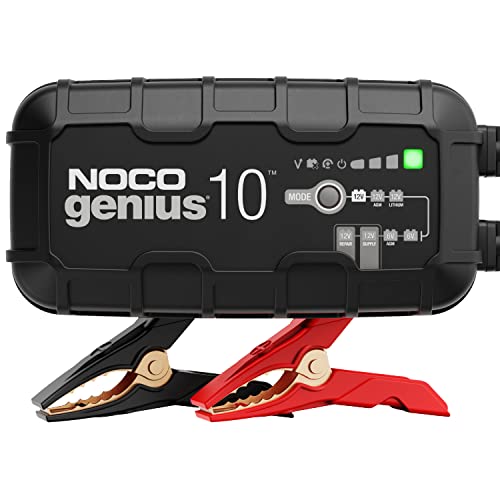
The GENIUS10 offers more power than GENIUS1 with 10A charging for 6V/12V Lead-Acid and LiFePO4 batteries. It maintains the same core benefits—automatic maintenance, trickle charging, desulfation, and temperature compensation. This model suits larger or more message-driven use cases in a warehouse where more charging power is needed without sacrificing the automatic protections. Best for: small fleets or maintenance bays that require a higher-charging option without complex setups. Caution: larger footprint and higher power draw may demand a dedicated outlet or circuit in some spaces.
Schumacher Electric SC1280 12V/6V Charger

The Schumacher SC1280 combines car and marine charging capabilities for 6V/12V batteries, with automatic voltage detection and a microprocessor-controlled charging algorithm. It also offers a trickle/float maintain mode to keep stored batteries ready. This is a practical choice for mixed-use environments where both automotive and marine batteries are common. Best for: garage spaces that service vehicles and boats. Caution: may be slower on deeply discharged or larger deep-cycle batteries compared to specialized high-current models.
Buying Guide
What should buyers consider when selecting a car battery charger for a warehouse or workshop?
- Battery types and voltage range: Look for compatibility with 6V, 12V, and 24V systems and both lead-acid variants and LiFePO4.
- Charging speed vs. maintenance needs: If you regularly replenish large batteries, prioritize higher current models (10A–25A). For small fleets or tight spaces, compact maintainers are valuable.
- Automation and safety features: Temperature compensation, automatic start/stop, reverse polarity protection, and short-circuit protection reduce risk in busy environments.
- Desulfation and repair modes: Desulfation can help revive some older batteries; consider whether this is a priority for your stock.
- Portability and space efficiency: In warehouse settings, smaller units save floor space and reduce clutter; wall-mountable or compact units can streamline workflows.
- Power requirements: Check outlet availability and circuit load. Some high-current models may need dedicated circuits.
FAQ
- What is the difference between a battery charger and a maintainer?
– A charger restores a depleted battery to full, while a maintainer keeps a fully charged battery at peak voltage over extended periods. - Can these chargers revive dead or deeply discharged batteries?
– Some models include a repair or pulse mode, but results vary by battery age and chemistry. Never rely on a charger to jump-start a dead battery. - Are LiFePO4 batteries supported by these devices?
– Yes, several models support LiFePO4 in addition to lead-acid variants. Check each product’s specifications. - Do these chargers require professional installation?
– Generally no; most are plug-in devices. Ensure you have a suitable outlet and safe mounting if using wall-mountable units. - Is a higher current charger always better?
– Higher current charges faster but may generate more heat and require appropriate wiring, especially in warehouse settings.