Best Brushless DC Motor 3 Phase: Top 5 Controllers for DIY Projects and More
Looking for a reliable 3-phase brushless DC motor (BLDC) controller to power a DIY robotics project, a small tool, or a PLC-based system? This guide highlights five well-suited options. Each pick is compatible with 6-60V DC inputs, 3-phase BLDC motors, and offers various speed and direction controls. The list emphasizes different use cases—from hobby projects to semi-professional automation—so you can choose the best fit for your needs and skill level.
Summary table of selected products
| Product | Best For | Voltage Range | Key Benefit |
|---|---|---|---|
| RioRand 350W Controller | DIY robotics and small tools | 6-60V | Hall-sensor compatibility with 120° motors; PLC-ready control |
| Bemonoc 42mm 24V Motor | Compact projects | 24V | High copper coil quality; long life |
| GODIYMODULES 7-24V 400W | General-purpose BLDC control | 7-24V | Powerful drive with PWM/analog input |
| Ransanx 400W Controller | PLC-compatible systems | 6-60V | Hall-based, forward/reverse/brake |
| Acxico 12V 30A Controller | High-speed/high-power setups |
RioRand 350W 3-Phase PWM Controller for 120° BLDC Motors

Best for DIY robotics and small tooling projects requiring precise PLC-compatible speed control. This controller is designed specifically for 120° electric angle 3-phase BLDC motors with Hall sensors. It supports 6-60V input and delivers 200-300W nominal power (350W peak) with 16A continuous (20A peak) output. It supports 0-5V analog or PWM (2.5-5V amplitude), making it suitable for PLC-based setups and automated test rigs.
Who it’s best for: hobbyists building autonomous rigs or small automation tools that rely on accurate motor speed regulation. Why selected: strong compatibility with hall-sensor motors and flexible speed interfaces. Caution: the main power circuit lacks an internal fuse; external protection is recommended. Also, forward/reverse and brake require careful throttle management (reduce speed below 50% before switching).
Bemonoc 42mm BLDC 24V 5000rpm Motor

Best for compact, high-speed applications where space is limited. This 42mm diameter BLDC motor runs at 24V up to 5000 RPM and features a 3-phase design with clearly labeled Hall lines (U, V, W) and power leads, leveraging copper windings for longer life. It’s ideal for precision propeller drives, small CNC attachments, or compact robotic joints.
Who it’s best for: builders needing a compact motor with good efficiency and durability. Why selected: 100% copper coils suggest lower resistance and better heat performance. Limitation: motor performance is highly dependent on an appropriate driver matched to the hall sensor wiring and voltage supply.
GODIYMODULES 7-24V 400W Hall-Less Driver
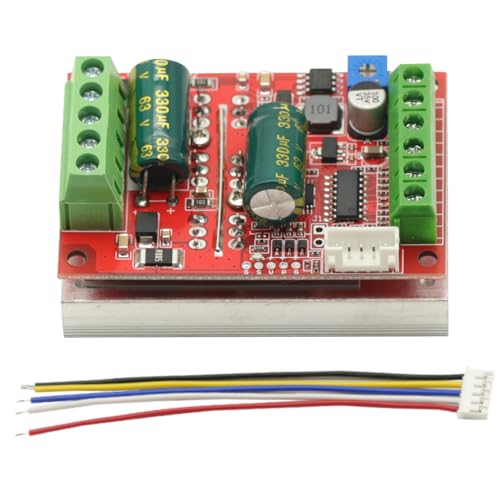
This controller centers on versatility in a 7-24V range with PWM and analog speed control, designed for Hall-less DC motors. It provides forward/reverse and braking, plus a robust VR/analog interface. Best for projects requiring a flexible speed control module that can map to PLC inputs and various motor types.
Who it’s best for: users who want straightforward PWM or analog control without Hall sensor requirements. Why selected: broad voltage range and built-in regression-friendly speed control. Caution: verify motor compatibility with a Hallless drive, as some Hall sensor motors require specific interface wiring.
GODIYMODULES 6-60V 400W PWM Driver With Forward/Reverse
Best for systems needing robust direction control and safety features. This BLDC PWM PLC driver supports 6-60V operation with forward/reverse via motor phase wiring. It includes motor phase outputs MA, MB, MC, and Hall signal integration for reliable event-driven control. Use this when you need a proven, multi-wire setup for PLC compatibility, including a 0-5V speed input option.
Who it’s best for: automation builders who require reliable dual-direction operation and safe stop/brake signaling. Why selected: clear phase wiring and compatibility with Hall-based motors. Limitation: typical reference mentions a main power path without an internal fuse; implement external protection measures.
Ransanx 400W 6-60V Hall PWM Controller

Best for PLC-ready installations needing a Hall-based driver with PWM. This unit is built to handle 6-60V DC and up to 400W, supporting PLC-compatible 0-5V speed control and PWM duty cycle. It features MA/MB/MC outputs, a stop and brake interface, and a direction control input. It’s suitable for test rigs and compact automation boxes.
Who it’s best for: engineers seeking a straightforward, PLC-oriented DI (digital input) control scheme. Why selected: explicit Hall motor compatibility and clear STOP/BRAKE signaling. Caution: ensure correct Hall wire matching for reliable operation; incorrect wiring may prevent startup or accurate direction control.
Acxico 12V 30A High-Power BLDC Controller

Best for high-speed, high-power applications requiring strong protection and heat management. This controller supports 12V operation at up to 30A continuous and is designed for high-speed high-power brushless motors. It emphasizes safety startup, heat dissipation through an aluminum heatsink, and temperature-based protection to reduce power when overheating.
Who it’s best for: users needing higher current handling with built-in thermal protection. Why selected: a focused safety feature set that helps protect both motor and controller during long operation. Limitation: effective performance relies on proper heat dissipation in compact enclosures and adequate airflow.
Buying Guide: How To Choose The Right 3-Phase BLDC Controller
Consider motor compatibility first. Confirm the motor angle (120° common for many hobby controllers) and Hall sensor configuration. If your motor is Hallless, select a driver designed for Hallless operation or check wiring schemes carefully. Voltage range should cover your entire supply, with a safety margin for peak currents.
Ease of control matters. Decide between on-board potentiometers, analog 0-5V inputs, or PWM signals from microcontrollers or PLCs. For PLC-heavy setups, favor controllers with clear 0-5V interfaces and robust STOP/BRK features. Look for forward/reverse safety sequences and recommended throttle practices to minimize voltage spikes.
Thermal management is critical. Controllers with heat sinks or fan-ready designs perform better in continuous operation. External fusing and proper wiring protection are essential, as some models omit internal fuses. Consider enclosure space and airflow when selecting a unit for higher-power motors.
Wiring clarity helps avoid misconnection. Controllers typically require accurate phase (MA, MB, MC) and Hall wires (HA, HB, HC) alignment. Some drivers specify color-coded leads; others provide modular connectors. Plan your wiring harness to minimize cross-talk and electrical noise in automation environments.
Support and documentation. Favor models with clear wiring diagrams, safety notes, and straightforward troubleshooting steps. Community forums and vendor guides can be valuable when integrating PWM or analog speed control with custom PLC programs.
FAQ
- What voltage range should I look for in a BLDC driver? – Choose a driver that covers your motor’s rated voltage plus a margin (common 6-60V).
- Do I need a fuse with these controllers? – Some controllers omit internal fuses; add external protection to prevent damage from faults or shorts.
- Can I use a Hallless driver with a Hall sensor motor? – Some drivers support Hallless operation with specific wiring; confirm compatibility with your motor’s wiring scheme.
- What is the difference between PWM and analog speed control? – PWM controls effective voltage via duty cycle; analog control provides a continuous reference voltage for speed.
- Is forward/reverse braking safe to use repeatedly? – Use throttle reductions before switching directions or braking to protect power components.
- Which controller is best for PLC integration? – Controllers with 0-5V analog input and clear PLC interfaces are ideal for PLC-automation projects.