Best Boost Solar Charge Controller Options for Efficient Off-Grid Power
Looking for a reliable boost MPPT solar charge controller to optimize power from your panels? This guide highlights five top picks designed for RVs, golf carts, boats, and off-grid systems. Each option emphasizes stable output, high-efficiency MPPT tracking, and broad battery compatibility. Suitable buyers include off-grid enthusiasts, recreational vehicle owners, and small solar installers seeking robust step-up charging. The quick reference table below compares key aspects at a glance.
| Product | Ideal For | Best Feature | Battery Types |
|---|---|---|---|
| Boost MPPT Solar Charge Controller 30A (1200W) – 12-60V | RV, off-grid power, lead-acid or LiFePO4 | Intelligent boost output with wide voltage range | Lead-Acid, LiFePO4, AGM, Gel |
| ECO-WORTHY 12A Boost MPPT Controller | Golf carts, small solar kits, multi-battery setups | Up to 95% MPPT efficiency, broad 12-72V support | Lead-Acid, LiFePO4, Gel, Flooded |
| Horsun 12A MPPT Boost Solar Controller | eBikes, scooters, Club Car, small systems | OLED display and high tracking efficiency | LiFePO4, Lithium, Gel, Flooded |
| EARNMee 30A Boost MPPT Controller (72V/60V/48V) | RV, golf cart, solar system enthusiasts | High efficiency with HD LCD monitoring | Lead-Acid, LiFePO4, Lithium, Gel |
| Generic 1200W Boost MPPT Controller – 12-60V | All PV panel setups seeking reliable boost output | Advanced MPPT with intelligent step-up boost | LiFePO4, Lithium, Lead Acid, AGM |
Boost MPPT Solar Charge Controller 30A — 1200W

Best for RVs and off-grid systems needing a reliable 12-60V boost with broad battery compatibility. The built-in intelligent boost helps stabilize voltage when panel voltage is marginal, supporting lead-acid and LiFePO4 chemistries. Suitable for users who want straightforward installation and robust protection features.
- Best for: RVs, outdoor energy storage, off-grid setups
- Why selected: Combines intelligent boost with wide compatibility and simple integration
- Limitation: No specific battery management beyond charging support; monitor temperature manually for extreme environments
ECO-WORTHY 12A Boost MPPT Solar Controller
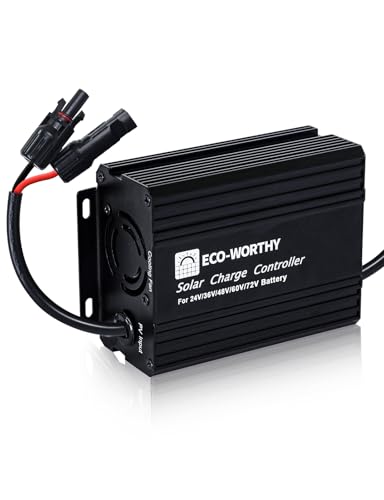
Best for compact systems and golf carts where 12V panels must efficiently charge 24V–72V batteries. This unit emphasizes up to 95% MPPT charging efficiency and supports various battery types, simplifying mixed installations. Ideal for budget-conscious setups requiring strong performance across multiple voltage levels.
- Best for: Golf carts, small solar kits, multi-voltage systems
- Why selected: High MPPT efficiency and broad voltage support
- Limitation: Higher current rating isn’t available for larger systems; consider higher-amp models for bigger arrays
Horsun 12A MPPT Boost Solar Controller

Best for users who want a clear, monitorable system with an OLED display and strong MPPT tracking up to 98% efficiency. It supports multiple battery chemistries, including LiFePO4 and gel, making it flexible for varied builds, from e-bikes to club cars.
- Best for: Small e-mobility projects, multi-battery setups
- Why selected: OLED readout provides easy real-time monitoring
- Limitation: 12A capacity may be limiting for larger solar arrays
EARNMee 30A Boost MPPT Controller

Best for larger RV or golf-cart setups that demand robust 72V/60V/48V operation with high-efficiency MPPT tracking. The unit emphasizes a high-resolution LCD for system monitoring and full protection features to guard against common electrical faults.
- Best for: RVs, golf carts, larger off-grid systems
- Why selected: Combines top-tier MPPT efficiency with comprehensive LCD monitoring
- Limitation: Higher power applications may benefit from models with greater than 30A capacity
Generic 1200W Boost MPPT Controller

Best for all PV panel setups seeking robust boost performance from 12-60V inputs. It features intelligent MPPT and a dedicated boost output for stable 48V/60V/72V charging, suitable for mixed battery chemistries in RVs, golf carts, and off-grid systems.
- Best for: General off-grid applications with mixed batteries
- Why selected: Reliable 1200W boost with broad voltage compatibility
- Limitation: Data varies by seller; verify compatibility with your battery bank before installation
Buying Guide: Key Considerations for Boost MPPT Controllers
- Voltage range and boost capability: Ensure the controller accepts your panel voltage and can boost to the battery bank voltage (48V/60V/72V) you need.
- Battery compatibility: Confirm support for LiFePO4, lithium, lead-acid, AGM, and gel batteries relevant to your setup.
- MPPT efficiency: Look for manufacturers citing high MPPT tracking efficiency (ideally 98–99%) and conversion efficiency (around 95% or higher).
- Display and monitoring: An LCD or OLED display helps you monitor voltage, current, and power in real time, aiding troubleshooting and tuning.
- Protection features: Overcharge, over-discharge, short-circuit, reverse polarity, and temperature protections protect both controller and battery banks.
- System size and expansion: Match controller amperage to your solar array size; consider future expansion to avoid bottlenecks.
- Physical build and cooling: Look for robust enclosures and cooling features (heat sinks, vents) for hot environments.
- Installation environment: Ensure water resistance and mounting compatibility for outdoor use or rugged conditions.
Frequently Asked Questions
- What is a boost MPPT controller? A device that enhances solar panel voltage to match higher battery voltages (e.g., 48V) while maximizing power extraction through MPPT tracking.
- Why choose a 72V-capable controller? If your system uses 72V battery banks, a controller with 72V output avoids unnecessary step-down losses and simplifies wiring.
- Can these controllers work with LiFePO4 batteries? Yes, most listed models support LiFePO4, lithium, lead-acid, and gel chemistries.
- Is high efficiency always better? Higher MPPT efficiency improves energy harvest, especially in partial shading or cooler conditions; however, real-world results depend on panel quality and array design.
- Do I need a separate solar charge controller for each battery type? Not usually; many controllers support multiple chemistries, but verify compatibility with your specific battery bank.
- What should I monitor regularly? Voltage, current, and temperature are key metrics; use the built-in display or an external monitor if available.