Best Black on Black Solar Panels for Off-Grid Power and Home Use
Readers seeking sleek, high-efficiency solar solutions often prefer a uniform black-on-black look for their setups. This guide showcases premium black-on-black solar panels and accessories that blend aesthetics with performance. From flexible, curved-surface options to rigid, high-efficiency modules, the following selections emphasize durability, efficiency, and suitability for RVs, boats, and off-grid homes. Each entry includes core features to help you compare at a glance and make a data-driven choice.
| Product | Brand | Key Strength | Typical Use |
|---|---|---|---|
| JJN Bifacial 200W Solar Panel | JJN | 23% efficiency; half-cut cells | Off-grid systems, RVs, boats |
| Renogy 1180W N-Type 2PCS | Renogy | High efficiency; double-sided power | Residential roofs, off-grid farms |
| Renogy 100W Flexible Panel | Renogy | Flexible, lightweight; 240° bend | Curved surfaces, marine, RVs |
| BougeRV Arch Pro 200W | BougeRV | N-type 16BB cells; 25% efficiency | RV, marine, portable setups |
| SUNGOLDPOWER 440W N-Type | SGPWATT | 16BB, high shade tolerance | Large off-grid installations, homes |
JJN 200W Bifacial Solar Panel

The JJN Bifacial 200W solar panel employs a 10BB monocrystalline cell design to reach up to 23% efficiency, delivering around 1000Wh daily under favorable sun. Its half-cut cell technology reduces power loss and improves shading resilience, while a black corrosion-resistant frame ensures durability in challenging weather. An IP65/IP67 rated junction box and connectors provide waterproof protection, making it suitable for outdoor RV, marine, and off-grid uses.
Renogy 1180W N-Type Dual Panel

Renogy’s 1180W N-Type bifacial panels deliver up to 25% higher efficiency with 16BB technology. The double-sided design, featuring a transparent backsheet, adds 5%–30% more real-world power. Built with a black aluminum frame, these panels resist harsh weather and are IP68 rated for water ingress protection. They’re ideal for large off-grid installations, rooftop setups, or high-demand RV and boat systems that require robust output and long-term reliability.
Renogy 100W Flexible Solar Panel
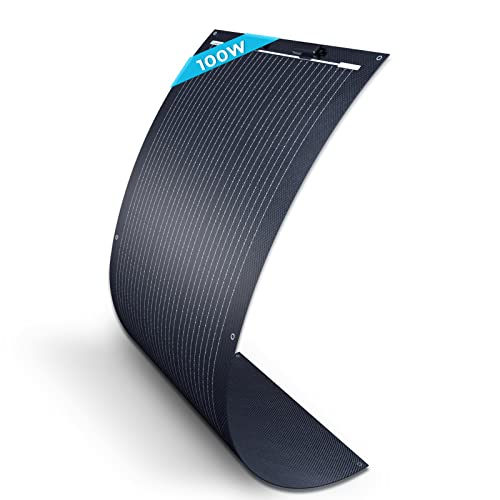
The Renogy 100W flexible panel is designed for curved surfaces and portable applications. It averages about 500Wh per day under good sun conditions and weighs far less than rigid panels, making installation easier on curved RV roofs, boats, or cabin walls. The panel uses half-cut PERC cell technology to improve light capture and electrical performance, delivering solid efficiency for a lightweight, low-profile solution.
BougeRV Arch Pro 200W Panel

BougeRV Arch Pro uses upgraded bypass diodes and a high-grade N-type16BB cell design to deliver up to 25% conversion efficiency. It aims for stable output even with partial shading and is compatible with 12V and higher-voltage battery banks when wired in series. Potential buyers should verify compatibility with their power station open-circuit voltage range, but the panel’s robust frame and shading resilience make it a reliable choice for RVs and small-scale off-grid setups.
SUNGOLDPOWER 440W N-Type Panel

This 440W panel uses N-Type technology with 16BB cells to reach up to 22.5% efficiency and strong low-light performance. Its half-cell design increases shade tolerance, and the black frame with IP68 protection ensures it remains weatherproof in harsh conditions. It suits large-scale off-grid installations or grid-tied systems requiring substantial daytime energy production without compromising on durability.
SUNGOLDPOWER 440W (Eight Panels)

This listing presents eight SUNGOLDPOWER 440W panels designed for high-capacity off-grid systems. With 16BB monocrystalline cells, these modules provide high efficiency and strong shade tolerance, backed by IP68 sealing and UL61730 certification for safety and quality. Suited for large residential or commercial off-grid projects, as well as high-demand marine and RV installations where reliability matters.
Buying Guide: Key Purchase Considerations
When evaluating black-on-black solar panels, several factors influence long-term performance and total value. First, efficiency and temperature performance matter; higher efficiency panels produce more power in limited spaces, while N-Type and half-cut cell technologies generally offer better performance in shade and heat. Second, durability features such as frame material, waterproof ratings (IP68 or IP65/67), and wind/snow load ratings determine suitability for outdoor environments. Third, panel construction, including busbar design (8BB, 16BB), cell type (mono-crystalline vs poly), and backsheet type, affects longevity and power consistency. Fourth, compatibility with your system is critical—voltage and open-circuit voltage ranges must align with charge controllers, inverters, and power stations. Finally, installation requirements and weight should guide whether a rigid rooftop panel, a flexible surface panel, or a portable setup best fits your vehicle, boat, or cabin. For best results, consider a mixed approach: high-efficiency rigid panels for roof space, supplemented by flexible panels for curved areas or portable use.
In choosing between the options above, think about your specific use case. Large off-grid homes or boondocking RVs may benefit from multi-panel arrays with strong double-sided output, while boats or campers on curved surfaces may favor flexible, lightweight models. Shading environments—trees, awnings, or other structures—make panels with enhanced shade tolerance and bypass diode protection especially advantageous. Finally, always verify warranty terms and compatibility with your existing battery banks and charge controllers to ensure smooth, long-term operation.