Best Black Frame Solar Panel Solutions for Off-Grid Power
Whether you’re outfitting an RV, a boat, a cabin, or a tiny home, black frame solar panels offer a sleek, glare-free appearance and efficient performance. This guide highlights five top options designed for curved surfaces, rooftop installations, and portable setups. Each entry includes who it’s best for, why it stands out, and a practical caveat to consider. Read on to compare options like flexible panels for curved roofs, high-efficiency N-Type cells, and bifacial designs that harvest energy from both sides.
| Product | Best For | |
|---|---|---|
| Renogy 100W Flexible Solar Panel | Curved surfaces, portable installations | 240° bendability, glare-free black appearance |
| BougeRV 200W N-Type 16BB | RVs and marine roofs needing high output | N-type cells, bifacial gain up to 30% |
| Callsun 200W N-Type | Shaded environments, multi-module layouts | Dual-module parallel design, bifacial up to 30% |
| ACOPOWER 100W N-Type Slim Panel | Tight roof spaces, curved surfaces | N-Type, ultra-slim profile |
| Renogy 100W N-Type | Off-grid cabins and boats with higher efficiency needs | 16BB N-Type cells, 25% efficiency |
Renogy 100W Flexible Solar Panel
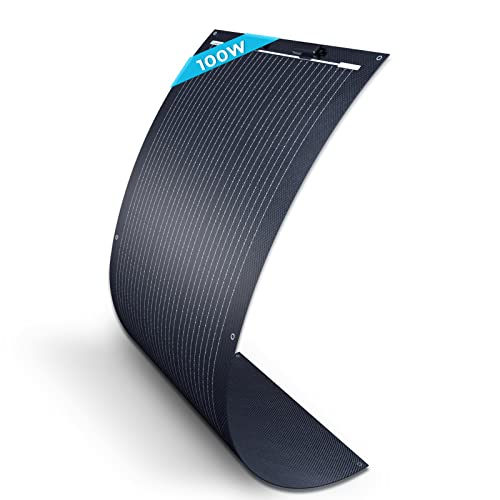
Best for installed on curved surfaces or in portable setups where a light, flexible solution is required. This panel uses half-cut PERC cells for improved light capture and efficiency. It weighs only a third of a rigid panel and provides an all-black, glare-free look. Ideal for marine, RV, cabin, van, or boat installations where flexibility matters more than maximum rigid-panel power. A potential limitation is that flexible panels can be more susceptible to micro-cracks if bent beyond recommended angles or not properly supported.
BougeRV 200W N-Type 16BB

Best for RVs and boats needing higher output with bifacial capabilities. N-Type cells and 16BB busbars trend toward higher efficiency and longer service life. The 16BB design reduces hot spots and cracks, while bifacial design adds up to 30% extra energy by utilizing rear-side reflections. Best for situations with ample exposure and the need for robust performance. Limitation: upfront cost may be higher due to N-Type and bifacial tech.
Callsun 200W N-Type Bifacial

Best for shading-tolerant, multi-module systems on RVs or rooftops. This panel uses N-Type 16BB cells and a bifacial design to capture light from both sides, boosting total output by up to 30%. The TwinCell anti-shade architecture keeps output steady when sections are shaded. Caution: bifacial gains depend on reflective conditions and rear-side exposure, so actual gains vary by installation.
ACOPOWER 100W N-Type Ultra Slim

Best for tight roof layouts and curved surfaces where space is at a premium. The slim profile (54.0 × 15.7 inches) enables flexible installation on RVs and multi-panel layouts while delivering high efficiency with N-Type cells. It also emphasizes low-light and high-temperature stability for consistent daily energy. Limitation: very slim design means it is more sensitive to mechanical support needs and wind uplift on certain roof structures.
Renogy 100W N-Type

Best for off-grid cabins and boats that prioritize efficiency and reliability. This 16BB N-Type panel delivers up to 25% efficiency, with improved high-temperature performance and reduced hot spots due to 16BB cell technology. It offers robust output in hot or bright conditions, making it a solid all-around option for more demanding off-grid setups. Limitation: higher efficiency panels can come at a higher upfront cost than standard P-Type designs.
Buying Guide
What should I look for in a black frame solar panel?
Consider cell type (N-Type vs. P-Type), busbars (16BB vs. 10BB), and whether you need bifacial capability. N-Type cells typically offer better temperature performance and higher efficiency, while bifacial panels harvest energy from the back side under suitable conditions. Also weigh panel form factor (rigid vs. flexible) against your roof geometry and mounting method.
Is bifacial tech worth it for off-grid use?
Bifacial panels can add up to about 30% extra output in optimal lighting with reflections on the back. They’re most effective when there is a reflective surface behind the panel or when placed at angles that maximize rear illumination. If your installation lacks backside exposure, gains may be modest.
How to choose based on space and weight?
Flexible panels are lighter and bendable, ideal for curved surfaces but may require careful mounting to avoid flex cracking. Slim panels save space on tight roofs but may require stronger mounting solutions to withstand wind loads. For RVs or boats, balance weight, space, and the potential need for parallel or series connections to reach your system voltage.
How important is heat performance?
Panels with low temperature coefficients lose less power as temperatures rise. N-Type cells generally maintain higher efficiency in heat, delivering steadier daily outputs in hot climates. If you’re in a sunny, hot environment, prioritize low-temperature performance in your choice.
What about installation considerations?
Look for modules that suit your mounting plan (roof, wall, or portable). Consider shading tolerance features like dual-module parallel designs or backsheet technology to reduce performance losses in partly shaded conditions. Ensure components match your battery system’s voltage and current requirements.
Frequently Asked Questions
- What is the advantage of N-Type solar panels? Answer: N-Type cells provide higher efficiency, better high-temperature performance, and reduced light-induced degradation compared to traditional P-Type cells.
- Are bifacial panels suitable for RV rooftops? Answer: They can be, especially if there is rear-side exposure or reflective surfaces; gains depend on installation conditions.
- Do flexible panels work on curved surfaces? Answer: Yes, many flexible panels are specifically designed to bend up to 240 degrees and conform to curved roofs.
- Is a slim panel better than a standard panel for vans? Answer: Slim panels save roof space and allow more layout flexibility, but ensure adequate support and airflow for cooling.
- Should I mix panel types in one system? Answer: You can, but ensure compatible voltages and wiring configurations to optimize overall performance.
- What is the main trade-off between high-efficiency and cost? Answer: Higher-efficiency panels typically deliver more power per area but can have higher upfront costs; match to your available roof space and energy needs.