Best Battery-Operated Motion Sensor Strobe Light Buying Guide
Find the right battery-powered motion sensor strobe light for security, deterrence, or visibility in low-light areas. This guide highlights five top options, each suited to specific scenarios—from indoor doors and small spaces to yards and outdoor sheds. Choose based on power source, detection range, noise level, and whether you need an audible alarm, a visual strobe, or both. The buyer profiles below help you pick the best match for your needs.
| Product | Best For | |
|---|---|---|
| Motion Sensor Alarm Indoor (AMHEY) | Home entry points and small shops | Long remote control range with 125dB siren and doorbell mode |
| ASPECTEK Yard Sentinel | Yards, gardens, and outbuildings | Ultrasonic deterrent with wide coverage and 3-mode sensing |
| Aolyty Solar Motion Sensor Detector | Solar-powered outdoor warning zones | Solar-powered with up to 110dB siren and motion-activated alert |
| ProGreen Battery Motion Sensor Light (2-Pack) | Porch, hallway, outdoor paths without wiring | Two lighting modes and easy battery-powered installation |
| COTINSE Solar Motion Sensor Alarm Outdoor | Property perimeter and remote outdoor areas | Dual speakers and rotating 13 sounds with police-style strobe |
Motion Sensor Alarm Indoor: AMHEY
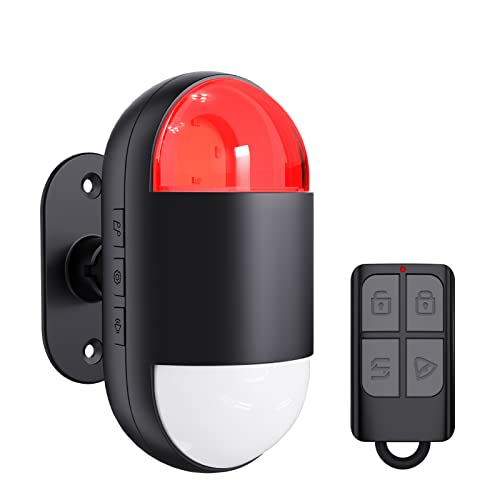
Best For: Indoor entryways, small offices, and temporary alarms. This device uses a 16-26ft infrared sensor range and a remote control with up to 328ft open-area distance. It activates a 125dB siren and a strobe light when movement is detected, providing strong deterrence for intruders. It also offers doorbell and alarm modes, plus two power options (AAA battery or USB charging). Caution: The siren is loud; place away from living spaces if noise could disturb occupants.
ASPECTEK Yard Sentinel Ultrasonic Deterrent

Best For: Outdoor yards or gardens needing deterrence from wildlife. Its all-in-one design combines adjustable ultrasonic frequencies with a high-intensity LED strobe and optional predator sounds. The 3-mode intelligent motion sensor supports Day, Night, and 24-Hour operation, with wide coverage up to 5500 square feet. Caution: The device relies on audible sounds to deter pests; if you prefer silent operation, use ultrasonic mode only.
Aolyty Solar Motion Sensor Alarm

Best For: Solar-powered outdoor warning zones where wiring is impractical. This device charges via solar power and emits up to 110dB, with motion detection capable of activating the warning sound. It’s suited to orchards, yards, and barns. Caution: Higher sound levels can affect nearby pets or people; consider placement away from living areas.
ProGreen 6000K Battery Motion Sensor Light

Best For: Outdoor or indoor spaces needing automatic illumination without wiring. This two-pack uses 9 LEDs delivering up to 100 lumens at 6000K. It provides two motion-detection modes (auto and on) and an off mode, suitable for porches, hallways, or closets. Caution: Requires three AAA batteries per unit, which may need periodic replacement for continuous use.
COTINSE Solar Motion Sensor Alarm Outdoor

Best For: Outdoor security with multi-sound deterrents and multiple LED strobes. The system cycles through 13 sounds in a continuous loop, including dog barking and siren, while alternating red and blue LEDs imitate police lights. It features dual 130dB speakers for broader coverage. Caution: Battery or solar power can vary by weather; test regularly to ensure reliable operation.
Buying Guide: Key Purchase Considerations
Power source and installation: Decide between battery-operated, USB-rechargeable, or solar-powered units. Battery options offer portability and quick setup, while solar-powered devices reduce maintenance. Consider how easy it is to mount or place the unit in your space.
Detection range and coverage: Look for infrared or motion sensors that match your space. Indoor needs may require shorter ranges, while yards and outdoor areas benefit from wider coverage and weather resistance. The ability to cover corners or long hallways matters for deterrence.
Audible versus visual alerts: Choose based on your environment. A loud siren complements a bright strobe for deterrence, but an all-visual setup may be preferable in noise-sensitive areas. Some units combine both for maximum impact.
Modes and customization: Devices with multiple modes (auto, on, off, doorbell) and volume or frequency controls allow tailoring to your needs. Some products offer adjustable strobe colors or pattern options to increase visibility.
Durability and weather resistance: Outdoor units should have weatherproof enclosures and robust seals. Consider UV resistance and temperature tolerance if the device will be exposed to sun, rain, or cold.
Portability and form factor: Compact designs fit on doors, windows, or tool sheds, while larger units may be better for perimeters or yards. Weight and mounting options influence how you install them.
Frequently Asked Questions
- What is a battery-operated motion sensor strobe light best used for? To deter intruders, alert for doorways, and illuminate walkways without requiring wiring.
- Do these devices require a maintenance schedule? Yes. Check batteries or solar charging, test alarms, and ensure sensors are clean and unobstructed.
- Can I use multiple devices together? Yes. For broader coverage, place units to cover different zones and use audible and visual cues in tandem where allowed.
- Which features matter most for outdoor use? Weather resistance, wide coverage, and effective deterrent sounds or strobes; consider solar or battery reliability for remote areas.
- Are there privacy concerns with motion-activated devices? Use in accordance with local laws and avoid recording features unless explicitly designed for surveillance; many devices focus on deterrence and alerting rather than recording.
- How do I choose between audible and visual alerts? Consider ambient noise levels and the presence of pets or neighbors who might be affected by loud sounds; choose the mode that minimizes nuisance while maximizing deterrence.