Best Battery Grid Tie Inverters for Home Solar Systems
Answering essential buyer needs, a battery grid tie inverter converts solar or battery power into usable household AC while syncing with the grid. This guide highlights five reliable options, clarifying who each inverter best serves and what to watch for before buying. Ideal for homeowners, off-grid enthusiasts, and DIY solar integrators seeking safe, efficient grid-tied operation.
| Product | Best For | Open Question | |
|---|---|---|---|
| Y&H 1200W Grid Tie Inverter Power Limiter | Mid-size solar setups with 76–90V PV input | Limiter sensor for load-based output | Is MPPT in the recommended Voc range? |
| Y&H 1000W Grid Tie Inverter Power Limiter | Battery-assisted systems with 25–60V inputs | Battery discharge mode with MPPT | Is 200W minimum panel power met? |
| YINZINR 1000W Grid Tie Inverter | Compact grid-tie for 36V panels and batteries | MPPT efficiency >99% | Best for same-spec panels and batteries? |
| Y&H 2000W Grid Tie Inverter | Higher-power grid-tie with 60–90V input | Stackable inverters for scalable output | Voltage compatibility with 240VAC systems? |
| TINGEN 1200W Grid Tie Inverter | Grid-tie with 55–90V input and LCD control | Clear LCD display and multiple modes | Is the voltage range suitable for 48V batteries? |
Y&H 1200W Grid Tie Inverter Power Limiter

The Y&H 1200W Grid Tie Inverter uses a limiter sensor to deliver only the power required by the load. This makes it suitable for homes that want to avoid overloading circuits while integrating solar energy. It supports PV open-circuit voltage of 76–90V and presents an LCD that shows operating status and allows photovoltaic/battery mode selection. The device is best for homeowners with mid-range solar arrays in the MPPT range, seeking straightforward grid connection plus mode control. A potential limitation is that the inverter’s efficiency depends on maintaining the panel voltage within the specified MPPT window; outside this window, performance can drop.
Who this is best for: Homeowners with 76–90V PV strings and a need for simple PV/battery mode switching; those prioritizing load-based power delivery and clear status feedback.
Y&H 1000W Grid Tie Inverter Power Limiter
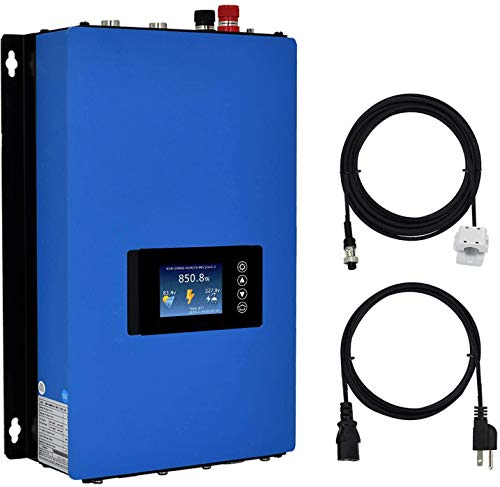
This model emphasizes battery compatibility, featuring a battery discharge mode that adjusts depth of discharge based on battery status. It is designed for 22–60V DC input with startup around 26V and requires a solar panel bank not less than about 200W. The MPPT-enabled design claims up to 99% efficiency, with a limiter sensor to ensure only the energy needed is exported. A caution is to check open-circuit voltage and ensure the panels stay within the recommended 38–60V Voc range for optimal efficiency.
Who this is best for: Systems pairing 36V or 48V batteries with modest solar arrays, where controlled battery discharge and tight MPPT performance are priorities.
YINZINR 1000W Grid Tie Inverter

The YINZINR inverter emphasizes a strong MPPT, claiming efficiency above 99% and a pure sine wave output suitable for sensitive electronics. It is designed for 20–50V DC input to 90–140V AC outputs, making it better for 36V solar panels paired with 36V batteries. It uses a lightweight aluminum housing and emphasizes environmental friendliness through solar-to-grid conversion. A limitation is that real-world performance can hinge on panel voltage consistency and matching the same specifications for the entire string to ensure reliable MPPT tracking.
Who this is best for: Small to medium solar projects using 36V systems or similar and requiring precise MPPT tracking and clean sine-wave output for electronics.
Y&H 2000W Grid Tie Inverter

The Y&H 2000W unit targets higher-output grid-tie setups with DC input 45–90V, startup around 49V, and a recommended 240V AC output. It supports 60V/72V battery operation with a battery discharge mode to optimize depth of discharge automatically. The inverter’s MPPT claims up to 99% efficiency and supports stacking multiple units for scalable power. A practical limitation is that it is not compatible with 110/120V systems, so users with those grid profiles should plan for 240V configurations or alternative inverters.
Who this is best for: Larger residential or small commercial systems that operate on American 240V grids and require scalable, multi-inverter configurations.
TINGEN 1200W Grid Tie Inverter
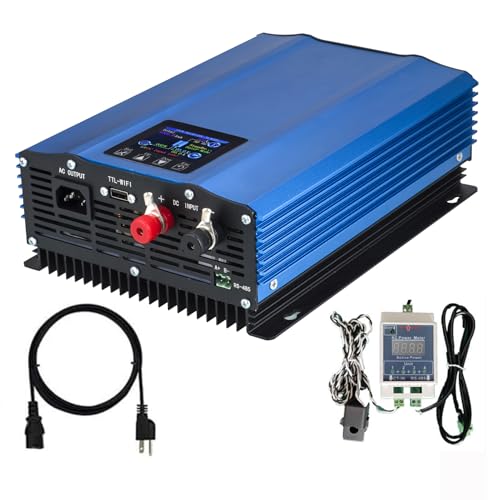
TINGEN emphasizes high-efficiency MPPT tracking (>99%), broad input voltage (55–90V) compatible with 48V batteries, and an output range of 90–140V AC. The LCD display provides real-time system data and there are four working modes for flexible operation. Best for users who value transparent live metrics on a user-friendly LCD and want a versatile unit that can adapt to shaded conditions. A potential limitation is that performance depends on maintaining the DC input within the specified range and ensuring safe wiring for 90V AC outputs.
Who this is best for: Grid-tie projects needing clear system visibility and multiple operation modes, especially when dealing with 48V battery systems and varying shading conditions.
Buying Guide: Key Considerations For Battery Grid Tie Inverters
- Voltage compatibility: Confirm the inverter’s DC input range matches your PV array voltage and battery bank (for example, 22–60V, 45–90V, or 55–90V). This ensures MPPT efficiency and reliable operation.
- Output voltage and frequency: Ensure the AC output aligns with your local grid (commonly 120V or 240V in the U.S.). Some models explicitly target 240V; others are limited to 110–120V.
- MPPT performance: Look for MPPT efficiency near or above 99% for optimal energy harvest, especially in environments with partial shading or varying solar input.
- Battery integration: If you plan to use batteries, verify compatibility with 36V, 48V, or 60V systems and check discharge controls to protect battery health.
- Limiter or load-based output: A limiter sensor helps export only what the load requires, preventing backflow or grid overdraw and increasing safety in some installations.
- Scalability: If you anticipate expanding, consider stackable units or modular configurations that can increase total power without redesigning the system.
- Installation considerations: Ensure wiring follows local electrical codes, and consider circuit protection, cable lengths between panels and inverter (as prescribed by the model’s limits).
- Display and controls: An LCD or similar interface enhances monitoring and mode selection, useful for adjusting to changing loads or battery conditions.
Frequently Asked Questions
- What is a grid-tie inverter with battery storage? A grid-tie inverter converts DC from solar panels or batteries to AC while syncing with the utility grid, and some models support battery storage with discharge controls for safe operation.
- Do I need MPPT for a grid-tie system? MPPT helps maximize solar energy harvest, especially under varying irradiance. It is recommended for most grid-tie applications.
- Can I stack multiple inverters? Some models are designed to be stacked or paralleled for higher overall output. Check the product documentation for compatibility and safety guidelines.
- What voltages are common for residential grids in the U.S.? Most homes use 120V or 240V AC, with the latter often used in larger systems or with higher power inverters.
- Is a limiter sensor important? A limiter helps export only the energy needed by the load, which can improve safety and reduce unnecessary backflow to the grid in certain setups.
- What should I consider when choosing between 1000W and 2000W units? Higher wattage supports larger solar arrays and loads, but confirm grid compatibility and battery voltage support to ensure a proper match with your system.