Best Battery Charger With Timer: Top Picks for Precision Charging and Jump-Start Power
Looking for a battery charger with a built-in timer that helps you maintain, revive, or start engines with confidence? This guide highlights five timer-enabled options best suited for DIYers, professional mechanics, and fleet managers who want precise charge control, durable builds, and reliable engine start power. Each pick is explained with who it’s best for, why it stands out, and a prudent caveat. A quick comparison table is included to help you choose at a glance.
| Product | Best For | Key Benefit |
|---|---|---|
| Schumacher SC1667 Time Controlled Charger | Garage pros and frequent jump-start users | 135-minute timer with three boost modes |
| Schumacher SC1445/SC1446 Wheeled Chargers | Rugged workshop setups | Powerful engine start with timer control |
| CRAFTSMAN 6A/175A 2-in-1 | Shop owners needing versatility | 135-minute timer, 175A start, 25A boost |
| YONHAN 20A/24V Maintainer | Seasonal battery care and long-term maintenance | Smart multi-chemistry maintenance with winter mode |
| DSR ProSeries 200A Manual Charger | Large engines and heavy-duty use | 135-minute timer, 200A start power |
Schumacher Electric 6V/12V Time Controlled Battery Charger & Engine Starter

Best for shop veterans who need monitored charging with flexible boost modes. The SC1667 offers a 135-minute precision timer, an ammeter to track charge rate, and a charge selector for tailoring care to standard, AGM, or gel batteries. It combines a 10A 12V charging mode with higher boost levels (50A/12V, 25A/12V, 25A/6V) and a 250A engine start, making it versatile for cars, trucks, and RVs. Best for a garage that handles varied battery chemistries and strong starting power. A potential limitation is its complexity for casual, infrequent users who prefer simpler one-button charging.
Who this is best for: Professionals and serious hobbyists who need precise control and robust starting power.
Schumacher Electric Wheeled Manual 10A Car Battery Charger and 250A Engine Starter, SC1445

Best for garages needing a durable, portable 2-in-1 charging and starting tool. This model delivers a 250A engine start and a 135-minute timer for controlled charging, plus a heavy-duty steel case, wheels, and a retractable handle suitable for frequent transport around the shop. It’s a solid pick for fleets or workspaces where mobility and reliability matter. A caution: the unit’s high amperage requires careful handling around non-professional users or in space-constrained setups.
Who this is best for: Shop teams and mobile technicians who move gear between vehicles or bays.
Schumacher Electric Wheeled Manual 10A Car Battery Charger and 200A Engine Starter

Best for users who want a balanced 2-in-1 device with strong starting capability and precise timer control. The unit provides a 200A engine start, 40A 12V boost, multiple charging options, and a 135-minute timer to oversee each stage. It’s a solid choice when you need reliable starting power without sacrificing charging versatility for 6V and 12V systems. Limitation: not ideal for extremely small vehicles or very low-current battery care where a gentler charger is preferred.
Who this is best for: Mixed-use garages needing a dependable, mobile, all-in-one charger and starter.
CRAFTSMAN Wheeled Manual 6A Charger and 175A Engine Starter
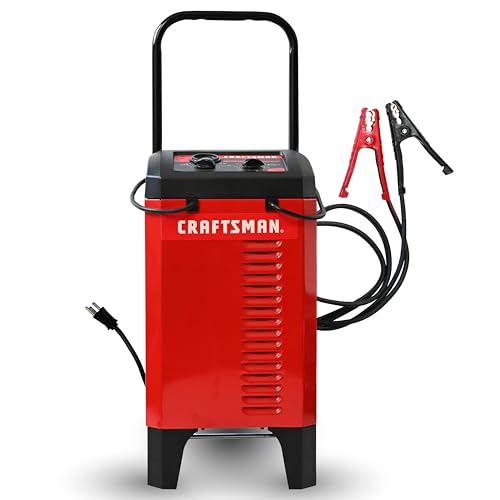
Best for 12V power sport, automotive, and marine batteries needing a reliable 2-in-1 solution with a 135-minute timer. The 175A engine start and 25A 12V boost provide solid starting power, while 6A charging handles routine top-ups. It offers precise manual control for tailored charging sessions. Caution: larger units may require more storage space and can be heavier to move in tight garages.
Who this is best for: Enthusiasts and small business operators who work across multiple 12V batteries and occasionally need a jump start.
YONHAN Battery Charger 20A/24V Maintainer

Best for long-term battery maintenance and winter care. This charger/maintainer supports LiFePO4, lead-acid, and various chemistries with 20A (12V) and 24V (10A) options, plus a dedicated repair mode and protective features (overcurrent, reverse, short circuit). Winter mode helps prevent drainage during cold periods. Limitation: not a jump starter; it requires a power outlet to operate.
Who this is best for: Vehicle owners and fleets focused on battery health and seasonal maintenance.
Battery Charger Timer Kit: 135-Minute Timer For Schumacher And Craftsman Chargers

Best for DIYers who want to retrofit existing chargers with a reliable 135-minute timer. This kit includes a 135-minute mechanical timer, a knob, and mounting screws to fit a wide range of Schumacher and Craftsman models. It helps standardize charging sessions and can extend ease of use for hobbyists. Caution: installation requires basic electronics familiarity and may not be compatible with every charger model.
Who this is best for: Home technicians looking to add precise timing to existing charging setups.
BN-LINK Indoor Countdown Timer with Repeat Function

Best for household and workshop tasks that require basic timed operation. This timer offers up to 6 hours, repeat functionality, and a straightforward push-button interface. While not a charger, it can be used to coordinate charging routines or other timed tasks around the workshop. Limitation: not a battery charger itself, so use this in conjunction with a charger.
Who this is best for: Home workshops needing reliable, simple countdown control for multiple devices.
Buying Guide
What to consider when choosing a battery charger with a timer:
- Timer features: Look for a timer that matches your typical charging sessions (135 minutes is common). Some models include hold positions and repeat functions for consistent cycles.
- Boost and engine-start power: Heavy-duty users should prioritize higher amperage (200–250A) for quick jump starts on larger engines, while casual users can opt for lower boost levels.
- Battery compatibility: Ensure the charger supports standard lead-acid, AGM, gel, and LiFePO4 chemistries if you own mixed battery types.
- Portability vs. durability: Wheeled units are easier to move in a shop; metal frames tend to be more durable in rugged environments.
- Safety features: Look for reverse polarity protection, overcurrent protection, and short-circuit protection for safer operation.
- Maintenance vs. jump-start focus: Decide if you primarily need ongoing maintenance, occasional jump starts, or both.
- Ease of use: For casual users, a straightforward interface with fewer controls reduces setup time and errors.
FAQ
- What is a timer-controlled battery charger used for?
It allows precise control over charging cycles, reducing overcharging and protecting battery life, especially during maintenance or delicate charging tasks.
- Can these chargers jump-start a vehicle?
Yes, many models include engine-start modes ranging from 150A to 250A, suitable for cars, trucks, and RVs. Check the specific start current for your vehicle.
- Are these chargers compatible with AGM or LiFePO4 batteries?
Most listed models support standard lead-acid, AGM, and gel; some also support LiFePO4. Verify compatibility with your battery type before charging.
- Is a timer necessary for casual charging?
Not strictly necessary, but a timer helps automate and standardize charging sessions, which is useful for maintenance or fleet operations.
- What should I avoid when using a timer charger?
Avoid leaving a battery unattended for long periods if the charger lacks proper safety protections. Always follow manufacturer guidelines for each battery type.
- Do these devices require an external power source?
Yes. Timers and charging circuits require an electrical outlet to operate, and some units include built-in mobility for workshop use.