Best Battery Charger With Desulfation Mode for Extending Battery Life
Finding the right battery charger that includes a desulfation mode can help rejuvenate older lead-acid batteries and keep newer ones healthy through the seasons. This guide highlights five reliable options that combine smart charging, maintenance, and pulse-desulfation to maximize performance. Each entry explains how the desulfation feature works, what battery types are supported, and practical use cases for cars, boats, motorcycles, and more. Whether you’re preparing for winter storage or regular maintenance, these chargers offer automatic protection, temperature adjustment, and user-friendly interfaces.
A quick overview of the chosen products:
| Product | Desulfation/Repair Feature | Battery Types | Key Benefit |
|---|---|---|---|
| NOCO GENIUS1 | Desulfator, Trickle | Lead-Acid, LiFePO4 | Compact all-in-one charger with precision charging |
| NOCO GENIUS5 | Desulfator, Trickle | Lead-Acid, LiFePO4 | More power in a small form factor for larger batteries |
| TowerTop 25A Max Pro | Desulfation/Repair, Auto-desulfator | Lead-Acid, Li-Ion | High current with robust protection and multi-mode options |
| VEVOR Smart Battery Charger 35A | Desulfation Phase, Pulse Repair | Lead-Acid, LiFePO4 | Large LCD display and four-mode versatility |
| YONHAN Battery Charger 20A | Repair Pulse Mode, Winter Mode | Lead-Acid, LiFePO4 | High-speed charging with efficient winter protection |
NOCO GENIUS1: 1A Desulfator Charger

NOCO GENIUS1 combines a compact design with multi-function charging: battery charger, maintainer, trickle charger, and desulfator. It supports 6V and 12V lead-acid chemistries—AGM, Gel, SLA, VRLA—as well as LiFePO4 batteries. An integrated thermal sensor adjusts charging based on ambient temperature, reducing the risk of overcharge in heat or undercharge in cold. This helps extend battery life during storage and regular use. It is suitable for small to mid-size vehicles, motorcycles, and power equipment where space is limited.
Key features include automatic protection against overcharge and a temperature-compensated charging profile. The GENIUS1’s desulfator mode can help recover partially sulfated lead-acid cells, improving cranking power and longevity. Its 1-amp rate makes it ideal for maintaining battery health without excessive charging current. This option is ideal for garage setups that prioritize space efficiency and straightforward operation.
NOCO GENIUS5: 5A Desulfator Charger

The GENIUS5 expands on the GENIUS1 with higher output while preserving the four-in-one design: charger, maintainer, trickle charger, and desulfator. It supports 6V and 12V lead-acid batteries and LiFePO4 cells. The integrated thermal sensor ensures safe operation in varying temperatures, optimizing charge cycles for peak efficiency. The higher current rating makes GENIUS5 well-suited for mid-size to larger batteries in motorcycles, ATVs, recreational boats, and small engines where faster replenishment is beneficial.
Desulfation with this model relies on pulse and conditional repair modes designed to break down lead sulfate crystals, potentially restoring capacity and extending battery life. With its compact footprint and improved power delivery, the GENIUS5 is a strong choice for enthusiasts who want faster turnaround without stepping up to a heavy-duty charger. Safety protections guard against miswiring, overcharge, and short circuits during complex cycling.
NOCO GENIUS10: 10A Desulfator Charger
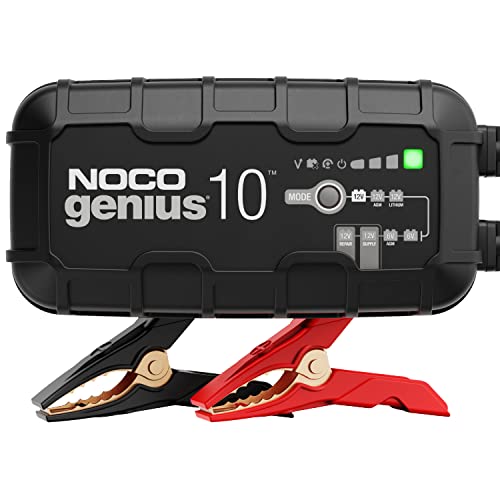
The GENIUS10 provides a higher-capacity option for larger lead-acid or LiFePO4 batteries, including marine and deep-cycle configurations. Like its smaller siblings, it operates as a battery charger, maintainer, trickle charger, and desulfator, with a temperature-compensated charging profile to prevent damage from environmental conditions. The 10-amp output accelerates charging for bigger packs while still offering float maintenance to prevent self-discharge during long storage periods.
Desulfation with GENIUS10 leverages pulse and enzymeless desulfation strategies designed to interrupt sulfation build-up in older batteries. The device’s protection suite—overcharge protection, reverse polarity, and temperature compensation—helps ensure safe long-term use. Properly paired with compatible lead-acid or LiFePO4 batteries, this charger supports boats, snowmobiles, and other equipment that requires reliable battery management without frequent replacements.
TowerTop 25A Max Pro Battery Charger

The TowerTop 25A Max Pro is a powerful, fully automatic charger with four current settings (3A, 15A, 25A, AUTO). It includes an automatic desulfation feature and a robust protection suite—reverse polarity, overcharge, overcurrent, short circuit, overheating, and more. This model is designed to charge 12V sealed lead-acid batteries, including AGM, Gel, Wet, and deep-cycle variants, and it can support Li-Ion chemistries with appropriate configurations.
With high efficiency and self-contained MCU control, it claims significant performance gains over traditional chargers. It detects battery types automatically, starts charging quickly, and transitions to maintenance or desulfation modes as needed. This makes TowerTop a practical option for garages, workshops, and larger battery banks on boats or RVs where rapid charging and robust protection are valued. The device is ETL certified and designed for ease of use by hobbyists and professionals alike.
VEVOR Smart Battery Charger 35A

VEVOR’s 35A smart charger addresses a broad range of 12V systems, including LiFePO4 and lead-acid variants. It operates in four modes: Charging, Maintain, Desulfation, and Supply. The LCD display provides real-time information on mode, voltage, current, and power percentage, making it easy to monitor progress. The desulfation mode uses pulse-repair techniques to tackle sulfation in aging batteries, potentially restoring capacity and extending life for marine, automotive, and deep-cycle applications.
Notable design features include a large-screen interface, independent control buttons, and a wide operating voltage range. The charger supports automatic detection and protection features such as overcharge and short circuits. While the device is roomy enough for bigger installations, it remains suitable for home garages, shops, and fleet maintenance where multiple battery chemistries are in use.
YONHAN Battery Charger 20A

The YONHAN charger provides 20 amps of charging current with 12V and 24V modes, supporting LiFePO4, lead-acid, and deep-cycle batteries. It features a 7-stage charging process with a dedicated repair pulse mode to recover idle or sulfated cells, plus winter mode for temperature-appropriate charging. The device emphasizes high-efficiency pulse repair to help revive old batteries. It also includes overcurrent, reverse polarity, and short-circuit protections to ensure safe operation.
Designed for versatility, YONHAN supports various platforms including cars, trucks, boats, ATVs, and lawn equipment. It’s marketed as a performance-oriented option for users who want fast charging combined with battery rehabilitation features. The display and intuitive controls help users monitor status and switch modes, making it suitable for both seasonal use and ongoing maintenance.
Buying Guide: Key Purchase Considerations
- Battery chemistry compatibility: Ensure the charger supports your battery type (lead-acid variants, LiFePO4, Li-ion). Desulfation is primarily relevant to lead-acid batteries.
- Desulfation effectiveness: Desulfation and repair modes vary by model. Pulse or desulfation cycles aim to convert sulfated plates back into usable material, potentially extending battery life—especially for aging batteries.
- Amperage and charging speed: Higher amperage charges faster but can be harder on small batteries. Choose a charger with a suitable current rating for your typical battery size (2–25A is common for consumer use).
- Temperature compensation: A thermal sensor helps prevent overcharging in heat and undercharging in cold conditions, protecting battery health and improving cycle longevity.
- Safety features: Look for overcharge protection, reverse polarity protection, short-circuit protection, and ETL/UL compliance where applicable.
- Display and usability: A clear LCD or similar display helps track mode, voltage, and current. Simple interfaces reduce the risk of misconfiguring charging cycles.
- Maintenance vs. restoration: Some chargers excel as long-term maintainers, while others emphasize rapid restoration of older or deeply discharged batteries. Consider your primary use case.
- Mounting and footprint: If space is limited, choose a compact unit with adequate power. For garages or workshops with multiple batteries, a larger unit with auto-detect can be advantageous.
In selecting a battery charger with desulfation features, assess your typical battery sizes, storage needs, and whether you favor compact designs or high-current capability for faster restoration. All five options highlighted above offer desulfation or repair modes, combined with smart charging and safety protections, making them suitable for different American households and garages looking to extend battery life without frequent replacements.