Best Battery Charger With Boost Start for Quick Vehicle Recuperation
Answering the need for a reliable, fast-starting battery charger, this guide highlights top choices designed to boost, start, and maintain 12V and 24V lead-acid batteries. These devices are ideal for car owners, boat and RV enthusiasts, and fleet managers who want rapid engine starts, safe maintenance, and versatile charging modes. Each pick below has a clear strength: some excel at rapid engine starts, others at long-term battery health and versatility across battery chemistries. The following summary table helps compare key capabilities at a glance.
| Product | Best For | Key Feature |
|---|---|---|
| TowerTop 12V Charger | Everyday drivers with 12V AGM, STD, Gel, and deep-cycle batteries | Auto desulfator, multiple current settings up to 25A |
| Schumacher SC1361 | All-around starters and maintainers for 12V power sport and marine | 50A engine start and 10A boost with trickle charging |
| Schumacher SC1281 | 5-in-1 device with strong starting power | 100A engine start, 30A boost, 6–2A maintenance |
| AZZUNOX 12V/24V Charger | Deeply discharged batteries and multi-chemistry setups | 130A cranking, 30A charging, 12V/24V modes |
| E-FAST 25A Smart Charger | Heavy-duty needs with rapid 12V or 24V charging | Boost mode up to 200s, 5-level current control |
Below you’ll find concise product-by-product sections, followed by a practical buying guide and a brief FAQ to help answer common questions about “boost start” battery chargers.
TowerTop 12V Smart Battery Charger With Auto Start

What it is best for: Owners with mixed battery types (AGM, STD, Gel, deep-cycle) who want automatic charging and a built-in desulfator. The charger offers 4 adjustable current settings (2A, 10A, 25A, AUTO) and can fully charge a 100Ah battery in under 3.5 hours. It’s designed to automatically detect battery status and begin charging within 30 seconds if forgotten, and it provides a pulse repair mode after full charge to maintain long-term health. It remembers last settings even after outages, aiding users who often experience power interruptions.
Why it was selected: It combines high efficiency (up to 85% charging efficiency) with safe maintenance and an engine-start capability. This makes it versatile for vehicles, boats, and RVs that require reliable starts and ongoing battery care. The “auto” feature and memory of settings improve usability for casual and proactive users alike.
Best for: Car owners and small-boat enthusiasts who need a versatile maintainer with boost-like capability and automatic protection. Caution: It may require manual setup for non-standard batteries or unusual cold-weather conditions beyond its listed compatibility.
Schumacher SC1361 4-in-1 Car Battery Charger

What it is best for: Users needing a compact, all-in-one solution that starts, charges, maintains, and reconditions 12V batteries. It delivers a 50-amp engine start and a 10-amp boost, plus 6–2-amp trickle charging for ongoing maintenance. Its smart trickle charge keeps batteries safe over time without overcharging.
Why it was selected: The SC1361 emphasizes a strong start capability with a flexible maintenance profile, making it suitable for power sports, automotive, and marine batteries. It’s a straightforward option for users who want reliable immediate power and long-term battery health in one device.
Best for: Weekend warriors and boat owners who need quick engine starts and safe, regular maintenance. Caution: The device emphasizes 12V batteries; users with atypical battery configurations should verify compatibility.
Schumacher SC1281 5-in-1 Starting and Charging System

What it is best for: A comprehensive 5-in-1 device for starts, charges, maintains, tests, and reconditions batteries. It provides 100-amp engine start, 30-amp boost, and 6–2-amp charging for 6V/12V systems, with smart trickle charging to prevent overcharging over time.
Why it was selected: This model offers robust starting power along with a broader maintenance suite, making it ideal for users managing multiple vehicles or fleets. Its reconditioning capability adds long-term battery health value in addition to immediate power.
Best for: Garage mechanics and fleet managers who need a versatile tool that handles aggressive starting needs and ongoing battery care. Caution: Higher startup current is powerful; users should follow safety instructions to avoid battery damage on delicate systems.
AZZUNOX 12V/24V Charger With Desulfator
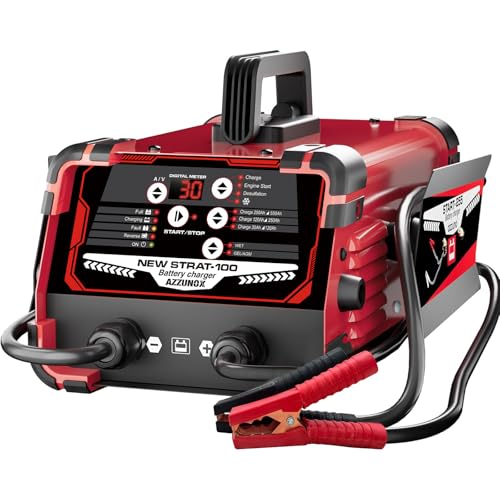
What it is best for: Deeply discharged batteries and multi-chemistry use, including AGM, Gel, Wet, EFB, calcium, MF, and deep-cycle variants. It provides up to 130A cranking current and 30A charging, with 12V and 24V modes and a recovery feature for depleted batteries above 1V.
Why it was selected: Its rugged, copper-coil construction and dual-voltage capability suit users with larger or more diverse battery inventories. The design’s recovery mode can help revive batteries that have been undercharged for extended periods.
Best for: Heavy-duty users who need a durable charger capable of reviving weak batteries across multiple chemistries. Caution: It will not start a battery below 1V, which the manufacturer notes as a damaged-battery condition.
E-FAST 25A Smart Charger with Booster Mode

What it is best for: Heavy-duty charging with 25A for 12V and 15A for 24V batteries, plus a 200-second emergency booster. The device supports Lead-Acid chemistries (AGM, GEL, SLA, Flooded, EFB) and LiFePO4, with a 5-level current selection from 2A to 25A and an Auto mode that adapts to battery resistance.
Why it was selected: The booster mode provides a quick jump-start-like capability for emergency scenarios, while the auto mode and wide chemistry compatibility address a broad user base. It’s a practical choice for garages with varied battery setups and vehicles.
Best for: Users who want a single charger that doubles as a jump-start aid and supports a wide range of batteries. Caution: The booster function is for 12V batteries only; plan accordingly if your setup includes 24V systems.
Buying Guide: How to Choose the Right Battery Charger With Boost Start
What kind of vehicle and battery chemistries will you support?
Consider your typical batteries: AGM, GEL, flooded/wet, EFB, calcium, MF, and deep-cycle. If you own boats, RVs, or ATV components, ensure the charger supports those chemistries and the voltage (12V vs. 24V). For mixed fleets, a model with multi-chemistry support and auto-detect is advantageous.
Do you need speed versus safety?
High-amp engine-start capabilities provide rapid starts but can be harder on delicate electrical systems if misused. For everyday cars, a device with smart trickle charging and maintenance mode helps preserve battery life. If you frequently encounter deeply discharged batteries, a booster or desulfation feature can be valuable.
What about maintenance and safety features?
Look for automatic shutoff, desulfation, and safe charging protection. A device that remembers last settings after outages improves reliability in homes and shops with intermittent power.
Portability and durability considerations
Manual vs. wheeled designs affect usability in garages and on job sites. A rugged housing with wheels, sturdy handles, and a reliable power cord helps when moving the charger around a workspace or shipside.
What is the total cost of ownership?
Beyond upfront price, factor in maintenance features, expected battery health benefits, and compatibility with your existing battery stock. A multi-chemistry, high-capacity charger may save money by reducing failed starters and extending battery life.
Practical tips for use
Always follow battery manufacturer recommendations for charging currents. Use Auto mode when possible to avoid overcharging. If you’re using booster modes, reserve them for emergency starts and avoid frequent use on normal operating batteries unless the device is designed for it.
Frequently Asked Questions
- What does a “boost start” feature do? A boost start function delivers a short high-current surge to help start a vehicle with a weak or dead battery. It is typically used in emergencies and is separate from standard charging modes.
- Can these chargers repair damaged batteries? Some devices include desulfation or reconditioning features to improve performance of marginal batteries, but they cannot repair batteries that are physically damaged or below safe operating voltage.
- Will these chargers work with 24V batteries? Several models support 24V systems or have dual-voltage modes. Check the product specifications to confirm 24V compatibility before use.
- Is it safe to leave a charger plugged in all night? Most modern chargers include auto shutoff and maintenance modes, which are designed to prevent overcharging. Always follow the manufacturer’s safety instructions for your specific model.
- Do I need a separate desulfator or booster? A charger with built-in desulfation or booster features can simplify operations and reduce the number of devices needed, but verify that these features align with your battery needs and tension levels.
- Which model is best for a fleet? For fleets, consider a high-amperage engine-start option, robust maintenance features, and multi-chemistry support. The Schumacher SC1281 and AZZUNOX options are strong candidates for mixed-use fleets.
All products listed above are intended to meet a range of buyer intents, from quick-start needs to long-term battery maintenance. When choosing, match your typical battery types, vehicle categories, and maintenance routines with a charger’s capabilities to ensure reliable starts and sustained battery health.