Best Battery Chargers for Trailer: Top Onboard and Portable Options
Trailers rely on reliable 12-volt power, whether you’re running accessories, lighting, or hydraulic systems. A robust battery charger helps keep your trailer battery healthy, extends life, and reduces downtime. This guide highlights five strong options, spanning simple trickle chargers to solar-maintained onboard units. Each selection balances ease of use, compatibility with lead-acid and lithium batteries, and suitability for marine, automotive, and heavy-duty trailer applications.
| Product | Brand | Key Strength |
|---|---|---|
| 10 Amp Panel Mount 12V Battery Charger | Generic | Onboard, 10A output, simple hookup |
| NOCO Genius GEN5X1 | NOCO | Compact, versatile bank charging, marine-grade |
| NOCO GENIUS1 | NOCO | Smart maintainer, versatile for multiple battery types |
| SUNER POWER Solar Battery Charger | SUNER POWER | Solar trickle charging with MPPT controller |
| 5 Amp Panel Mount 12V Battery Charger | Generic | Compact onboard 5A option for smaller loads |
When choosing a charger for a trailer, consider amperage, installation method, and battery type support. For larger trailers with multiple demands, higher amperage onboard units reduce charge times. Solar options excel in remote setups or for seasonal storage. Portability matters for occasional use, while onboard units suit frequent maintenance cycles. The products below represent a mix of traditional AC chargers and solar-assisted models to cover common trailer scenarios.
10 Amp Panel Mount 12V Battery Charger

This onboard charger delivers a straightforward 12V output at 10 amps, suitable for trailers that run lighting, hydraulics, or other accessories. It is designed for a 12V system with a 120V AC input and a pair of 24-inch battery cables, 16 AWG. The unit is appropriate for repeated charging cycles on hydraulic dump trailers, cars, or marine applications where a reliable, simple charger is desired. Its panel-mount design helps keep instrumentation tidy and accessible on larger trailer setups.
Key considerations: installation space, durability, and compatibility with your battery types. This model is best for users who want a no-frills charger that gets the job done quickly and is easy to wire into a dedicated 120V circuit on the trailer. It provides dependable maintenance without advanced charging modes, making it suitable for standard 12V lead-acid batteries commonly found in trailers.
NOCO Genius GEN5X1: 1-Bank Onboard Charger
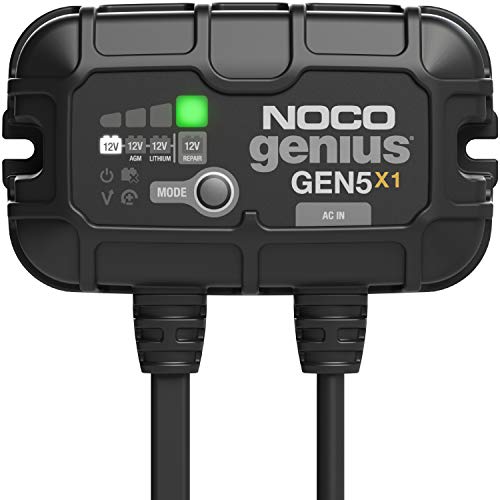
The GEN5X1 is a compact, highly capable onboard charger designed for harsh marine environments. It features a single 5A bank and supports 12V lead-acid and lithium systems, including AGM and LiFePO4 configurations. With selectable charging modes for each bank and temperature compensation, this unit optimizes charging in varying conditions. Its rugged construction and compact footprint make it a strong choice for trailers that require reliable maintenance charging, regardless of weather.
Considerations: installation space, compatibility with lithium chemistries, and the need for precise temperature compensation. While a single bank, the GEN5X1 provides advanced charging control and protection features such as overcharge protection and mode selection to maximize battery longevity during frequent trailer use.
NOCO GENIUS1: 1A Smart Charger

The GENIUS1 combines charging, maintenance, and desulfation in a compact 1A unit suitable for maintenance on smaller battery banks. It supports 6V and 12V lead-acid batteries as well as lithium options like LiFePO4, making it versatile for trailers with mixed battery sets. An integrated thermal sensor adjusts charging to ambient temperatures, helping prevent overcharging in heat and undercharging in cold conditions. This model is ideal for seasonal trailers or light-duty setups where a small, smart charger is preferred.
Key considerations: charging speed and battery type compatibility. For trailers with larger or multiple batteries, pairing a higher-amp onboard charger with a maintenance-only unit like GENIUS1 can optimize overall battery health without overwhelming the system.
SUNER POWER Solar Battery Charger With MPPT
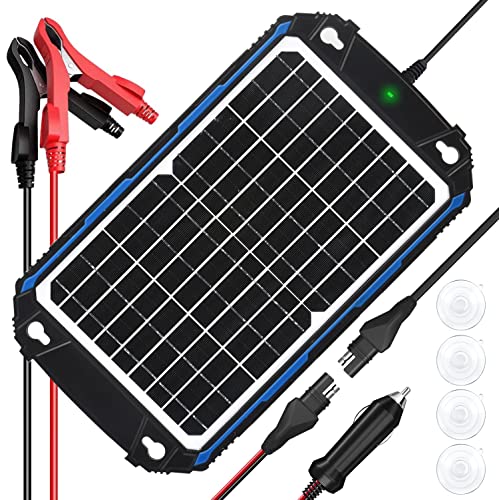
This solar-powered charger uses Ultra-Smart MPPT technology to maximize energy conversion and charging efficiency, delivering up to 99% tracking efficiency and 98% peak efficiency. It supports 12V systems and employs a three-stage charging algorithm (Bulk, Absorption, Float) to optimize battery health. The unit resumes charging automatically after discharge, reducing the need for manual intervention. It’s well-suited for trailers kept in remote or off-grid locations where regular AC power is unavailable.
Buying considerations: solar exposure, weatherproofing, and compatibility with 12V lead-acid and lithium batteries. While solar charging reduces grid dependency, performance depends on sun availability and mounting angle. This option is excellent for seasonal trailer use, RVs, boats, and other setups where constant power is not guaranteed.
5 Amp Panel Mount 12V Battery Charger

The 5 Amp Panel Mount charger provides a compact onboard option for smaller trailer electrical loads. With 5A output, it’s capable of maintaining standard 12V batteries used in light-duty trailers, boats, and utility vehicles. The unit includes 24-inch battery cables, 18 AWG wiring, and a straightforward setup designed for easy integration into an existing trailer electrical system. It suits users who want a budget-friendly, reliable charger that fits into tight spaces on smaller trailers.
Key considerations: amperage sufficiency, cable gauge, and ease of installation. For larger batteries or frequent heavy use, a higher amperage model may be preferable, but this charger excels as a dependable maintenance or primary charger for smaller systems.
Buying Guide: Key Purchase Considerations And Comparisons
Selecting the right trailer charger involves balancing amperage, installation needs, and battery types. Here are important factors and how different options compare:
- Amperage and charging speed: Higher amperage (e.g., 10A onboard) charges faster but may require more robust wiring and a larger power supply. Lower-amps units (5A or 1A) are simpler, safer for small batteries, and ideal for long-term maintenance.
- Onboard vs. portable: Onboard chargers stay installed and can deliver continuous maintenance. Portable trickle chargers are flexible but require manual connection and monitoring.
- Battery chemistry support: Check compatibility with lead-acid, AGM, Gel, VRLA, and LiFePO4. Lithium compatibility is increasingly common but may require special modes or protections.
- Temperature compensation and safety: Temperature-sensing features help prevent overcharging in heat and undercharging in cold. Overcharge and short-circuit protections are important for trailer environments exposed to heat or vehicle vibration.
- Solar capability: Solar options reduce grid dependence and are great for remote trailers or holiday setups. MPPT controllers maximize energy capture, especially in fluctuating light.
- Installation considerations: Panel-mount units require suitable mounting space and access to AC power. Direct-mount and under-hood options need secure mounting hardware and vibration resistance.
Comparative snapshot: For frequent, robust charging of larger trailer battery banks, onboard 10A or higher units like the 10 Amp Panel Mount or NOCO GEN5X1 provide strong performance and protection. For mixed battery chemistries or limited space, NOCO GENIUS1 offers smart maintenance with temperature compensation. In off-grid or remote setups, solar-based chargers from SUNER POWER or POWOXI provide autonomous charging with safety protections and durable construction. For smaller trailers, the 5A onboard charger or compact 1A equivalents deliver reliable maintenance without complexity.
All models aim to extend battery life while ensuring safe, reliable operation in varying trailer environments. Consider your trailer’s electrical load, battery type, and the climate where the trailer operates to select the best fit. By choosing a charger that aligns with your usage pattern—maintenance, rapid recharge, or solar-assisted charging—you can minimize downtime and keep trailers ready for work or recreation.