Best Battery Chargers for Solar Systems: Top 5 Options for 12V Setups
Choosing the right battery charger for a solar system helps you keep batteries healthy, maximize energy capture, and extend system life. The following selections are purpose-built for 12V batteries used in cars, boats, RVs, motorcycles, and off-grid setups. Each option below emphasizes efficiency, durability, and safety features suitable for American conditions. Read through to compare features, install ease, and long-term reliability.
Summary Of Selected Products
| Product | Brand | Key Feature | Output Type | Ideal Use |
|---|---|---|---|---|
| POWOXI Upgraded Solar Battery Trickle Charger | POWOXI | Smart protection with 7.5W panel | Trickle charging | Motorcycles, cars, light duty |
| SOLPERK Solar Panel Kit 20W | SOLPERK | High efficiency, adjustable mount | 12V charging | Boats, cars, RVs, trailers |
| SUNER POWER 12W Pro | SUNER POWER | Ultra-Smart MPPT, 3-stage charging | 12V trickle charging | Cars, motorcycles, small boats |
| SUNAPEX 25W Solar Battery Charger Kit | SUNAPEX | MPPT with 99% efficiency | 12V charging | Cars, RVs, boats |
| ECO-WORTHY 10W Solar Car Battery Maintainer | ECO-WORTHY | PWM with reverse/overcharge protection | Trickle charging | Everyday maintenance |
Below you’ll find five in-depth product sections. Each entry presents a practical overview, supported by its features and typical use cases. The focus is on real-world performance, safety features, and compatibility with common 12V lead-acid and Li-based batteries in terrestrial environments.
POWOXI Upgraded 7.5W Solar Battery Trickle Charger
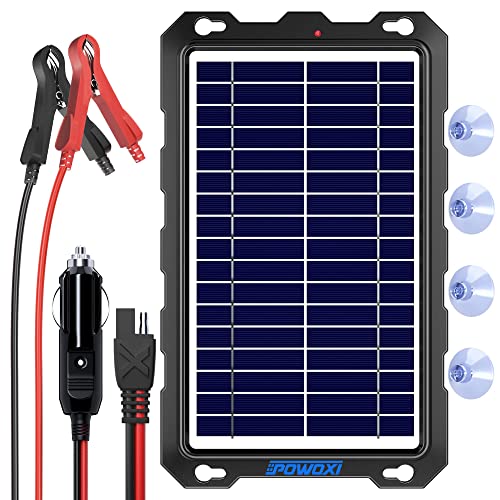
The POWOXI unit delivers a compact 7.5W solar panel paired with an intelligent charge controller. Its built-in protection system guards against overcharge and short circuits, making charging safer for a range of 12V batteries in vehicles, boats, motorcycles, and small recreational systems. The glass is high-transparency and robust, designed to withstand wind, snow, and impact. A key advantage is maintenance-free operation, with stable output and a focus on safety in variable daylight conditions.
Core strengths include battery-friendly charging logic, minimal user intervention, and reliability in low-sun or cloudy conditions. The system is well-suited for trickle charging during off-season storage and for keeping critical 12V systems ready for use. Its 7.5W output is ideal for smaller batteries or to top up while vehicles are parked, a practical choice for households with lightweight solar setups.
SOLPERK Solar Panel Kit 20W 12V
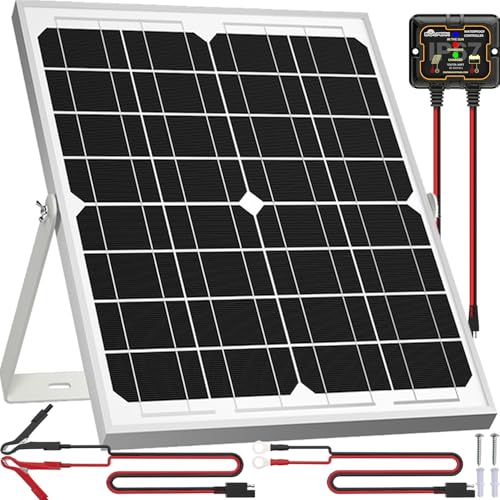
This 20W panel kit uses monocrystalline A+ cells to offer documented high conversion efficiency. It’s designed to charge and maintain a broad mix of 12V batteries, including LiFePO4, lithium-ion, AGM, and GEL formats. The kit’s durability is reinforced by a low-iron tempered glass surface and corrosion-resistant aluminum frame, delivering weather resistance and a service life that can span decades in outdoor installations. A smart three-stage charge controller helps prevent overcharging and protects against voltage spikes without drawing energy from the battery when not needed.
With its robust mounting options and weatherproof construction, SOLPERK is excellent for boats, RVs, cars, and trailers. It’s particularly valuable in remote or off-grid settings where water exposure, wind, and snow are common. The comprehensive controller feedback ensures users can gauge charging progress and battery status at a glance, making it a reliable, hands-off solution for steady energy maintenance.
SUNER POWER 12W Pro With Ultra-Smart MPPT

SUNER POWER emphasizes optimization with Ultra-Smart MPPT technology that claims high tracking efficiency and peak conversion efficiency near the ceiling for 12V systems. The 12W output is paired with a three-stage charging profile to prevent overcharge while maintaining battery health during long-term maintenance. The product is marketed as a no-maintenance, auto-resume charger, which is advantageous for seasonal storage or periodic use where continuous monitoring isn’t practical.
Key considerations include how MPPT performance translates in real-world, partly shaded conditions and the extent to which the controller integrates with a broader solar array. For users with limited space or smaller batteries, this unit offers a balance of efficiency and simplicity, ensuring the battery remains ready for operation without frequent manual checks.
SUNAPEX 25W Solar Battery Charger Kit

SUNAPEX offers a higher wattage option with 25W of solar input and a built-in MPPT controller designed to maximize output across a range of battery chemistries. The kit includes a sturdy aluminum frame and a MPPT controller capable of delivering efficient performance even in less-than-ideal light. It’s positioned for larger 12V battery banks used in cars, RVs, boats, and trailers, delivering faster replenishment and greater resilience against weather changes.
For users who need quicker response times and greater daily energy transfer, SUNAPEX provides a strong balance of power, reliability, and ease of installation. As with any MPPT system, ensuring proper heat management and correct voltage settings is important to safeguard battery health over time.
ECO-WORTHY 10W Solar Battery Maintainer
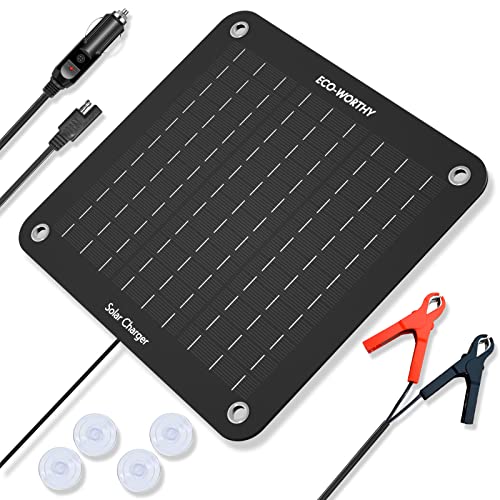
ECO-WORTHY emphasizes basic, reliable maintenance through a 10W monocrystalline panel that uses trickle charging to avoid overcharging. A built-in blocking diode prevents reverse charging, a simple yet essential feature for outdoor installations where conditions change overnight. The setup typically suits vehicles and equipment kept in storage or used intermittently, such as seasonal trailers, garden equipment, or fleet vehicles.
This option is notable for straightforward maintenance, particularly when a low-maintenance charger is preferred. The lack of overly complex electronics keeps it accessible for novices while still delivering a dependable charge to prolong battery life during periods of non-use.
Buying Guide: What To Consider When Choosing A Solar Battery Charger
To select the best charger for a solar system, balance power, protection, and practicality. Here are key purchase considerations and comparisons across the options listed:
- Output power and battery size: Higher wattage (like 20–25W) benefits larger 12V batteries and higher energy demands, improving charge speed. Smaller panels (7.5–12W) suit trickle charging and maintenance for vehicles with smaller batteries.
- Charging technology: MPPT controllers optimize power under varying sunlight, particularly in dim or partially shaded conditions. PWM controllers are simpler and often sufficient for basic maintenance, but MPPT generally provides better efficiency in real-world setups.
- Battery chemistry compatibility: Ensure compatibility with LiFePO4, Li-ion, AGM, GEL, and flooded lead-acid batteries. Some kits explicitly list supported chemistries; others are more universal but review safety notes.
- Durability and weatherproofing: Look for waterproofing (IP ratings), tempered glass, and corrosion-resistant frames if installations are outdoors or exposed to harsh weather.
- Safety features: Overcharge protection, reverse current protection, built-in diodes, and short-circuit protection reduce risk to both the battery and the charger.
- Installation and mounting: Consider kits with easy mounting options, longer cables, and included brackets. Collapsible or compact designs save space for portable apps.
- Maintenance needs: Some models advertise “no maintenance,” particularly crucial for long-term off-grid setups. Others require periodic checks to ensure monitoring indicators are readable.
Practical guidance for selecting among the five options includes assessing your typical sun exposure, battery bank size, and whether you need a fast recharge or a steady maintenance cycle. For coastal or rural areas with variable daylight, MPPT-based systems offer more resilience and faster recovery. If you prioritize simplicity and ultra-low maintenance, a PWM-based approach with reverse protection provides reliable baseline performance. Always verify connector types and their compatibility with your battery terminals and wiring harnesses.