Best Batteries for Solar Systems: Reliable Power Storage for Off-Grid Living
When planning a solar setup, choosing the right battery is crucial for dependable energy storage. This guide highlights five top options that balance capacity, durability, and safety for American households, RVs, boats, and off-grid cabins. Each product is evaluated on energy density, charging stability, cycle life, and smart features to help you compare effectively and select the best fit for your solar array.
Summary of selected products:
| Product | Brand | Type | Approx. Capacity | Notable Feature |
|---|---|---|---|---|
| 2-Pack 12V 100Ah LiFePO4 Battery | GRNOE | LiFePO4 | 100Ah per battery | Low-temp protection, 10+ year life |
| POWOXI 7.5W Solar Trickle Charger | POWOXI | Solar Panel Charger | 7.5W | Smart protection, high efficiency |
| Jackery Solar Generator 1000 v2 | Jackery | Portable Power Station | 1070Wh | 1-hour fast charge, LFP battery |
| ECO-WORTHY 1200W Kit | ECO-WORTHY | LiFePO4 System | 12V 280Ah + 6x195W panels, expandable | Integrated BMS, Bluetooth/WiFi |
| ECO-WORTHY 48V 600Ah Server Rack Battery | ECO-WORTHY | LiFePO4 | 48V, 600Ah | UL certification, 100A BMS |
GRNOE 12V 100Ah LiFePO4 Battery — 2-Pack

The GRNOE 12V 100Ah LiFePO4 battery combines compact design with a high energy density suitable for off-grid solar storage. Each unit measures 12.9 by 6.7 by 8.6 inches, weighing 22.48 pounds, delivering energy density around 57 Wh per pound—significantly lighter than traditional SLA/AGM options. The built-in BMS provides protections against overheating, overcurrent, overcharge, over-discharge, and short circuits, contributing to long-term reliability in RVs, marine setups, and residential solar systems. A smart low-temperature cut-off activates at 32°F, preventing charging in dangerously cold conditions. For optimal charging, a 14.6V±0.2V charger is recommended, as standard 12V chargers may not fully charge this battery.
Key considerations:
– Weight and space savings are substantial relative to lead-acid batteries, making it easier to retrofit existing solar systems.
– The lifecycle is designed to exceed traditional lead-acid batteries by a wide margin, offering long-term cost savings with proper care.
– Cold-weather performance is supported, but users should ensure proper charging equipment and vehicle or shelter insulation to maximize capacity in winter conditions.
POWOXI Upgraded 7.5W Solar Trickle Charger
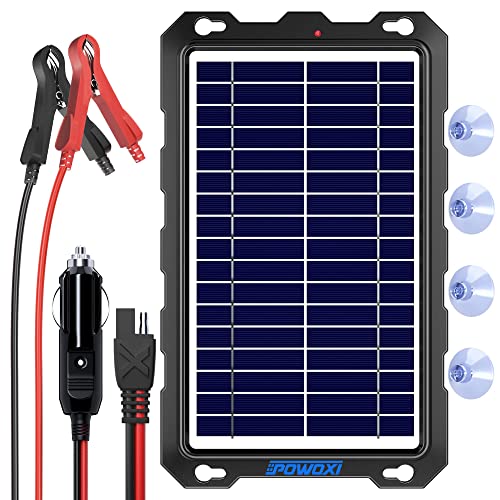
The POWOXI solar charger is a compact, waterproof trickle charger designed to maintain 12V automotive batteries, including those used in solar setups. It features an internal protection system and smart fast charging to maximize conversion efficiency, typically around 25–30% under optimal conditions. The device is built with high-transparency glass and durable materials that withstand wind, snow, and impact, making it suitable for outdoor use on RVs, boats, and off-grid cabins. The integrated blocking diode helps prevent backflow and overvoltage, contributing to safer, longer-lasting battery health.
Key considerations:
– Best used for maintaining charge on ancillary batteries or small solar arrays rather than providing primary energy storage.
– Weather resistance and robustness are advantageous for outdoor installations, but power output remains modest and should be matched to system needs.
– Compatibility with various battery chemistries varies; verify LiFePO4 or lead-acid compatibility for your system.
Jackery Solar Generator 1000 v2

The Jackery Solar Generator 1000 v2 pairs a 1,070Wh LiFePO4 battery with a robust 1,500W AC output and a 3,000W surge capacity, enabling operation of multiple appliances during outdoor adventures or emergencies. Weighing about 23.8 pounds and featuring a foldable handle, it is portable enough for on-the-go use. The unit supports rapid charging via the Jackery App, allowing a 0–100% recharge in roughly one hour with emergency charging activated. It also emphasizes longevity with a stated life exceeding 4,000 charge cycles while maintaining more than 70% of its original capacity over time, ensuring long-term reliability for off-grid living or travel.
Key considerations:
– Excellent portability and quick recharge capability are ideal for emergency kits and RV trips.
– The built-in LFP battery supports extended cycle life, but total energy storage is fixed at 1,070Wh.
– For permanent home backup, consider larger-capacity options or modular solar kits to scale as needed.
ECO-WORTHY 1200W Kit With LiFePO4 System

This complete off-grid system from ECO-WORTHY includes six 195W solar panels, two 12.8V 280Ah Li-ion (LiFePO4) batteries, a 60A MPPT charge controller, and a 3000W pure sine wave inverter. The recommended daily energy output is about 5.52 kWh under four peak sun hours, suitable for RVs, cabins, or sheds. The dual-axis tracker concept increases efficiency by more than 40%, and the LiFePO4 chemistry supports deep cycles and safer operation. The integrated BMS provides essential protection while enabling interconnection with leading inverters through CAN/RS485 for smarter system control.
Key considerations:
– A complete kit offers a simpler path to full system deployment, ideal for beginners seeking an all-in-one solution.
– The dual-axis tracking and high conversion efficiency improve daily energy yield in suitable locations.
– System expansion is possible by paralleling multiple packs, though space and weight must be managed for mobile use.
ECO-WORTHY 48V 600Ah Server Rack Battery Kit

This 48V LiFePO4 battery system is designed for home backup and industrial applications. The robust 100A BMS and 125A circuit breaker provide multi-layer protection, while the full-metal shell offers rugged durability. The system supports up to 32 parallel units, enabling expansion to 163.84 kWh, and includes CAN/RS485 as well as Bluetooth/Wi-Fi for remote monitoring. UL1973 and UL9540A certifications underscore a strong safety profile, making it suitable for residential backup, data centers, or larger off-grid installations that demand reliable power storage and advanced system monitoring.
Key considerations:
– High energy capacity supports larger homes or commercial-scale off-grid setups.
– Server-rack form factor is ideal for dedicated energy rooms or utility spaces but requires appropriate mounting and ventilation.
– Compatibility with inverters and monitoring platforms should be verified for seamless integration.
ECO-WORTHY Home Power Station Backup

This home power station combines a 5000W inverter with four LiFePO4 batteries to deliver a substantial 16.384 kWh storage capacity, and the option to parallel up to 32 batteries for even greater output. Integrated CAN/RS485 allows for smart communication with compatible solar inverters, while Bluetooth and Wi-Fi enable remote monitoring of battery status via a mobile app. The unit is UL-certified for safety, and the robust build aims to support heavy-duty home backup needs, emergency power, and solar system components integration.
Key considerations:
– Very high backup capability suitable for whole-home resilience or large off-grid systems.
– Advanced communication features improve system visibility and control to optimize charging and discharge cycles.
– Ensure proper ventilation and weight considerations when deploying multiple racks or heavy configurations.
Buying Guide: Key Purchase Considerations And Comparisons
When selecting a battery for solar systems, consider these core factors to balance performance, longevity, and cost:
- Chemistry and cycle life: LiFePO4 batteries offer longer lifespans (often 3,000–15,000 cycles) and safer chemistry than traditional lead-acid, making them a popular choice for home, RV, and off-grid storage.
- Voltage and capacity: Ensure your system voltage (12V, 24V, 48V) matches the rest of the solar hardware and that the total usable capacity aligns with your daily energy usage and backup needs.
- Battery management and safety: A robust BMS with protections against overcharge, over-discharge, short circuit, and temperature extremes is essential for safety and longevity.
- Temperature performance: Cold-weather operation matters for winter climates. Look for low-temperature cut-off features or compatible charging strategies to avoid damage.
- Form factor and install practicality: Rack-mountable or compact designs save space and simplify installation in homes, sheds, RVs, or boats. Weight matters for mobile installations.
- Monitoring and connectivity: Bluetooth, Wi-Fi, CAN/RS485, and app-based dashboards help you track health, SOC, and voltage, enabling proactive maintenance.
- Expandability: If future growth is anticipated, choose systems that allow paralleling multiple units or integrating additional panels and inverters.
- Certifications and safety: UL1973/UL9540A and other safety certifications provide assurance for domestic and commercial use, particularly for home backup setups.
Comparing top options:
– For portable and frequent travel, Jackery’s 1000 v2 provides strong power in a compact, travel-friendly package with fast charging and durable battery chemistry.
– For long-term stationary backup with modular expandability, ECO-WORTHY’s 48V 600Ah and 12V 100Ah packs offer scalable configurations, strong safety features, and robust monitoring options.
– For cost-conscious kits that still deliver reliable solar power, ECO-WORTHY’s complete 1200W kit provides an all-in-one approach with built-in MPPT and a balanced mix of panels and batteries.
– For consistent cold-weather performance, the GRNOE 12V 100Ah LiFePO4 battery provides low-temperature protection and extended life, though it requires correct charging practice to maximize capacity.
– For small auxiliary charging and maintaining standby batteries, the POWOXI trickle charger is a valuable companion that helps preserve battery health in remote solar setups.
In summary, the best choice depends on your deployment: portable vs. stationary, user experience with solar kits, and the required scale of energy storage. Prioritize LiFePO4 chemistry for longer life and safety, ensure proper BMS and charging compatibility, and plan for future expansion if your energy needs are likely to grow.