Best Bathroom Vent Humidity Sensor Solutions for Smart, Quiet, Efficient Ventilation
People seeking automatic, humidity-responsive bathroom ventilation will find several capable options. This guide highlights five top products, explaining who they’re best for and why they stand out. It’s ideal for homeowners prioritizing auto-on/off control, quiet operation, and easy installation. The following table summarizes each option to help you compare at a glance.
| Product | Brand | Humidity Sensor Type | Approx. CFM | Best For |
|---|---|---|---|---|
| Leviton DHS05-1LW | Leviton | Built-in humidity sensor with auto on/off | ¼ HP rating (not a direct CFM spec) | Simple, slim installation; ideal for standard bathrooms |
| VIVOHOME Autoflow (160-110-30CFM) | VIVOHOME | Three-mode auto humidity-based control | 160/110/30 | Flexible speed ranges; better for larger bathrooms |
| OREiN 3-in-1 (160 CFM) | OREiN | Humidity sensor with auto-on at 60% | 160 | Easy room-side install; good balance of light and airflow |
| LightFuze (130 CFM) | LightFuze | Humidity sensing with auto control | 130 | Strong lighting options; versatile color temperatures |
| VIVOHOME AutoFlow (160-110-50CFM) | VIVOHOME | Smart auto-ventilation with three speeds | 160/110/50 | Energy-efficient with constant airflow feature |
Leviton Humidity Sensor Switch for Bathroom Exhaust Fan

The Leviton DHS05-1LW automates bathroom ventilation by turning the fan on and off in response to humidity. It’s best for buyers seeking a simple, space-efficient solution that fits in most wallboxes. The unit can be installed with or without a neutral wire, expanding compatibility with older homes. A potential limitation is that it does not publish an obvious CFM rating, so match expectations to your existing fan’s capacity and airflow needs.
VIVOHOME Autoflow Bathroom Exhaust Fan with Humidity Sensor

This VIVOHOME model provides smart ventilation that adapts to humidity levels with three modes: 30 CFM at low humidity, 110 CFM at moderate humidity, and 160 CFM when humidity is high. It runs on a brushless EC motor for energy efficiency and includes a retrofit kit. It’s best for households needing a robust, humidity-responsive unit without attic access. A caution is that installation requires accurate ducting and sizing to maximize efficiency.
OREiN 3-in-1 Bathroom Exhaust Fan with Light & Humidity Sensor

OREiN combines a 160 CFM fan with auto-on at 60% humidity, a bright 1500-lumen light, and a 3CCT color option (3000K/4000K/5000K). It fits standard 6″ ducts and is easy to install from inside the room. It’s best for homeowners who want a single unit handling venting, lighting, and humidity sensing. A limitation is that the LED lighting is not compatible with dimmers or extra timer features.
LightFuze Bathroom Exhaust Fan with Light & Humidity Sensor

LightFuze offers 130 CFM with a 1.0-sone quiet operation and 5 selectable color temperatures (2700K–5000K). Its humidity-triggered auto-control helps maintain a dry bathroom, and the bright, adjustable lighting is useful for daily routines. Choose this if lighting versatility is a priority and you want steady, low-noise performance. A caution is that the product emphasizes lighting options; humidity control works best when used with the included sensor features.
VIVOHOME AutoFlow Bathroom Exhaust Fan (160-110-50CFM)
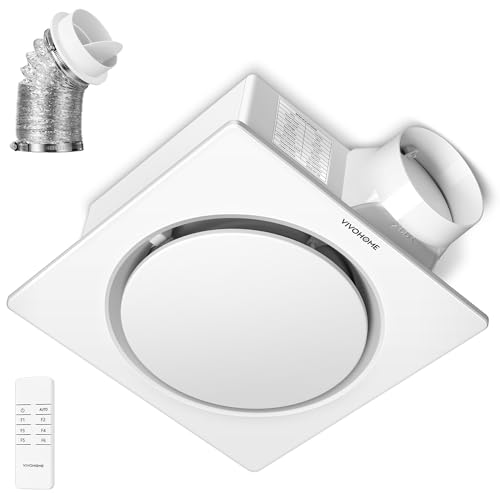
This VIVOHOME unit provides 160/110/50 CFM with smart auto-ventilation and a constant airflow feature to maintain stable performance despite duct resistance. It’s ideal for users who want a scalable airflow range and a remote control option for manual adjustments. A limitation is the need to ensure the included installation kit fits your ceiling opening and duct configuration.
Buying Guide: Key Purchase Considerations
- Humidity sensing accuracy: Look for units with auto-on at a defined RH threshold (common values are 50–60%). This influences how reliably the bathroom clears moisture.
- Airflow capacity (CFM): Choose a model whose CFM aligns with your bathroom size. Larger bathrooms benefit from higher CFM or a unit with auto-adjusting flow.
- Installation practicality: Consider whether you need attic access or if a room-side install is possible. Also check whether the unit supports neutral-wire alternatives.
- Lighting options: If you want combined lighting, confirm color temperature options and light brightness (lumens) to suit your space.
- Energy efficiency: Brushless EC motors typically use less power than traditional AC motors and offer longer life, reducing operating costs.
- Remote vs. wall control: Decide if you prefer a remote, app control, or a wall switch. Some units require a specific remote or app ecosystem and may not work with standard wall controls.
- Noise level: Measured in sones, a lower number means quieter operation. Most bathroom fans operate around 1.0–1.5 sones.
- Installation space: Check ceiling opening dimensions and duct size before purchase to avoid fit issues.
FAQ
- What is a humidity sensor in a bathroom fan? It detects moisture levels and turns the fan on or off to manage humidity and prevent mold.
- Do I need a neutral wire for these sensors? Some models support installation with or without a neutral wire; verify compatibility with your electrical box.
- What size bathroom requires higher CFM? Larger bathrooms or those with poor ventilation benefit from higher CFM (e.g., 160–240 CFM) for faster moisture removal.
- Can I replace a non-humidity fan with a humidity-sensing model? Yes, many models retrofit to standard 6″ ducts, but confirm opening size and mounting compatibility.
- Is installation difficult for a DIYer? Many units are designed for room-side installation with basic tools, but some require electrical work or attic access—plan accordingly.
- Do these sensors affect lighting performance? Some models pair lighting with humidity sensing; ensure lighting output meets your needs if you rely on it daily.