Best Baseboard Heater Wall Thermostats for Precise Electric Heating
Need a reliable baseboard heater thermostat that matches your 240V or line-voltage system and keeps your space comfortable? This guide highlights top options for American homes, from simple mechanical dials to modern programmable and smart models. Each product is chosen for clear temperature control, easy installation, and practical suitability for different �hard-to-control� spaces. Best for: basic replacement, precise control, and remote scheduling.
| Product | Best For | Voltage | Key Benefit |
|---|---|---|---|
| YeloDeer 240 V 4-Wire Manual | Budget or mid-range setups | 240V | High accuracy and wide range |
| Cadet T522-W Mechanical | Simple, dependable control | 120/240V | Double-pole, easy install |
| YeloDeer Dual Voltage 110V-265V | Versatile, family homes | 110-265V | 4-wire manual, broad compatibility |
| Stelpro SWT1F Mechanical | Commercial or multi-heater setups | 240V | Versatile applications, easy dial |
| Mysa Smart Thermostat Lite | Smart-home integration | 120-240V | WiFi, 7-day scheduling, voice control |
YeloDeer 240 V 4-Wire Manual Electric Baseboard Thermostat

Best for: homeowners needing precise control on a 240V system with easy installation. This model is a slim, wall-flush design with a large knob for straightforward adjustment. It offers higher accuracy than basic mechanical thermostats and supports a 40 °F to 80 °F (4.4 °C to 26.7 °C) range for 240V up to 4800 W. Caution: verify compatibility with existing wiring and ensure proper 4-wire hookup before installation.
Cadet T522-W Double Pole Mechanical Wall Thermostat

Best for: reliable replacement in line-voltage setups. This double-pole (4-wire) model includes a positive off position and color-coded wires for straightforward installation. It’s a robust option when nothing fancy is required beyond dependable temperature control. Caution: it is a mechanical device, so it lacks smart scheduling or app control.
YeloDeer Dual Voltage 4-Wire Manual Thermostat

Best for: homes needing 110V or 240V operation with a single device. This unit supports both voltages, offering 120/240V compatibility and a similar control range (40 °F to 80 °F). It’s a good pick when you plan to future-proof or share the same thermostat across different circuits. Limitation: dual voltage devices may require careful wiring to prevent misconnections during upgrades.
Cadet T521-W 5280W T-Stat

Best for: single-pole control in 120/240V applications where a straightforward temperature dial is enough. Rated for up to 22 amps, this model is suitable for electric baseboard heaters and other line-voltage loads. Caution: single-pole design means it only interrupts the hot line, not both lines.
Stelpro SWT1F Mechanical 240V Thermostat

Best for: versatile installations across residential and commercial electric baseboards. The SWT1F offers straightforward temperature adjustments with a simple two-wire connection and is compatible with a wide range of heating products. Caution: being mechanical, it lacks digital features and smart programming.
Mysa Smart Thermostat Lite
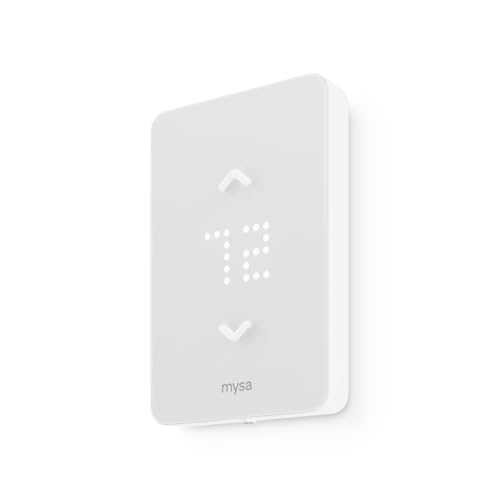
Best for: homes seeking wireless control and energy savings. The Mysa Lite connects over WiFi, supports 7-day scheduling, and integrates with HomeKit, Alexa, and Google Assistant. It’s compatible with 120-240V systems. Caution: requires a stable WiFi connection and compatible smartphone for full feature access.
Buying Guide: Key Purchase Considerations
- Voltage compatibility: Confirm whether your baseboards operate at 120V, 240V, or both. Choose a model rated for your circuit to ensure safe operation and proper wattage handling.
- Control type: Mechanical thermostats offer reliability with simple dials; electronic thermostats provide higher accuracy. Smart thermostats enable scheduling and remote control but require WiFi.
- Wiring configuration: Some units are 2-wire (line-voltage only) while others are 4-wire (with neutral and/or separate control lines). Ensure your wiring matches the thermostat’s requirements.
- Installation considerations: Check whether the unit is designed for flush-wall mounting and whether it includes easy-to-follow wiring diagrams or color-coded wires for quick setup.
- Accuracy and range: Higher precision helps maintain comfortable temperatures with less fluctuation. Look for a thermostat with a wide operating range and accurate temperature sensing.
- Smart features: If you want energy savings and remote control, prioritize models with app support, voice assistant integration, and scheduling capabilities.
FAQ
- Q: Do I need a smart thermostat for baseboard heaters? A: It depends on your goals. Smart thermostats offer scheduling and remote control, but mechanical or electronic non-smart models can be cheaper and reliable for simple temperature control.
- Q: Can I mix different brands on the same electrical circuit? A: It’s not recommended. Use thermostats that match your heater’s voltage and wattage rating to avoid compatibility issues.
- Q: What is the advantage of a double pole thermostat? A: A double pole switches both live wires, providing more complete disconnection for safety and sometimes improved system performance.
- Q: How should I choose between 120V and 240V models? A: If your baseboard heater is wired for 240V, choose a 240V or dual-voltage thermostat. For 120V heaters, select a 120V model or a properly rated dual-voltage unit.
- Q: Are there installation precautions for baseboard thermostats? A: Yes. Turn off the circuit, follow wiring diagrams, and verify that the device is rated for your heater’s wattage and voltage. If unsure, consult a licensed electrician.
- Q: Do these thermostats require a hub or subscription? A: Most listed models do not require a hub. Some smart models may need a smartphone app and WiFi, but no ongoing subscription is required for basic scheduling.