Best Automatic Transfer Switches for Solar Power Systems
Choosing an automatic transfer switch (ATS) for solar setups helps protect batteries, ensure continuous loads, and optimize energy use. The following five models are well-suited for off-grid, hybrid, or grid-tied solar systems, offering quick transfer, battery protection, and versatile input options. Each product below includes key features and how it complements solar configurations.
| Product | Voltage Range | Key Benefit | Input Type |
|---|---|---|---|
| MOES Dual Power Controller 50A | DC 12-48V / AC 110-240V | Battery protection with automatic grid backup | DC/AC dual sources |
| MOES Smart Automatic Transfer Switch 80A | DC 12-48V / AC 110-240V | App remote control and seamless switching | DC/AC dual sources |
| Briidea 50A 5500W ATS | AC 110/220V | Unattended battery protection and fast transfer | AC mains/solar inputs |
| JONASC 63A 2P ATS | AC 110V | Dual-mode operation with protection features | AC sources |
| Go Power! TS-30 | Up to 30A | Delay switch for generator compatibility | Dual sources |
MOES Dual Power Controller 50A: Auto Transfer for Off-Grid Solar
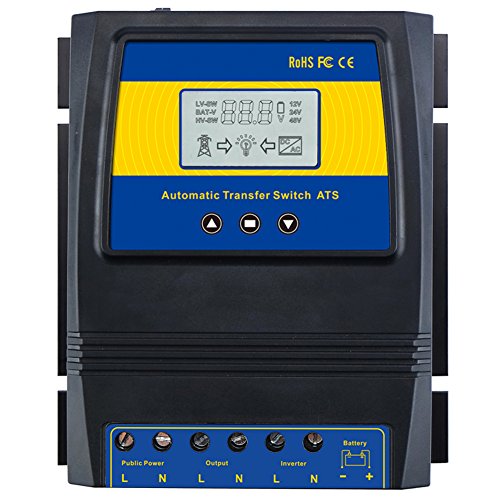
The MOES Dual Power Controller supports both DC and AC inputs, designed for off-grid solar and wind systems. It automatically shifts between battery and grid power to protect batteries when voltage falls below the cut-off and switches back when recovery voltage is reached. It distinguishes 12/24/48V DC and 100–120V/220–240V AC with auto-detection, making it adaptable to various battery chemistries, including sealed, gel, lead-acid, and lithium. This model emphasizes battery protection and uninterrupted loads during switching, suitable for hybrid solar installations.
MOES Smart Automatic Transfer Switch, 80A: Remote Control and Fast Switching

This MOES unit provides automatic switching between DC (inverter) input sources and AC public power, enabling efficient solar and wind energy use while protecting batteries. It offers manual overrides and app Bluetooth control via a MOES hub for remote operation beyond Bluetooth range. On cloudy days, it automatically shifts to grid power to protect the battery and returns to inverter power when the battery voltage recovers. The transfer is designed to be rapid, minimizing disruption to loads and maintaining network continuity.
IGEYAPA 100A AC110V ATS: High-Capacity Auto/Manual Transfer

IGEYAPA’s 100A ATS supports two power sources with automatic and manual modes, designed for fast changeover and continuous power. It supports multiple input configurations (mains, generator, photovoltaic) with four wiring options. The automatic mode prioritizes a reliable transfer, while the manual mode provides emergency switching. It’s built to maintain supply to critical loads during outages and is suitable for mid-size home solar setups that require higher current handling and resilience against voltage disturbances.
IGEYAPA 100Amp 4P ATS: Four-Pole Solar Auto Transfer

The 100A 4P IGEYAPA ATS provides comprehensive switching for two power sources with four-pole access, ensuring seamless transitions between solar/wind inverters and grid or generator power. It features automatic and manual modes, quick response times, and clear indicator logic. Protection against short circuits, overloads, and undervoltage helps safeguard connected equipment while maintaining continuous operation for critical loads in off-grid or hybrid solar configurations.
JONASC 63A 2P ATS: Flexible Auto/Manual Changeover

JONASC’s 63A 2P ATS provides reliable automatic and manual transfer between two AC sources. It supports input voltages typical of residential solar setups and offers a rapid transfer time (around 2 seconds) to maintain power to connected loads. With built-in protection against short circuits, overloads, and phase issues, it is suited for protecting appliances and ensuring stable operation during source transitions in small to medium solar configurations.
Go Power! TS-30: Generator Delay and Dual Source Flexibility

The Go Power TS-30 supports two 30-amp sources and includes a generator delay, enabling safe startup sequencing for generator-backed solar systems. Its installation is streamlined with practical knockouts, and the design emphasizes straightforward integration into home or RV power systems. It’s a compact option for users needing reliable two-source switching with a simple installation path and dependable generator coordination.
Buying Guide: Key Considerations for Selecting an ATS for Solar
- Current rating and pole count: Match the ATS current (amperage) to your solar array, inverter, and load requirements. Higher amperage and appropriate pole count (2P vs 4P) enable more flexible configurations for multiple sources.
- Input compatibility: Ensure the unit supports your source types (PV, inverter, utility/grid, generator) and voltage ranges (DC and AC as applicable). Auto-detection helps reduce misconfiguration.
- Transfer time: Faster transfers minimize downtime for sensitive loads. Typical ranges span from sub-10 ms to a few seconds depending on model and mode.
- Protection features: Look for short-circuit, overload, undervoltage, and phase-loss protections. Battery protection features are crucial for extending life in solar setups.
- Control options: App or remote control capability is valuable for monitoring and control beyond local access. Manual override is useful during maintenance or unusual conditions.
- Installation and wiring: Check wiring configurations (two-source, four-wire, DIN rail mounting) and installation ease. Clear indicators and intuitive wiring diagrams reduce setup time.
- Reliability and protection of loads: For critical loads, prioritize ATS with robust protection and fast, seamless switching to avoid power interruptions.
- Budget vs. performance: Higher-end models often offer more features (remote control, faster transfer, broader input ranges) but weigh against budget and system complexity.