Best Automatic Halogen Leak Detector for Quick and Accurate Halogen Gas Detection
When selecting an automatic halogen leak detector, prioritize speed, sensitivity, and ease of use. This guide highlights five top options suited for HVAC professionals, automotive technicians, and facility engineers who need fast, reliable leak detection. Each choice is explained with who it’s best for, why it was selected, and any practical limitations. The buyer can compare models side-by-side and choose based on sensor type, portability, and detection capabilities.
| Product | Best For | Key Benefit |
|---|---|---|
| Elitech ILD-200 | HVAC techs and automotive pros | Infrared + heated diode sensors; broad halogen detection |
| Elitech CLD-100 | Mobile inspections | Fast response; flexible probe for hard-to-reach areas |
| INSTRUKART XP-1A | Industrial and critical systems | Digital processing; clear visual indicators |
| Elitech ILD-100H | New users and field work | Heated diode with TFT screen; straightforward readings |
| SENSYX SFD200 | Cordless operation on the go | Rechargeable battery; compact and portable |
Elitech ILD-200 Infrared Leak Detector
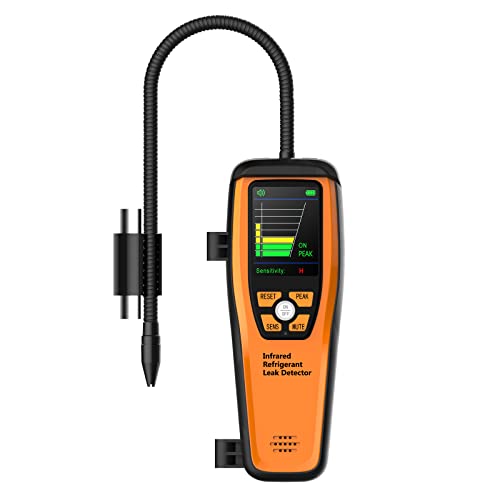
Best for a broad range of halogen refrigerants, the ILD-200 uses infrared sensing with high anti-interference and fast response. It detects all halogenated gases, including CFCs, HFCs, HCFCs, HFOs, and blends like R410A and R134A. The sensitivity can be adjusted to match the detection task, with a maximum sensitivity around 0.14 oz/yr. This model is well-suited for HVAC installers and automotive techs who need quick, dependable readings across diverse refrigerant types.
Who it’s best for: technicians who work on both residential HVAC and automotive systems and require a single detector to cover multiple refrigerants. Why selected: infrared reliability and broad gas range reduce the need for multiple devices. Limitation: higher sensitivity settings may require more careful calibration in noisy environments.
Elitech CLD-100 Freon Leak Detector

The CLD-100 is a compact halogen leak detector designed for quick deployment with a flexible probe for hard-to-reach spots. It builds on a traditional corona sensor with updated analog circuitry, delivering fast triggers for R11, R22, R134A, R404a, and R410A, along with all halogenated refrigerants. It offers six adjustable sensitivity levels and a 6-second preheating time. This model is ideal for mobile technicians who need a balance of speed, portability, and reach.
Who it’s best for: service vans and technicians who inspect vehicles and small systems frequently. Why selected: portability and a flexible probe improve detection in tight spaces. Limitation: detection sensitivity maxes around 0.21 oz/yr, which may be lower than some infrared-based models.
INSTRUKART XP-1A Halogen Leak Detector

The XP-1A provides a robust, industrial-grade detection solution with advanced digital signal processing. It features visual leak size indicators, rapid response with a high-frequency alarm, and a relatively broad sensitivity range. The device targets halogen refrigerants used in HVAC systems, with a focus on reliable performance in demanding environments. This model is a solid pick for industrial maintenance teams seeking precise leak localization.
Who it’s best for: industrial facilities and service technicians who require digital indicators and repeatable performance. Why selected: comprehensive signal processing and clear visual cues aid accurate pinpointing. Limitation: operating temperature and rugged use may require careful handling in harsh job sites.
Elitech ILD-100H Heated Diode Sensor

The ILD-100H uses a heated diode sensor for accurate detection across halogen refrigerants. It includes a TFT screen for straightforward readings on sensitivities, leakage alerts, battery levels, and other important information. Sensitivity is adjustable from High to Low, with a maximum of about 0.1 oz/yr. This model is well-suited for users who prefer a clear display and quick interpretation of readings in the field.
Who it’s best for: technicians who value a clear TFT display and simple operation. Why selected: user-friendly interface reduces interpretation time. Limitation: slightly lower maximum sensitivity compared to infrared options, which may matter for very small leaks.
SENSYX SFD200 Rechargeable HVAC Detector

The SFD200 offers cordless operation with a rechargeable lithium battery and a USB-C charger for extended mobility. It uses a highly sensitive sensor to detect halogen leaks and provides adjustable sensitivity. This model is advantageous for on-the-go inspections where power outlets are limited and mobility is essential.
Who it’s best for: field technicians who travel between sites and need cordless convenience. Why selected: portability and battery-powered operation. Limitation: battery life guidance is not specified and may influence long shift usability.
2 in 1 POROMETISTO HLD01 Halogen Detector

The POROMETISTO HLD01 integrates two sensitivity controls and two calibration modes, with a clear LCD display and a triple-alert system. It supports USB-C charging and features an extended hose for easier testing. It uses a three-color display (red, yellow, green) to indicate leak severity and includes automatic and manual calibration options for different environments. This model is suited for technicians who need flexible calibration and a longer hose for challenging leaks.
Who it’s best for: users needing adjustable calibration and extended testing range. Why selected: versatile detection and user-friendly LCD readings. Limitation: it may be more feature-rich than necessary for simple checks, which could complicate basic use.
Buying Guide
What type of sensor should you choose?
Infrared sensors offer fast response and broad refrigerant detection, including many blends. Heated diode sensors are reliable and often easier to interpret on TFT or LCD displays. Some models combine both for versatility. Consider your typical refrigerants (R22, R410A, R134A, R600a, etc.) and whether you need dual-sensor capability.
How important is portability?
Field service often requires lightweight, cordless devices with adjustable probes or flexible probes to access tight areas. If you work in mobile service or tight compartments, a compact detector with a flexible probe or a rechargeable battery is ideal.
What about sensitivity and response?
Higher sensitivity helps detect smaller leaks but may increase false alarms in busy environments with background gases. Look for adjustable sensitivity levels and a clear visual or audible alert system to balance sensitivity with practicality.
Ease of use and display
A clear display (TFT or LCD) and intuitive controls reduce interpretation time in the field. If you prefer quick readings, prioritize models with visually distinct indicators or color-coded alerts. Reliability and ease of calibration are also critical for daily use.
Maintenance and durability
Sensor life, replacement parts, and build quality influence long-term costs. Some detectors advertise long sensor life (up to 10 years in some models) and rugged construction suitable for harsh environments. Consider models with simple calibration routines and robust housings.
Frequently Asked Questions
- What is a halogen leak detector used for? It detects leaks of halogen refrigerants used in HVAC, automotive, and industrial systems to prevent product loss and environmental release.
- Which sensor type is best for beginners? A detector with a heated diode or infrared sensor and a clear display is typically easier to learn on and provides reliable results across common refrigerants.
- Do I need dual-sensor capability? Dual-sensor models (infrared and heated diode) offer broader detection and redundancy, useful for professionals who work on diverse equipment.
- How important is portability? For field technicians, cordless operation and compact form factors significantly improve efficiency and accessibility to hard-to-reach leaks.
- What maintenance is required? Regular calibration, sensor longevity checks, and battery maintenance help ensure consistent performance over time.
- Can these detectors detect all refrigerants? Most models cover common halogen refrigerants and blends; always verify supported gases against your typical refrigerants before purchase.