Best Automatic Grid Disconnect Switches for Reliable Power Transfer
Answering the need for safe, automatic power switching, the right grid disconnect switch helps you manage multiple power sources with minimal downtime. This guide highlights five top automatic transfer switches and related disconnect solutions, ideal for home backup, off-grid systems, generators, and vehicle installations. Best for home backup and small-scale off-grid setups are models that prioritize seamless transitions and simple installation. Read on to compare features, suitability, and practical limitations.
Product Comparison Table
| Product | Best For | Key Benefit | Limitations |
|---|---|---|---|
| Go Power TS-30 30 Amp Automatic Transfer Switch | Small homes and portable generators | Dual-source compatibility and generator delay for smooth transitions | Limited to 30A per source |
| MOES Dual Power Controller 50A | Off-grid solar/wind systems | Auto-distinguishing voltages for various battery chemistries | Configuration can be complex for beginners |
| Automatic Transfer Switch 125-Amp (phabcf) | Residential/commercial heavy-use | Automatic and manual modes with clear monitoring | Higher amperage may require professional installation |
| Antrader Enclosed Motor Disconnect | Outdoor installations; generators and equipment | IP66 rating and UV/weather-proof design | Designed as motor disconnect; use context matters |
| 250A Smart Remote Battery Disconnect (Ponzkoe) | Vehicles, RVs, boats, long-term parking | Remote kill switch with LED status indicators | Not for industrial equipment; voltage constraints |
Go Power TS-30 30 Amp Automatic Transfer Switch

The Go Power TS-30 is designed for dual-source operation, handling up to two 30-amp sources. It includes a generator delay switch to ensure safe, smooth transitions when switching to or from a generator. This model is best for users who need straightforward installation and reliable automatic switching in small to medium setups, such as backup power for a home or a compact RV system.
Best for: Small homes, cabin or RV setups that rely on a generator as a backup and require simple wiring. The inclusion of a delay feature minimizes backfeed risks when generators start or stop, which can protect sensitive electronics.
Why selected: It balances ease of installation with dependable automatic transfer between two sources, making it a practical starter option for grid-tied or off-grid backup configurations.
Limitation: It’s limited to 30A per source; larger homes or higher load locations will need higher amperage equipment or parallel solutions. Ensure the generator and mains wiring are sized for your anticipated load.
MOES Dual Power Controller 50A Automatic Transfer Switch
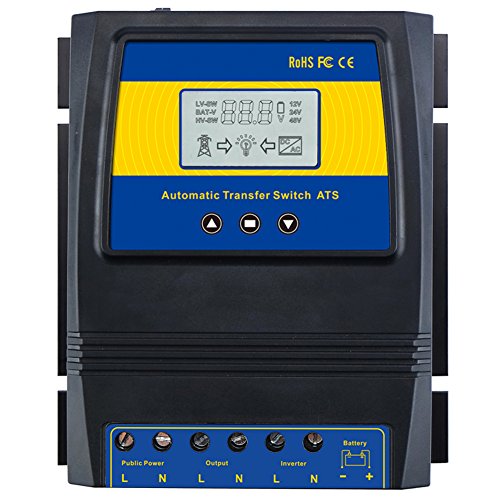
The MOES controller is tailored for off-grid solar and wind systems, capable of auto-switching between battery and grid supply. It supports DC 12V/24V/48V and AC 110-120V or 220-240V with automatic detection and customizable cutoff/recovery voltages. This flexibility helps protect battery life and ensures reliable operation in fluctuating weather conditions.
Best for: Off-grid solar or wind installations where battery protection and automatic source switching are priorities, especially with mixed battery chemistries.
Why selected: Its auto-detect capability and voltage range support make it suitable for multi-source renewable systems, reducing manual intervention and battery stress during transitions.
Limitation: Setup can be more complex due to multiple voltage ranges and configurable cut-off/recovery points; careful tuning is needed for optimal performance.
Automatic Transfer Switch 125-Amp (phabcf)
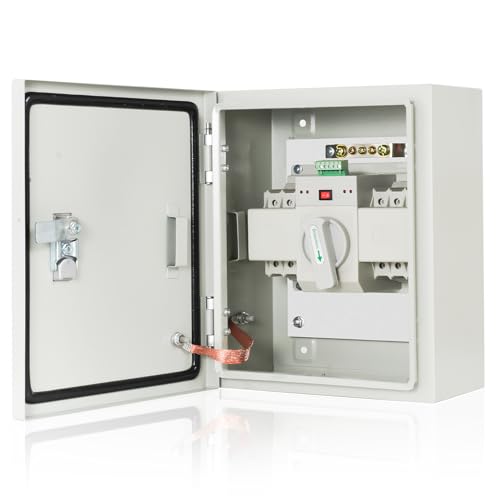
This 125A automatic transfer switch targets residential, commercial, and industrial use where higher power demand is present. It offers both automatic and manual operation modes with integrated status indicators, enabling quick status checks and one-touch resets. The enclosure is designed for durable installation in multiple locations, with a complete kit included for secure mounting.
Best for: Homes or small businesses needing robust, automatic switching with clear monitoring and a manual override option for maintenance or testing.
Why selected: The blend of automatic switching and visible status indicators helps operators quickly verify power status during outages or routine checks.
Limitation: Higher amperage systems may require professional electrical work and compliance with local codes, especially in commercial environments.
Antrader Enclosed Motor Disconnect Switch

The Antrader enclosed motor disconnect is designed for outdoor or indoor use with IP66-rated weather protection. It’s built from ABS and UV-resistant materials, enabling reliable operation in harsh environments. The switch provides quick, safe disconnection for generators, boats, and welding setups, supporting safe maintenance and safety protocols.
Best for: Outdoor installations where weather exposure and quick shutdowns are necessary, such as generator setups or remote equipment power controls.
Why selected: Weatherproof construction and UV resistance help ensure long service life in challenging environments.
Limitation: As a motor disconnect, it is not a full automatic transfer switch; use purely for disconnect tasks or as part of a broader power management system.
Nilight 100A Battery Disconnect Switch

The Nilight 100A disconnect switch provides a rugged, two-position On/Off operation to safely isolate a battery in marine, automotive, or RV applications. Its construction emphasizes durability, with a focus on safe disconnection and long-term reliability for power-down scenarios when vehicles or vessels aren’t in use.
Best for: Marine, RV, or automotive scenarios where a dependable physical isolation of the battery is desirable to prevent parasitic drain or theft risk.
Why selected: A straightforward mechanism and sturdy housing make it a practical choice for simple grid-disconnect needs in mobile or remote setups.
Limitation: Not an automatic transfer switch; it does not switch sources automatically and relies on manual operation or an external control system.
Buying Guide: How To Choose The Right Automatic Grid Disconnect Switch
- Source compatibility: Determine whether you need two sources, a generator, or a grid-tied main power with a backup system. Choose a switch that supports the required amperage per source (30A, 50A, 125A, etc.).
- Voltage and battery considerations: For off-grid systems, confirm the controller supports your battery voltage (12V, 24V, 48V) and the AC voltage you use (110-120V or 220-240V).
- Installation complexity: Some units offer simple plug-and-play setups, while others require durable enclosures or professional wiring. Consider skill level and local electrical codes.
- Mode of operation: Automatic vs. manual modes affect how outages are managed. In busy environments, automatic transfer with status indicators minimizes downtime.
- Durability and environment: Outdoor or harsh environments require IP-rated or UV-resistant housing. Indoor installations prioritize compact form factors.
- Monitoring and indicators: Visual status indicators help verify system health and transitions quickly during outages.
- Safety features: Delays for generators prevent backfeed during startup and shutdown, protecting equipment and operators.
FAQ
- What is an automatic transfer switch (ATS)?
An ATS automatically switches power from a primary source to a secondary source when it detects a problem with the primary source, ensuring uninterrupted power to connected loads.
- Do I need a professional to install an ATS?
Many installations require electrical knowledge and adherence to local codes. If unsure, consult a licensed electrician.
- Can an ATS work with solar panels?
Yes, certain ATS models are designed to switch between solar-generated power and the grid or a battery bank, useful for off-grid systems.
- What amperage should I choose for a home backup setup?
Consider your total expected load and peak demand. Choose an ATS with an amperage rating at or above your needs, or use multiple devices if necessary.
- Is a generator delay feature important?
Yes, a generator delay helps prevent backfeed and reduces wear on generators by allowing safe synchronization with the rest of the system.
- Are battery disconnect switches the same as ATS?
No. Battery disconnect switches isolate the battery and protect against parasitic drain, while an ATS switches between different power sources.