Best Automatic Door Opener Sensor Guide for Safer, Hands‑Free Access
Answering the search for “automatic door opener sensor” with clear, buyer-focused guidance. This guide highlights five reliable options suitable for offices, entrances, and accessibility needs. Each option is best for specific environments—from commercial entryways to pet doors—so you can pick the model that matches your doorway, control method, and safety requirements. The table below compares key details to help you decide quickly.
| Product | Best For | Connectivity | |
|---|---|---|---|
| Olideauto Touchless Commercial Door Opener | High‑traffic entrances needing touchless operation | 2pcs stainless steel touchless hand sensors | Wired control, handheld programmer |
| MENGQI-CONTROL PIR Motion Sensor Exit | Access control systems with relay triggers | Door exit sensing, 24G microwave tech | Integrated with master device power unit |
| Olideauto Swing Door Operator | Disabled access and safety‑mocused entries | Wireless/wired handicap push button options | WiFi app control, voice assistant ready |
| Olideauto Smart WiFi APP Control (Olide-510FW) | Smart home integration and remote control | App control with Alexa/Google Assistant | WiFi, smartphone app |
| TOPENS TC102 Infrared Beam Sensor | Gate or door systems needing reliable safety sensing | Infrared photocell with emitter/receiver | Works with TOPENS openers and third‑party boards |
Olideauto Touchless Commercial Door Opener

- Best for high‑traffic commercial entrances requiring touchless operation.
- Features a touchless hand sensor for safer, more convenient access.
- Manual closing force is adjustable with a handheld programmer.
- Safely reopens if an object is detected in the closing path.
This model is ideal where hygiene and ease of access are priorities, such as offices, clinics, or retail entries. A potential limitation is the need for a compatible power or control setup as part of a larger system.
MENGQI-CONTROL Request to Exit PIR Sensor

- Best for integration with master control devices and relay triggers.
- Supports NO and COM, with a 4 mW range style detection and 24G microwave tech.
- Designed to be paired with a power unit or control device for automatic opening.
- Limitation: Not designed for NC (Normal Close) configuration on its own.
This sensor excels when paired with a complete access control system, making it suitable for hallways and doorways in secured facilities. It may require additional components for full operation.
Olideauto Swing Door Operator

- Best for accessibility with disabled users and wellness standards.
- Includes wireless and wired handicap push button options and a DC12V 880lbs electric strike.
- Remote control via phone app and voice assistants enhances convenience.
- Caution: Manual opening is restricted when knob lock is engaged, requiring unlocking for manual use.
Choose this if you need a robust, accessibility‑focused door operator with flexible control methods. Ensure compatible door weights and mounting clearances are met for optimum performance.
Olideauto Smart WiFi APP Control Automatic Door Opener (Olide-510FW)
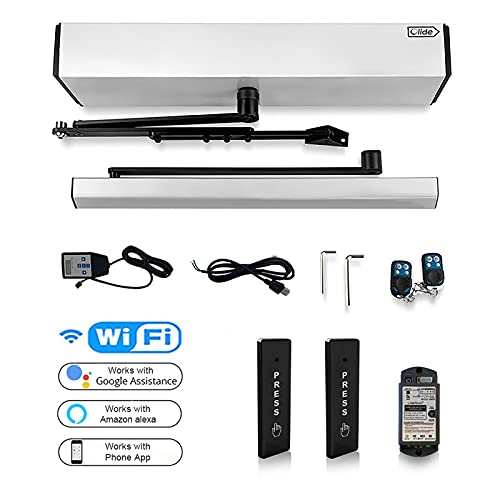
- Best for smart home integration and remote access control.
- Smart WiFi door opener compatible with Alexa and Google Assistant for voice control.
- All major parameters, such as manually push force and hold open time, are tunable via handheld programmer.
- Limitation: Requires WiFi connection and account setup for full functionality.
Use this model when you want app control, automation routines, and voice control. If you have inconsistent WiFi in your area, remote features may be slower or intermittent.
TOPENS TC102 Infrared Beam Sensor

- Best for safety in gate or door opener systems that require a reliable beam sensor.
- Dual component design with emitter and receiver to detect interruptions in the infrared beam.
- Weather resistant for year‑round use; compatible with most gate openers and third‑party boards.
- Limitation: Primarily a sensor unit; requires a compatible opener or control board to function.
Opt for this sensor when you need dependable non‑contact detection to stop or reverse opening in response to obstacles. Ensure your opener board supports the “Normal Open” or “Normal Close” signals for proper integration.
Buying Guide: Key Considerations For Automatic Door Opener Sensors
- Door type and weight: Match the opener with your door’s weight, swing direction, and mounting space. Heavier doors require more robust operators and sometimes dual‑swing setups.
- Sensor type and environment: Choose touchless sensors for hygiene, PIR for interior use, or infrared beam sensors for added safety with gates or wide openings.
- Control method: Determine if you prefer handheld programmers, wall switches, wireless push buttons, or smart home integrations.
- Safety features: Look for automatic re‑opening on obstacle detection and fail‑safe modes in power outages or sensor faults.
- Connectivity and compatibility: Assess whether WiFi, Bluetooth, or wired connections fit your space and whether third‑party devices (Alexa/Google Assistant) are needed.
- Security considerations: Ensure access control aligns with facility security policies, especially in commercial or clinic settings.
- Installation requirements: Check for required mounting height, clearance, electrical wiring, and whether professional installation is recommended.
- Maintenance and support: Consider the availability of spare parts, remote diagnostics, and customer support when selecting a system.
FAQ
- What is the primary difference between touchless and sensor‑triggered door openers?
– Touchless systems use hand sensors to detect proximity, while sensor‑triggered openers rely on motion or beam sensors to determine when to open or stop the door. - Can these systems be used with existing doors?
– Many models are designed to retrofit doors with compatible frames, but installation depends on door weight, swing type, and available mounting space. - Do these systems require an internet connection?
– Some models offer smart app control via WiFi, while others operate via wired or handheld control without internet. - What safety features should I prioritize?
– Look for automatic re‑opening on obstacle detection, slow hold times, and programmable safety zones to prevent pinching or trapping. - Are these systems suitable for accessibility compliance?
– Yes, when configured with appropriate push buttons, sensor ranges, and hold times to ensure easy and safe entry for all users. - Is professional installation recommended?
– For most commercial or multi‑unit installations, professional wiring, alignment, and programming reduce safety and performance risks.