Best Automatic Cable Harness Testers for Quick Diagnostics
For professionals who install, maintain, or troubleshoot network and coax cabling, an automatic cable harness tester speeds up fault finding and verification. This guide highlights five reliable testers that cover data, voice, and coax applications, with clear visual feedback and long-range capabilities. Each section notes how the device handles continuity, miswires, opens, shorts, and more, helping you choose a tool that fits your workflow.
| Product | Brand | Key Strength |
|---|---|---|
| Klein Tools VDV526-100 | KLEIN TOOLS | Single-button testing for RJ11/RJ12/RJ45; fast LED results; CAT3, CAT5e, CAT6/6A support |
| Klein Tools VDV526-200 | KLEIN TOOLS | RJ45 data cables; large backlit LCD; comprehensive fault detection |
| Klein Tools VDV501-851 | KLEIN TOOLS | Voice, data, coax testing; up to 2000 ft length measurement |
| iMBAPrice RJ45 Network Tester | iMBAPrice | Automatic tests; RJ11/RJ45; quick fault detection |
| TESMEN TLP-900AR | TESMEN | POE and shielded cabling support; multi-function tracing and NCV |
Klein Tools VDV526-100 Network Tester

The VDV526-100 is designed for efficient testing of voice and data cables with a single-button operation. It supports CAT3, CAT5e, and CAT6/6A cables, making it versatile across older and newer installations. Its LED indicators deliver fast status cues: Pass, Miswire, Open-Fault, Short-Fault, and Shield, enabling quick fault location without extensive manual interpretation. This model is ideal for on-site verification after crimping or when deploying new networks, providing a compact yet capable solution for everyday use.
Klein Tools VDV526-200 Cable Tester

The VDV526-200 extends data cable testing to RJ45 configurations with an emphasis on data integrity. Its large backlit LCD makes pin-to-pin wiremap results easily readable in dim environments, which is helpful on job sites with limited lighting. The tester covers a broad fault spectrum, including Open, Short, Miswire, Split-Pair faults, Cross-over, and Shield. This model suits technicians who need thorough analysis, especially when installing or diagnosing mixed legacy and modern network runs.
Klein Tools VDV501-851 Cable Tester Kit
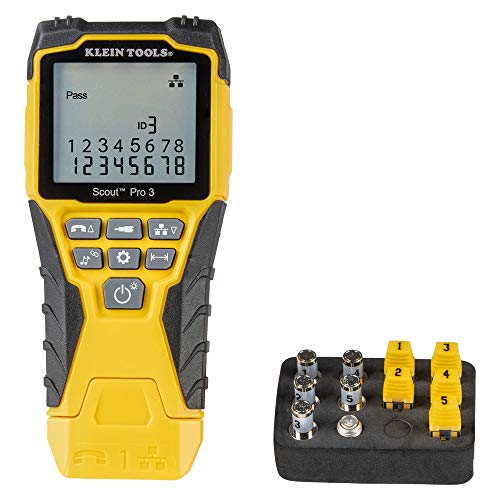
This kit tests voice, data, and video cables, including coax, offering a broad testing capability in one package. It also provides extended cable length measurement up to 2000 feet (610 meters), helping installers verify long cable runs and locate potential defects across lengthy installations. The VDV501-851 is well-suited for projects that involve mixed media, such as office networks that combine Ethernet and coax-based video feeds.
iMBAPrice RJ45 Network Tester
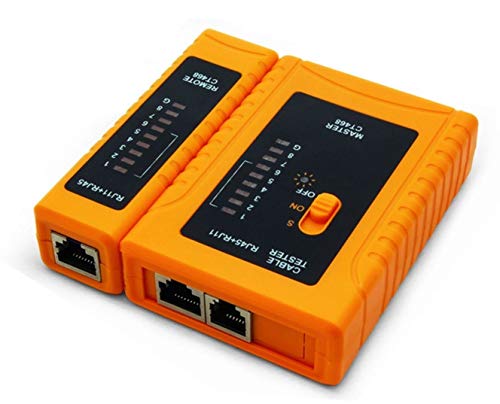
The iMBAPrice tester offers automatic testing with LED status indicators for RJ11 and RJ45 cables. It focuses on continuity, open, short, and crossed wire pairs, making it a practical choice for quick on-site checks. The tool is designed to be simple to use, enabling rapid verification after wire terminations or during routine maintenance. The device supports two-wire line testing and includes features like line DC detection for quick triage of cable states.
TESMEN TLP-900AR Network Cable Tester

The TESMEN TLP-900AR targets professional environments with anti-interference capabilities and multi-functional tracing tools. It supports CAT5/CAT6/POE/shielded cables and includes a non-metallic probe for safer operation around energized lines. Its LED indicators show line sequence status to identify incorrect connections, opens, shorts, or miswirings. The included NCV feature helps detect live circuits, enhancing safety during testing in complex installations such as data centers or security systems.
Buying Guide: Key Considerations When Choosing an Automatic Cable Harness Tester
Choosing the right automatic cable harness tester depends on the types of cables you encounter, the scale of installations, and the working environment. Here are essential considerations and practical comparisons to help you decide:
- Cable types supported: Look for testers that cover RJ11/RJ12/RJ45 for voice and data, and coax support when your work includes video or CCTV installations. Some models also test CAT3, CAT5e, CAT6/6A, and POE-capable cables.
- Fault detection repertoire: The most useful testers can identify Open, Short, Miswire, Split-Pair faults, Cross-over, and Shield faults. A broader fault set reduces the need for multiple tools.
- Readability and interface: Backlit LCDs or large LED indicators improve visibility in dim workspaces. Clear pin-to-pin wiremaps help you locate miswires quickly.
- Cable length measurement: For long cable runs, devices that measure up to 2000 feet (610 meters) provide valuable verification of continuity and installation compliance.
- Safety features: NCV (non-contact voltage detection) and remote testing options reduce risk when working near energized lines. POE detection is a plus for modern Ethernet deployments.
- Ease of use: A single-button test or streamlined workflows minimize training time and speed up fieldwork. Consider whether the device supports remote testing or requires direct terminal access.
- Durability and form factor: Field-ready devices should withstand harsh environments and provide reliable readings in various lighting conditions. A backlit display is particularly helpful on job sites.
- Accessory ecosystem: Some kits include multiple remotes or additional adapters, which can expand testing capabilities across different cable types and installation scenarios.
- Brand support and updates: Reputable brands with active support channels and firmware updates tend to offer better long-term value and compatibility with newer cable standards.
Across the options above, testers from well-known brands provide consistent performance for routine electrical and networking tasks, including wiring verification, fault isolation, and length measurement. For mixed-media installations, choosing a model with coax support and POE detection can streamline diagnostics. When evaluating a device, consider your typical job size, whether you need remote testing, and how quickly you must identify faults to keep projects on schedule.