Best Automatic Backup Generators for Reliable Home Power
The top picks are automatic backup generators designed to restore power during outages with minimal manual effort. This guide highlights models suited for different homes and needs, from whole-house standby units to portable, ready-to-deploy options. Ideal buyers include homeowners seeking continuous power during storms, renters needing portable back-up, and those prioritizing remote monitoring or easy remote start.
Summary of chosen products:
| Product | Type | Best For | Key Benefit |
|---|---|---|---|
| Generac Guardian 10kW Home Standby | Standby | Medium-to-large homes needing whole-house protection | Wi‑Fi monitoring with 100 Amp transfer switch |
| Generac Guardian 22kW Home Standby | Standby | Larger homes with higher power demand | 200 Amp smart switch and outdoor enclosure |
| Westinghouse 12500 Watt Dual Fuel Portable | Portable | Smaller homes or job sites needing transfer-switch readiness | Gasoline/Propane dual-fuel flexibility |
| Westinghouse 14500 Peak Watt Tri-Fuel Portable | Portable | Homes needing higher surge and multi-fuel options | Gas/Propane/Natural Gas compatibility |
| Champion 11,000-Watt Wireless Remote Start | Portable | Backups with easy remote control | Wireless start and CO shutoff |
Generac Guardian 10kW Standby Generator

Features include Wi-Fi enabled monitoring with Generac 7172 Mobile Link for remote performance checks, and a 100 Amp, 16-circuit transfer switch for whole-house protection. The unit is designed for outdoor use with a durable aluminum enclosure and offers a 5-Year Limited Warranty as long-term assurance.
Best for: Homeowners who want dependable, automatic whole-house power during outages and value remote status updates. The product is chosen for balanced capacity and smart monitoring that supports proactive maintenance. Caution: Remote monitoring requires an internet connection and may incur subscription costs for advanced features.
Generac Guardian 22kW Standby Generator
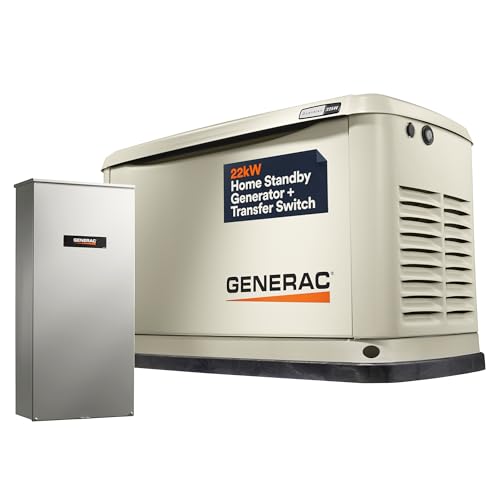
Includes the Generac 7043 22kW Mobile Link Wi-Fi connectivity and a 200 Amp NEMA 3R smart switch housed in an outdoor aluminum enclosure. This model is built for comprehensive whole-house protection and long-term reliability, backed by a 5-Year Limited Warranty.
Best for: Larger homes with higher electrical loads seeking robust standby power and advanced remote monitoring. Caution: The initial installation may require professional electrical work and adherence to local codes for transfer equipment and clearances.
Westinghouse 12500 Watt Dual Fuel Portable

Portable generator offering 9,500–12,500 watts depending on fuel and a 6.6-gallon tank with up to 12 hours runtime. Includes a remote start key fob, multiple outlets, and a heavy-duty engine with automatic low oil shutdown and a digital hour meter. Transfer-switch readiness allows a smooth connection to compatible setups.
Best for: Homeowners who want a versatile, portable backup with dual-fuel capability and built-in monitoring features. Caution: Portable units require a transfer switch for quick switching during outages and proper outdoor placement for safety.
Westinghouse 14500 Peak Watt Tri-Fuel Portable

Provides up to 11,500 running watts (gas) or 12,000 peak watts and supports propane and natural gas in addition to gasoline. Equipped with a heavy-duty 550cc engine, a long runtime on a full tank, and multiple outlet types including RV-ready options. A solid choice for frequent, higher-demand outages.
Best for: Homeowners who need higher surge power and multi-fuel flexibility for longer outages. Caution: Tri-fuel setups may require professional installation for transfer-switch integration in some configurations.
Champion Power Equipment 11,000-Watt Portable

Wireless remote start, 11,000 starting watts and 9,000 running watts, and a noise level around 64 dBA at 23 feet. The CO Shield auto shutoff provides safety against carbon monoxide. It also features cold-start technology for easier starts in cooler weather.
Best for: Those who want convenient remote operation and a quiet, portable backup with built-in safety features. Caution: As a portable unit, it may require manual setup to connect to a transfer switch for seamless outage recovery.
Buying Guide: Key Considerations for Choosing an Automatic Backup Generator
- Power needs: Compare running watts and surge watts to match your home’s electrical load. Standby generators are best for full-home protection, while portable units suit targeted circuits or essential loads.
- Fuel type and availability: Decide between natural gas, propane, or gasoline. Dual-fuel options add flexibility during fuel shortages or weather events.
- Transfer switch compatibility: Whole-house systems typically require a transfer switch compatible with your service panel. Consider 100 Amp vs 200 Amp options based on home size and circuits.
- Remote monitoring: Wi-Fi connectivity helps track performance and maintenance. Ensure you have reliable internet access for alerts and status updates.
- Durability and weather resistance: Outdoor units should have a corrosion-resistant, weatherproof enclosure and proper clearance for safe operation.
- Electrical codes and installation: Standby units often require professional installation to meet local electrical codes and permit requirements.
- Maintenance and warranties: Look for longer warranty coverage and the availability of service in your area. A 5-Year Limited Warranty is common for standby units.
Frequently Asked Questions
- What is the difference between standby and portable generators?
Standby generators are permanently installed, automatically start during outages, and typically connect to the home’s transfer switch. Portable generators are moved and started manually and require a transfer switch or essential-load connections for safe operation. - How do I determine the right wattage for my home?
Add up the running watts of essential appliances (refrigerator, furnace blower, lights, outlets) and select a unit with adequate running and surge watts to cover peak demands. - Is remote monitoring worth it?
Remote monitoring provides alerts, status updates, and maintenance reminders, which can help prevent unexpected outages and simplify upkeep. - Do I need professional installation for a standby generator?
Yes. Standby systems typically require licensed installation to ensure proper wiring, permits, and code compliance. - Can a portable generator power an entire home?
Most portable generators cannot power an entire home simultaneously. They are best for essential circuits or multiple high-demand loads via a transfer switch. - What fuels are safest for home backup?
Natural gas and propane offer cleaner, easier-to-store options for home backup, while gasoline is widely available but has shorter shelf life and storage considerations.