Best Auto Changeover Switches for Generators
Answering the need for reliable power continuity, these auto changeover switches (ATS) automatically switch from a primary power source to a backup source, such as a generator or solar, when the main supply fails. They’re ideal for homes, small businesses, and workshops that require uninterrupted power. This guide highlights five top options, who they’re best for, and practical buying tips to simplify your choice.
Summary table of selected products
| Product | Best For | Key Benefit |
|---|---|---|
| JONASC 110V 63A 3P ATS Dual Power Automatic Transfer Switch | Medium-load homes and small offices | Fast 2-second transfer with robust protection |
| 100Amp AC110V Automatic/Manual Transfer Switch 2P 50/60Hz | DIYers and temporary setups | Flexible auto/manual modes and dual power inputs |
| 6-63amp AC220V Dual Power Switch Automatic Transfer Switch 2P 50/60Hz | Two-supply redundancy for small equipment | Clear auto/manual operation with real-time monitoring |
| 125 Amp 3P Dual Power Automatic Transfer Switch | Industrial or larger home backups | Heavy-duty protection and seamless transitions |
| 110V Dual Power Automatic Transfer Switch 2P 63A CE Certified | General purpose residential/commercial use | Balanced protection and rapid 2-second transfer |
JONASC 110V 63A 3P ATS Dual Power Automatic Transfer Switch
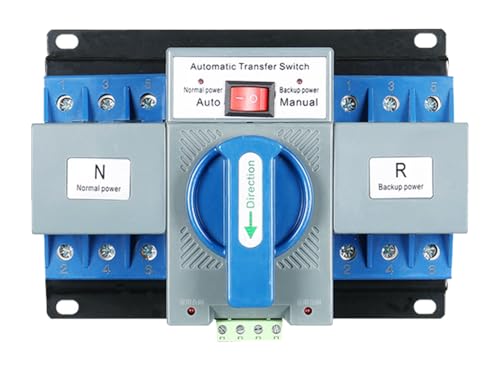
The JONASC model is designed for AC110V systems with a line current range of 6A–63A and a quick conversion time around 2 seconds. It supports automatic and manual operation, enabling simple testing and manual override when needed. It’s well-suited for small commercial spaces or residential setups where primary power reliability matters and a backup is required for critical loads. Safety is reinforced by protections against short circuits, overloads, phase loss, and undervoltage.
Best for: Small to mid-size load centers that demand fast, automatic switching and clear protection. Choose this if you want an established auto-changeover solution with dual-mode operation and straightforward installation.
Caution: Ensure correct wiring for two load circuits and verify compatibility with your generator or alternative power source. The unit’s protection features depend on proper installation and maintenance.
100Amp AC110V Automatic/Manual Transfer Switch

This 100A two-pole system provides both automatic and manual modes, suitable for panels where two input sources can be connected to main and backup feeds. It can switch within about 0.05 seconds when the primary source is abnormal and supports connections from mains, generators, or photovoltaic systems. It’s best for DIY enthusiasts and semi-professional setups that require precise source testing and quick transitions.
Best for: Environments needing rapid, reliable automatic switching with the option to manually override for testing or maintenance. Avoid this if you require ultra-compact form factors or single-source reliance only.
Limitation: The manual mode requires careful attention to switch positions to avoid accidental cross-connection or misconfiguration during testing.
6-63amp AC220V Dual Power Switch Automatic Transfer Switch 2P

This model operates at 220V with a 2P 63A rating and supports automatic and manual modes with real-time monitoring of input sources. It’s designed for straightforward auto-transfer between main and backup sources, with clear indicator LEDs to show current status. It’s a practical choice for smaller commercial setups or garages where reliable automatic switching is necessary.
Best for: Users needing a robust dual-source switch with simple auto/manual control and clear status indicators. Choose this if you want balanced protection and easy operation in a 220V system.
Caution: Verify that wiring and load compatibility align with the 220V single-phase configuration; avoid overloading beyond 63A to maintain protection features.
125 Amp 3P Dual Power Automatic Transfer Switch

The 125A dual-power switch is designed for seamless transitions between mains and standby power sources, making it suitable for industrial, commercial, or large residential environments requiring uninterrupted service. It includes a safety lockable feature to prevent accidental activation and tampering, along with multiple protections such as insulation, ground protection, and phase loss detection. This model emphasizes safety and durability in high-load scenarios.
Best for: Medium to large load centers needing heavy-duty protection and reliable transitions. Consider this if you prioritize operational safety and tamper resistance in active power environments.
Limitation: The extra protection features may require more thorough installation to ensure the lockable mechanism and wiring are correctly utilized during routine maintenance.
110V Dual Power Automatic Transfer Switch 2P 63A
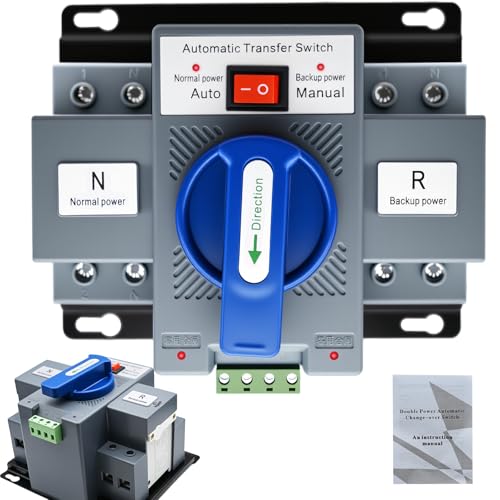
This 2P 63A, 110V ATS supports automatic and manual operation with dual-mode switching. It monitors phase status to detect faults and performs a quick transfer to backup power when needed, then returns to normal automatically. It’s a practical fit for spaces needing reliable 110V power with straightforward installation and operation.
Best for: General residential or light commercial use where 110V operation and quick, autonomous switching are priorities. Choose this if you want a compact solution with dependable auto switching.
Limitation: May not be suitable for higher amperage demands beyond 63A; ensure your backup source can handle load requirements during switching.
Buying Guide
Key purchase considerations
- Voltage and amperage: Match the ATS rating to your electrical system and expected load. Oversizing can add cost, while undersizing can cause nuisance tripping.
- Automatic vs. manual modes: Automatic mode is essential for uninterrupted power, while manual mode is useful for testing and controlled shutdowns.
- Transfer time: Faster transfers minimize downtime for sensitive equipment; typical ranges are 2 seconds or less.
- Protection features: Look for protection against short circuits, overloads, phase loss, undervoltage, and insulation issues to protect both equipment and personnel.
- Source compatibility: Ensure the device accepts mains, generator, or photovoltaic inputs as needed for your setup.
- Installation and mounting: Some models are DIN-rail compatible or require a specific enclosure; consider space, wiring, and accessibility for maintenance.
- Safety and tamper resistance: Lockable features and clear status indicators can prevent accidental changes and enhance security in critical environments.
Practical tips for choosing
- Choose a unit with a transfer time that aligns with your equipment tolerance for power interruptions.
- Prefer models with clear LED indicators or display readouts for quick status checks during troubleshooting.
- If you expect frequent switching, prioritize thermal robustness and longer lifecycle components to reduce maintenance needs.
Common scenarios
- Residential backup: A 2P 63A or 3P 63A unit can support essential circuits during outages.
- Small business: A 100A or 125A ATS provides better headroom for multiple devices and office equipment.
- Industrial use: Higher amperage (125A) and 3P configurations support larger loads and critical systems.
FAQ
- Q: Do auto changeover switches require professional installation? A: While some models support DIY wiring, it’s best to have a licensed electrician handle electrical interconnections and safety checks.
- Q: Can ATS work with solar or generator inputs? A: Yes, many models support mains, generator, and photovoltaic inputs, enabling flexible power sourcing.
- Q: What happens during a transfer failure? A: In well-designed systems, the ATS will attempt to switch to the backup source automatically; if both sources fail, an alarm or protective shutoff may engage.
- Q: How do I choose the right amperage? A: Calculate your essential load and select an ATS with a margin above peak demand to avoid nuisance trips.
- Q: Are all ATS units water-proof for outdoor use? A: Not all are; check enclosure ratings and mounting conditions to ensure suitability for outdoor or damp environments.
- Q: Do these devices protect against undervoltage? A: Many models include undervoltage protection to safeguard connected equipment during power fluctuations.