Best All in One Inverter Charger MPPT
Answering the need for compact, integrated power systems, these all-in-one inverter chargers combine MPPT solar controllers, inverters, and battery chargers into single units. They’re best for off-grid cabins, home energy storage, or any scenario where space and efficiency matter. This guide highlights five top options, explaining who they suit, why they’re chosen, and practical limitations to consider before buying.
| Product | Type | Best For | Key Benefit |
|---|---|---|---|
| LiTime 3500W 48V | 48V, 3500W | Large off-grid setups, home storage | UPS with 6000W surge |
| LiTime 3000W 24V | 24V, 3000W | Smaller cabins, 24V battery banks | Flexible MPPT/output modes |
| LiTime 5000W 48V | 48V, 5000W | High-power backup, farm setups | Parallel up to 6 units |
| Renogy 3500W 48V | 48V, 3500W | Home storage, off-grid hybrids | Integrated 80A MPPT |
| Ampinvt 5000W 48V | 48V, 5000W | RVs, cabins, larger off-grid | 5kW output with 100A MPPT |
LiTime 3500W 48V All-in-One Solar Inverter Charger

The LiTime 3500W 48V model integrates an MPPT controller, inverter, and charger in a single unit. It supports a peak surge up to 6000W and offers an uninterrupted power supply (UPS) function to protect sensitive electronics during outages. Best for larger off-grid or home storage systems needing reliable, pure sine wave output.
- Best for: Off-grid homes and cabins with 48V battery banks.
- Why chosen: High surge capacity and integrated UPS support robust backup power.
- Limitations: 48V system requires matching battery configuration; installation should comply with electrical codes.
LiTime 3000W 24V All-in-One Solar Inverter Charger

This 24V unit is ideal for small to mid-size off-grid setups or homestead energy storage. It combines a 60A MPPT controller with a robust 3000W inverter and UPS. It supports multiple charging modes and provides an LCD/LED interface for real-time monitoring.
- Best for: 24V battery banks in compact homes or cottages.
- Why chosen: Flexibility in charging modes (MPPT First, Grid First, Inverter First) enhances energy management.
- Limitations: 24V configuration means higher battery string voltage planning; ensure compatibility with your battery type.
LiTime 5000W 48V Hybrid Inverter Charger

This 5000W unit uses a parallel-capable design, offering a 100A MPPT charger and 40A battery charging. It supports PV priority and hybrid modes for stable power when mains or PV energy fluctuates. A strong choice for home backups and farm use.
- Best for: High-demand home backup and parallel expansion up to 30 kW with multiple units.
- Why chosen: Parallel capability provides scalable backup power for growing energy needs.
- Limitations: Parallel setups require proper balancing and electrical planning; ensure safety when linking units.
Ampinvt 5000W 48V All-in-One Solar Inverter Charger
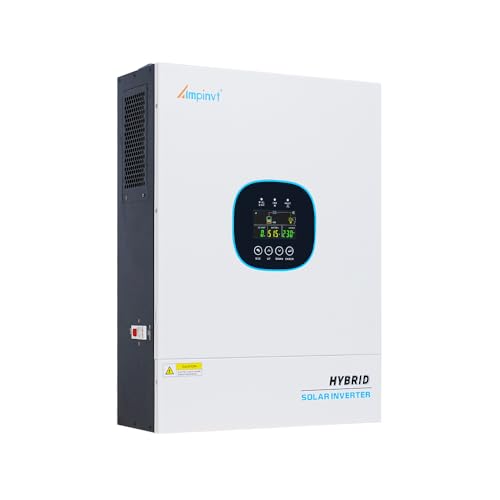
The Ampinvt unit blends 100A MPPT charging with a built-in 5000W inverter and AC charging. It supports single-phase and up to 6 in parallel, enabling larger off-grid or backup systems. It accommodates lead-acid and lithium chemistries, with multiple charging modes for flexible energy management.
- Best for: RVs, cabins, and remote sites needing scalable backup power.
- Why chosen: High MPPT current and parallel capability suit expanding off-grid networks.
- Limitations: Parallel configurations require careful wiring; verify compatibility with your specific battery types.
Renogy 3500W 48V Hybrid Solar Inverter Charger

Renogy’s 3500W unit blends an 80A MPPT controller with an 40A battery charger in a single compact design. It supports 48V AGM, Sealed, Gel, Flooded, and Lithium batteries, with Bluetooth for remote monitoring. It functions as a UPS when mains are interrupted, delivering stable hybrid performance.
- Best for: Home energy storage users who want Bluetooth monitoring and battery versatility.
- Why chosen: Integrated UPS and battery mode presets simplify hybrid operation.
- Limitations: Bluetooth monitoring may require setup; ensure battery chemistry is compatible with presets.
Buying Guide
What to consider when choosing an all-in-one MPPT inverter charger:
- System voltage and battery chemistry: Match the unit to 12V/24V/48V and to lead-acid or lithium chemistries used in your setup.
- Power rating and surge: Ensure continuous wattage covers your essential loads and that the peak surge meets motor or compressor starts.
- MPPT capacity and efficiency: Higher MPPT current yields faster solar charging in dense sun conditions.
- UPS and transfer behavior: Look for fast automatic switching to battery during outages if critical devices depend on power continuity.
- Parallel capability: If you anticipate growth, verify how many units can be paralleled and the necessary wiring requirements.
- Monitoring features: Bluetooth, RS485, or LCD panels aid real-time system visibility and troubleshooting.
- Storage and installation: Consider space savings from “all-in-one” designs versus modular components and the required wiring layout.
FAQ
- What does “all-in-one” mean in these devices?
They integrate an MPPT solar charger, inverter, and battery charger into a single box for simplified installation and space savings.
- Can these units work with any battery type?
Most models support lead-acid and lithium chemistries, but always check compatible presets and battery presets for your unit.
- Do all-in-one inverters support grid-tied operations?
Many offer UPS or hybrid modes, but “grid-tied” functionality depends on the model’s configuration and local electrical codes.
- What is MPPT, and why is it important?
MPPT optimizes solar charging by adjusting voltage to capture maximum power under varying sun conditions, improving charging efficiency.
- Is parallel operation safe for multiple units?
Yes, when designed for parallel use and installed per manufacturer instructions; improper wiring can create safety risks.