Best Air Flow CFM Meters for HVAC and Drones
The best air flow CFM meters deliver accurate airflow readings and quick data access for HVAC professionals, drone operators, and maintenance technicians. This guide highlights five top options that balance precision, portability, and ease of use. Each product is evaluated for who it’s best for and potential limitations, so you can pick the right tool for your ductwork, wind measurements, and air velocity needs.
Summary table of selected products:
| Product | Best For | Key Benefit | Limitations |
|---|---|---|---|
| BTMETER BT-100 | HVAC pros, drone operators | Combo wind speed, wind temp, and CFM with tripod mount | Smaller sensor range for very high speeds |
| TopTes TS-301 | Outdoor activities, HVAC basics | Large backlit display; 6 units; humidity and temp | Humidity sensor may need time to acclimate |
| BTMETER BT-816B | Portable field use | Multi-mode, backlit, quick wind chill and temp | Lower-end accuracy in extreme temps |
| AOPUTTRIVER AP-856A | Pro wind monitoring | USB data export; MAX/MIN/AVG; CFM and cross-section support | More complex setup |
| BTMETER BT-846A | Professional HVAC testing | Wide range, 600 data logs, CFM/CMM units | Higher price point |
BTMETER BT-100 Handheld Anemometer

Best for professionals who need a compact tool that reports wind speed, wind temperature, wind chill, and CFM. It measures air speed in multiple units (m/s, km/h, ft/min, knots, mph) and provides a wire-free option for drone operations with a tripod mounting hole for stable measurements. The device has dual temperature sensors and 8 vanes to improve low-flow sensitivity in HVAC ducts. Use this when you want to calculate air flow as CFM from wind velocity and duct area. Caution: the device’s wind speed range may be less optimal for very high-speed testing.
TopTes TS-301 Digital Anemometer
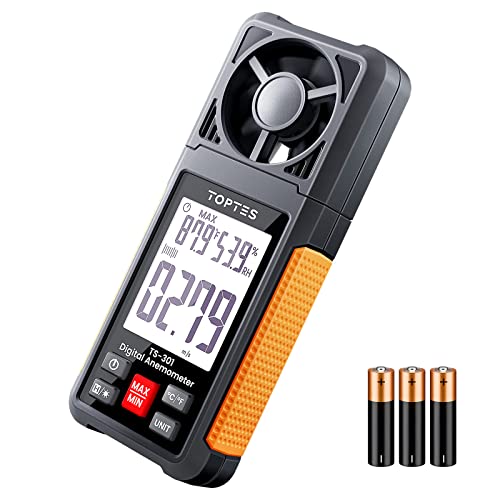
Best for outdoor activities and general HVAC checks with a large backlit display. It supports six units of wind velocity (ft/min, ft/s, mph, knots, km/h, m/s) and includes wind humidity and wind temperature readings. The humidity sensor helps you gauge indoor air quality and potential condensation risks. Temperature and humidity may require acclimation, especially after environmental changes. Choose this for easy readability in bright sun or low-light conditions.
BTMETER BT-816B Mini Anemometer

Best for portable field use with multi-mode testing. It features a sensitive temperature sensor, 7-blade fan, and selectable units (m/s, ft/min, knots, km/h, mph). It reports wind chill and temp in real time and supports auto or manual power-off. The device is versatile for outdoor measurement, electrical equipment testing, and HVAC assessments. Limitation: precision may vary slightly with rapid ambient temperature shifts.
AP-856A Pro HVAC Anemometer
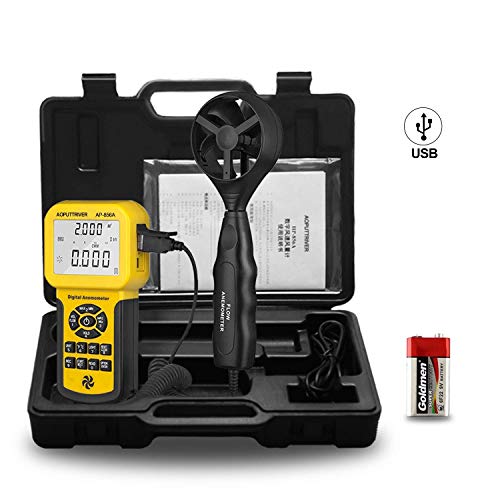
Best for professionals needing high-precision wind speed with USB data export. It covers wind speed from 0.001–100 mph and 0.001–45 m/s, plus a CFM readout. The device stores data and supports MAX/MIN/AVG, with a cross-sectional area input to calculate air flow. It is suitable for windsurfing, sailing, aerial measurement, and HVAC diagnostics. Caution: data analysis requires USB connection to a PC for full utilization.
BTMETER BT-846A Pro HVAC Anemometer

Best for HVAC professionals who need extensive wind measurements and data logging. The BT-846A measures wind speed in five units and wind temperature, plus air flow in CFM and CMM. It logs up to 600 data groups and ships with a protective carrying case. It supports real-time CFM reading, making it ideal for duct testing and balancing. Limitation: the initial setup can be more complex than entry-level models.
Buying Guide
What should I consider before buying an air flow CFM meter?
Purpose: Decide whether you need an instrument primarily for HVAC duct work, field testing for drones, or both. If you work in ducts, prioritize CFM, cross-sectional area input, and a wide wind speed range. For outdoor or drone use, emphasize portability, battery life, and a readable display in sunlight.
What units and data features matter?
Look for devices offering multiple units (m/s, ft/min, mph, knots, km/h) and CFM or CMM displays. USB data export is valuable for post-test analysis. Consider MAX/MIN/AVG functions to track performance over time. A backlit display enhances visibility in low-light environments.
How important is sensor accuracy and range?
Higher accuracy reduces measurement error in critical tests. Check stated accuracy percentages and the measurement range. For duct measurements, confirm the ability to set cross-sectional area to calculate true CFM output.
What are typical limitations to expect?
Some models require acclimation for humidity and temperature readings. Others offer more features but have steeper learning curves or higher costs. Consider the needed balance between portability, data capabilities, and ease of use for your job.
Are accessories worth it?
Tripod mounting, protective cases, and extendable sensors can improve stability and reach in tight spaces. If your work involves drones or long ducts, a product with an extendable sensor or a clamp-on cross-section input can save time and improve accuracy.
FAQ
- What is a CFM meter used for? A CFM meter measures air flow in cubic feet per minute, often used to balance HVAC ducts and verify vent performance. Some models also display wind speed and temperature.
- Can these devices measure humidity? Several models include humidity sensors, which helps assess indoor air quality and environmental conditions that affect readings.
- Do I need USB data export? If you perform detailed reporting or keep logs, USB data export facilitates data analysis on a PC. It is optional for basic field use.
- Is a tripod mount important? A tripod mount is valuable for hands-free measurements during drone flights or fixed-position tests, improving stability and accuracy.
- How do I choose the right unit system? Select a model that supports the units you routinely use (m/s, ft/min, mph, knots, etc.) to minimize conversion work.
- Are these meters accurate for duct testing? Most models provide duct-appropriate readings, especially when you input the correct cross-sectional area to compute CFM. Check the specified range and accuracy for duct work.