Best Air Compressor Filter System for Clean, Dry Air and Prolonged Tool Life
Choosing a reliable air compressor filter system is essential for extracting moisture, oil, and particulates from compressed air. This article highlights five top options that balance filtration stages, ease of maintenance, and compatibility with common workshop tools. Each product is evaluated on filtration effectiveness, pressure range, and user-friendly features to help American professionals and hobbyists select the right system for painting, plasma cutting, and general pneumatic tasks.
| Product | Brand | Filtration Stages | Max Pressure | Drainage |
|---|---|---|---|---|
| 3/4″ NPT Industrial Grade 3 Stage Air Drying System | Gokluuk | 5 Micron, 0.01 Micron Coalescing | 240 PSI | Auto Drain |
| 3/4″ NPT Industrial Grade 4 Stage Air Compressor Drying System | NEPIKE | 5 Micron, 0.01 Micron, Desiccant | 240 PSI | Auto Drain |
| LNCHKA Pneumatic Air Filter Regulator Combo | LNCHKA | 5 Micron ( Brass ), 0-150 PSI Regulator | 145 PSI (max) | Manual/ Semi-Auto |
| NANPU 3/4″ NPT Industrial Grade 3 Stage System | NANPU | 5 Micron, 0.01 Micron, Desiccant | 175 PSI | Auto Drain |
| 3/4″ NPT Industrial Air Dryer with 3 Stages | CAtArt | 5 Micron, 0.01 Micron, Desiccant | 240 PSI | Auto Drain |
Below are detailed overviews of five top picks, focusing on filtration performance, maintenance, and practical use for spray painting, plasma cutting, and general workshop efficiency.
Gokluuk 3-Stage Air Drying System

The Gokluuk system uses a three-stage approach designed for industrial environments with high-pressure needs. Stage 1 employs a 5-micron filter to remove most particulates and moisture, while Stage 2 adds a 0.01-micron coalescing filter to trap fine moisture and oil. A coalescing element with a red indicator helps track replacement timing, aiding preventive maintenance. The unit supports up to 240 PSI and includes a gauge port for monitoring. An auto-drain feature helps maintain system cleanliness with minimal manual effort. Ideal for plasma cutting and painting operations that require dry air at the nozzle.
NEPIKE 4-Stage Industrial Air Drying System

The NEPIKE unit consolidates a four-stage filtration network: a 5-micron initial filter, a 0.01-micron coalescing filter, a desiccant-based drying stage, and an auto drain with visual indicators. It also features a lockable regulator that covers a broad 0–240 PSI range, enabling precise pressure control for spray finishing and tool feeds. With auto drains on each stage, maintenance is reduced while ensuring consistent dry air output. This system is well-suited for automotive spraying and precision plasma cutting where moisture control is critical.
LNCHKA Filter Regulator Combo
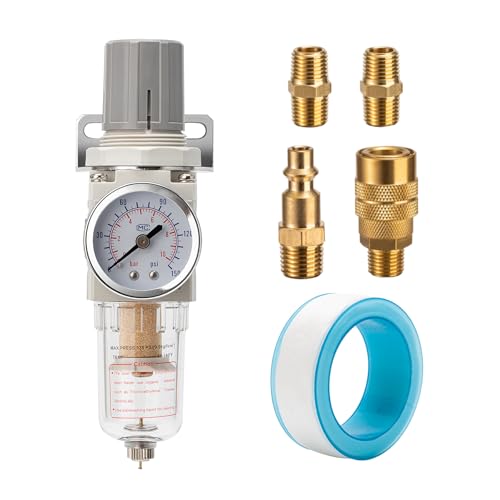
The LNCHKA combination emphasizes universal compatibility and straightforward maintenance. Its 1/4″ NPT setup fits many standard compressors, with a visual-friendly transparent bowl for quick inspection. The brass filter element provides solid filtration, while the regulator ensures stable outflow pressure within the recommended range. The unit is suitable for shops that require dependable filtration for pneumatic tools, spray guns, and light industrial tasks, offering a balance between cost and performance with easy bottom drainage.
NANPU 3-Stage System with Desiccant

NANPU’s three-stage configuration emphasizes high filtration efficiency and visible desiccant status indicators. Stage 1 uses a 5-micron filter to capture moisture and particles, while Stage 2 employs a 0.01-micron coalescing filter to trap residual contaminants. The desiccant stage ensures that dried air reaches spray guns and plasma cutters with minimal dew point. A red indicator alerts when replacement is needed, supporting proactive maintenance. This setup is particularly effective for paint finishing and precise cutting tasks that demand consistently dry air.
CAtArt 3-Stage Industrial Dryer System

The CAtArt model emphasizes an integrated three-stage filtration with clear maintenance cues. The first stage is a 5-micron filter that reduces particulates and moisture, followed by a 0.01-micron coalescing filter that targets ultra-fine moisture and oil. The desiccant stage delivers the driest air, improving tool performance for plasma cutting and spray applications. A green indicator guides replacement timing, and an auto-drain feature keeps the system ready for continuous operation. It is suitable for demanding industrial environments where consistent air quality is non-negotiable.
Buying Guide: How to Choose an Air Compressor Filter System
- Filtration stages: Most systems use a combination of particulate (5 microns or larger), coalescing (0.01 micron), and desiccant stages. More stages generally mean drier air, but consider maintenance needs and space.
- Pressure range: Ensure the unit supports your compressor’s max PSI. Common ranges are 0–145 PSI or up to 240 PSI for industrial setups.
- Drainage: Auto drains reduce maintenance, while manual or semi-auto drains offer budget-friendly options but require regular attention.
- Indicator alerts: Visual lights for filter replacement or desiccant color-change indicators help prevent performance drops.
- Compatibility: Check NPT thread size (3/4″ vs 1/4″ or 3/8″) and mounting options. Brass filters offer durability and corrosion resistance beneficial in workshop environments.
- Maintenance considerations: Look for accessible filter elements, clear sight windows, and easy-disconnect fittings to minimize downtime.
- Applications: For painting and spraying, prioritize ultra-dry air and moisture removal; for plasma cutting, moisture control reduces corrosion and improves cut quality.
- Space and cost: Multi-stage systems provide superior air quality but require more space and upfront investment. Balance with your tool needs and workflow.
These options provide a range of filtration performance and maintenance profiles suitable for American workshops, whether you are painting cars, operating plasma cutters, or running precision pneumatic tools. When selecting, consider your typical workpiece materials, climate, and how often the system will be in use to choose the best balance of filtration depth and ease of upkeep.