Best Air Compressor Filter Regulator Lubricator Units for Pneumatic Systems
If you’re shopping for an Air Filter Regulator Lubricator (FRL) for a pneumatic setup, you want a reliable FRL that keeps moisture out, delivers steady pressure, and provides lubrication. This guide features five top FRL units that are well-suited for hobby workshops, home garages, and light industrial tasks. Each product list highlights who it’s best for and why, plus practical cautions to consider before purchasing.
Summary table of selected products
| Product | Best For | Notes |
|---|---|---|
| LNCHKA FRL Unit | General pneumatic systems needing clear visibility and robust plastic bowl | Transparent filter cup and brass filter element |
| NANPU 3/8″ FRL Combo | Residential and light commercial tools | 5 micron brass filter, compact 3/8″ NPT |
| Campbell Hausfeld FRL | Users needing easy maintenance and modular mounting | 3-in-1 FRL with quick-release bowl |
| NANPU 1/2″ FRL Combo | Mid-size tools and compressors | 5 micron brass element, robust build |
| AIRZOE FRL Combo 1/4″ | Smaller systems with compact footprint | 0-145 psi range, 5 micron brass element |
LNCHKA Air Compressor FRL Unit

Best for: General pneumatic systems needing durable filtration and reliable lubricated output. This unit features a transparent polycarbonate filter cup and a brass filter element, offering clear visibility and corrosion-resistant filtration. The gauge-capable regulator helps maintain stable pressure up to 145 PSI, with a recommended operating range of 0-120 PSI. The oil mist cup aids lubrication for downstream devices, promoting smoother operation and longer equipment life. The semi-auto drain aids maintenance in light-duty setups.
Why chosen: It combines visual filter access with robust components in a single FRL, making it a practical choice for shops that value durability and straightforward adjustments. The semi-auto drain simplifies routine maintenance in environments with regular condensate formation.
Caution: The maximum operating pressure is 145 PSI; avoid pushing above the recommended 120 PSI range to ensure consistent output and filter life.
NANPU 3/8″ NPT FRL Combo

Best for: Home garages and light workshops with 3/8″ NPT fittings. Features a piggyback design with a 5-micron brass filter element and an operating range up to 125 PSI, delivering solid air purification and lubrication in a compact footprint. The semi-auto drain and bracket enhance ease of installation and ongoing maintenance.
Why chosen: Its compact, 3/8″ NPT configuration suits many standard compressors, while the 5-micron filter provides strong filtration for typical shop tools. The unit’s durability and reuse feasibility make it a practical long-term choice.
Caution: Some users may need to verify compatibility with existing brackets or mounting hardware to ensure a snug fit in tight spaces.
NANPU 3/8″ FRL Combo 3-in-1 Two Unit

Best for: Medium-duty setups seeking a two-unit FRL arrangement in a single assembly. The 3/8″ NPT piggyback configuration integrates a regulator, filter, and lubricator with a pressure range of 0-125 PSI. Its 5-micron brass element supports solid filtration, while longer life and reuse potential make it a solid value.
Why chosen: This option is ideal if you want a compact, two-unit solution for reliable air treatment and lubrication without needing extra space or multiple parts to assemble.
Caution: Ensure the mounting space accommodates two units in one line; restricted space can complicate installation on smaller machines.
Campbell Hausfeld FRL Unit

Best for: Users who value modular mounting and straightforward maintenance. This 3-in-1 FRL unit supports automatic lubrication to extend tool life and includes a 3.5-ounce quick-release bowl with a quarter-turn drain. The unit handles up to 125 PSI output for typical pneumatic tools.
Why chosen: The modular mounting bracket and easy maintenance design offer practical advantages in workshops that reconfigure setups or swap tools often. A 5-micron filter helps remove dirt and moisture efficiently, supporting longer tool life.
Caution: The maximum input pressure can be up to 250 PSI, but the effective output is 125 PSI; plan your system to stay within that window for optimal performance.
NANPU 1/2″ FRL Combo
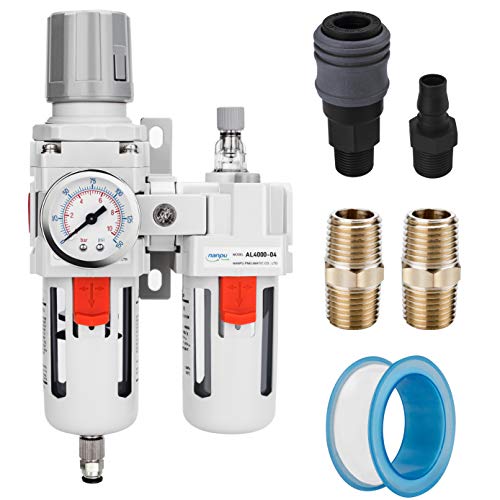
Best for: Mid-size compressors and tools requiring a robust 1/2″ NPT connection. This piggyback FRL unit uses a 5-micron brass filter element and provides strong filtration and lubrication across a broader pressure range.
Why chosen: The 1/2″ NPT size broadens compatibility with mid-size equipment, delivering reliable air conditioning and lubrication for continuous-use tools.
Caution: The unit’s larger port size may require additional space or longer piping runs—plan installation accordingly.
AIRZOE FRL Combo 1/4″

Best for: Small, space-constrained setups that still require clean, lubricated air. The 1/4″ NPT configuration fits compact compressors and spray equipment. It features a 5-micron brass filter element and a gauge to monitor pressure, with a working range up to 145 PSI.
Why chosen: This option is ideal when footprint is a priority. The 0-145 PSI gauge helps you fine-tune performance for delicate tools or precise spraying tasks.
Caution: Like other compact FRLs, it may have a smaller condensate drain capacity; monitor drainage to prevent buildup in busy operations.
ARO C38121-600-VS FRL (Ingersoll Rand)

Best for: Professionals using standardized 1/4″ NPT components with a focus on reliability. The ARO FRL setup includes a P39124-600 piggyback filter/regulator and L36121-100 lubricator, with manual drain and polycarbonate bowls.
Why chosen: Ingersoll Rand’s ARO line is recognized for robust, field-proven components. The combination of a manual drain and durable bowls fits environments where maintenance scheduling is predictable and regular checks are feasible.
Caution: The kit’s setup may require careful alignment with existing lines and fittings; verify connector compatibility before installation.
Buying Guide
What is an FRL and why do you need one?
An FRL (filter, regulator, lubricator) assembly cleans incoming air, stabilizes pressure, and oils downstream tools to prolong life and improve performance. It is essential for spray systems, pneumatic tools, and automation lines where air quality and consistent pressure matter.
Key purchase considerations
- Fittings and size: Common sizes are 1/4″, 3/8″, and 1/2″ NPT. Match to your compressor output and tool inlets.
- Filtration grade: 5 micron brass elements are typical for general use; finer filtration reduces moisture and debris but may raise pressure drop.
- Pressure range: Choose a unit whose operating and maximum pressures align with your system’s demands (often up to 120-145 PSI for FRLs).
- Bowl material and maintenance: Polycarbonate bowls show visibility but may scratch; aluminum or metal bowls offer durability but less visibility.
- Drain type: Semi-auto drains reduce maintenance but require periodic checks; manual drains provide direct control.
- Mounting and space: Some FRLs include modular brackets for easy placement; ensure space for future upgrades.
How to compare FRLs
- Configuration: 3-in-1 vs. split components (separate filter, regulator, lubricator).
- Port size: Ensure compatibility with existing piping and hoses.
- Maintenance: Quick-release bowls and accessible drains save time.
- Durability: Brass elements resist corrosion; polycarbonate bowls resist impact and heat.
Practical usage tips
- Install FRL components close to the point of use to minimize moisture and contaminants in the line.
- Drain condensate regularly to maintain performance and prevent water buildup.
- Check regulator setting frequently to avoid tool damage from over-pressurization.
FAQ
- Q: What does an FRL do for my compressor? A: It filters moisture, regulates pressure, and lubricates downstream tools for smoother operation.
- Q: Which size FRL should I choose? A: Match the inlet/outlet size to your compressor and tools (common choices are 1/4″, 3/8″, 1/2″ NPT).
- Q: Is a lubricator necessary for all tools? A: Some tools benefit from lubrication, especially impact tools and cylinders; others may require dry air, so assess your equipment needs.
- Q: How often should drains be serviced? A: Semi-auto drains reduce manual work, but inspect and clear condensate as part of routine maintenance.
- Q: Can I combine FRLs from different brands? A: It’s best to use components designed to work together, or confirm compatibility for threads, seals, and flow.
- Q: Do FRLs wear out? A: Filters can clog; bowls and seals can degrade; replace elements and inspect components during maintenance.