Best Air Compressor and Dryer Package for Clean, Dry Air
Looking for a reliable air dryer package that keeps compressed air free of moisture, oil, and contaminants? This guide highlights five top refrigerated air dryers that pair well with common workshop and industrial air compressors. Each option targets different flow rates and compressor horsepower, helping you pick the right match for your tools and workflow. Ideal buyers include automotive shops, CNC workshops, spray-paint environments, and serious hobbyists running multiple pneumatic devices.
| Product | Best For | Key Capacity | Notes |
|---|---|---|---|
| HPDAVV Industrial Refrigerated Air Dryer | Medium-duty shop/garage, 7.5–10 HP compressors | 35 CFM | R134a cooling; robust moisture removal |
| VEVOR 85 CFM Refrigerated Dryer | Industrial 15–20 HP systems | 85 CFM | Color screen, automatic drainage |
| Schulz 50 CFM Refrigerated Dryer | Mid-range 10–15 HP setups | 50 CFM | Includes water separator and oil coalescing filter |
| VEVOR 125 CFM Refrigerated Dryer | Higher-capacity 20–30 HP systems | 125 CFM | Large evaporator, automatic drainage |
| CAtArt 3/4″ Industrial Dryer | Versatile, filtration-focused systems | 4-stage filtration, 0.01 μm stage | Includes auto-drain |
HPDAVV Industrial Refrigerated Air Dryer
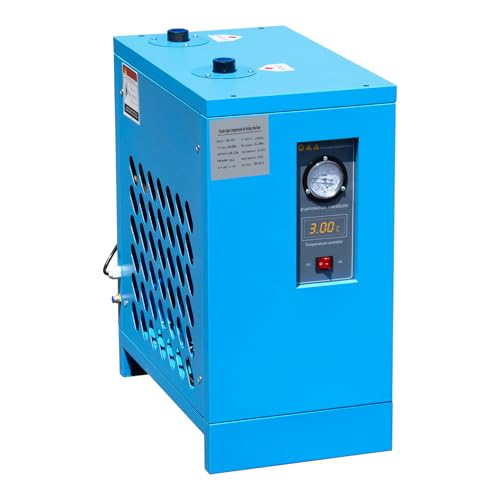
Best for shops needing reliable moisture removal with stable cooling performance. This dryer is designed to service 7.5–10 HP compressors and delivers 35 CFM of dry air. It uses an energy-efficient R134a cooling system to prevent moisture buildup during peak demand, making it suitable for pneumatic tools, spray painting, and CNC operations. Choose this if you operate a moderate-size workshop and require consistent, clean air with minimal maintenance. Caution: ensure adequate space for airflow around the unit to avoid heat buildup.
VEVOR 85 CFM Refrigerated Dryer

Best for larger garages or small industrial environments using 15–20 HP compressors. This unit handles up to 85 CFM and uses R134a refrigerant with a color screen control panel and automatic drainage for easy operation. It is well-suited for heavy use where moisture control significantly improves tool life and finish quality. Better for: higher airflow needs; Consider avoiding if you only run a light-duty, single-tool setup to avoid over-sizing.
Schulz 50 CFM Refrigerated Dryer

Best for mid-range 10–15 HP compressor setups, this Schulz unit offers a complete moisture and oil-free drying package with an industrial water separator and oil coalescing filter. The kit design ensures ultra-dry air suitable for spray finishing and precision pneumatic tools. Choose this if you want a plug-and-play solution with integrated filtration; caution: ensure compressor output does not exceed the filter stage tolerances to protect the filters.
VEVOR 125 CFM Refrigerated Dryer
Best for high-capacity systems, this 125 CFM dryer is designed for 20–30 HP compressors and features a color screen, automatic drainage, and robust heat exchange for rapid moisture removal. It suits industrial environments with heavy continuous use and multiple downstream tools. Choose this if you need rapid drying at high flow; be mindful of space and electrical supply requirements in tight rooms.
CAtArt 3/4″ Industrial Dryer (Stage Filtration)

Best for systems needing comprehensive multi-stage filtration, this 3/4″ NPT unit offers a four-stage approach with a 0.01-micron coalescing stage and an automatic drain. It is ideal when you require ultra-dry air for plasma cutting, painting, or high-precision tools. Use this if your existing system benefits from staged filtration; avoid if your setup cannot accommodate additional piping and drain lines.
Refrigerated Dryer Selection Guide
When choosing a refrigeration dryer, consider the following:
- Flow rate compatibility: Match CFM to the total demand from your downstream tools to avoid under-drying or over-sizing.
- Compressor horsepower: Higher HP equipment often needs larger dryers to maintain dew point performance.
- Refrigerant type and efficiency: R134a and R410a offer different cooling capacities; verify availability and energy use.
- Moisture removal target: Dew point requirements depend on tools (paint sprayers, CNC machines, and blast cabinets require lower dew points).
- Drainage: Automatic drains reduce maintenance; check for manual drain benefits if you have limited power backup.
- Filtration integration: Some units include filters; others require separate pre- or post-filters for oil and particle removal.
Buying Guide: Practical Considerations
What size dryer do you really need? Start by adding the CFM requirements of every downstream tool and choose a dryer with a comfortable margin above that total. How often will you drain condensate? Systems with automatic drainage save time but require power and periodic maintenance. Is space a constraint? Larger units demand more floor space and better ventilation. Do you require a color touchscreen or simple controls? For busy shops, a user-friendly interface accelerates setup and reduces operator error. Finally, consider future expansion: a dryer with a scalable design can handle additional tools as your shop grows.
FAQ
- What is the main purpose of a refrigerated air dryer?
To remove moisture and contaminants from compressed air, protecting tools and processes from moisture-related damage.
- How do I know which CFM rating I need?
Sum the CFM requirements of all downstream devices and add a buffer to select a dryer with adequate capacity.
- Is automatic drainage necessary?
Automatic drainage reduces manual maintenance and helps maintain consistent dew points, especially in high-use environments.
- Can I mix brands in a single package?
Yes, many setups pair different dryers with various compressors, but ensure compatibility in electrical requirements and connection sizes.
- What maintenance does a refrigerated dryer require?
Regularly check and replace filters as needed, inspect condensate drains, and clean heat exchangers to maintain efficiency.
- Are these dryers suitable for spray painting?
Yes, when configured for low dew point and proper filtration to prevent moisture and oil from affecting finishes.