Best AGM Deep Cycle Battery Charger Options for Reliable Marine, RV, and Solar Uses
Whether you’re maintaining a marine battery, an RV deep-cycle pack, or a solar storage system, a smart AGM battery charger helps maximize life and readiness. This guide highlights five compatible models that excel with AGM and other lead-acid or LiFePO4 batteries. Each option is suited for different needs: compact, high-precision maintenance; multi-bank charging for bigger systems; or rugged marine durability. Below, you’ll find clear guidance to choose the right charger, plus a quick comparison table of the featured products.
| Product | Best For | Key Benefit |
|---|---|---|
| NoCO GENIUS10 | Medium to large systems, frequent maintenance | High power, temperature compensation, desulfation |
| NoCO GENIUS5 | Compact setups needing robust charging | Balanced power and size, multi-battery support |
| NoCO GEN5X2 | Two-bank marine or heavy-use rigs | Two independently controlled banks |
| NoCO GENIUS2 | Budget-friendly, versatile charging | Force mode for deep-cycle recovery |
| TowerTop 2/10/25 | Very fast charging and adjustable power | Multiple current settings, auto-maintainer |
NOCO GENIUS10: 10A Smart Battery Charger

The GENIUS10 is a versatile all-in-one charger designed for 6V and 12V lead-acid (including AGM and deep-cycle) and LiFePO4 batteries, plus maintenance features for marine and powersport use. Its integrated thermal sensor dynamically adjusts charging to ambient temperature, helping prevent overcharge in heat and undercharge in cold. Best for: medium-sized systems with frequent maintenance needs and a desire for precise temperature compensation. Limitation: higher initial cost relative to basic chargers.
NOCO GENIUS1: 1A Smart Charger

The GENIUS1 offers compact, low-current charging for small or auxiliary batteries. It supports 6V and 12V lead-acid and LiFePO4, with an integrated thermal sensor for temperature-aware charging. Best for: tiny systems or trickle-maintenance on boats or small equipment. Limitation: modest power makes it less ideal for large deep-cycle batteries.
YONHAN Battery Charger 20A

The YONHAN charger provides 12V options at 20A and 24V at 10A, designed to charge, maintain, and repair a broad range of lead-acid batteries, including AGM and deep-cycle. Features winter/holiday modes, multiple protections, and a repair mode. Best for: larger systems in need of fast charging and winter storage readiness. Limitation: not a jump-starter and the repair mode is not a substitute for a truly dead battery.
NOCO GENIUS5: 5A Smart Charger

The GENIUS5 delivers a balance of power and compact form, ideal for 6V/12V lead-acid and LiFePO4 batteries, with temperature-compensated charging and desulfation. Best for: small to mid-size systems with limited space. Limitation: not as feature-rich as multi-bank models for larger fleets.
NOCO Genius GEN5X2: 2-Bank Onboard Charger
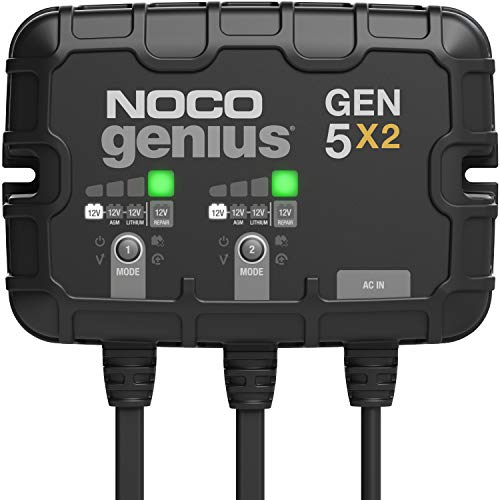
This two-bank onboard charger provides 10A total, 5A per bank, with independent charging and maintenance for each 12V battery. Modes include 12V, 12V AGM, 12V Lithium, and 12V Repair, making it suitable for boats and larger solar setups. Best for: dual-battery configurations and marine applications requiring separate charging channels. Limitation: installation is more involved due to its onboard nature.
TowerTop 2/10/25 Amp 12V Charger

The TowerTop charger offers four current settings (2A, 10A, 25A, AUTO) with a max 25A, enabling fast charging and auto maintenance. It features winter mode, desulfation, and a memory function to retain last settings. Best for: users who need flexible, fast charging across various battery sizes. Limitation: higher current draw requires adequate power supply and proper ventilation.
Buying Guide: Key Purchase Considerations
Battery chemistry and system size drive charger selection. For AGM and other lead-acid deep-cycle batteries, opt for models with temperature compensation to prevent sulfation and overcharge. If you operate multiple batteries, consider multi-bank units for independent charging. Compact models suit small PV setups or trickle maintenance, while higher amperage chargers speed up recovery and charging of large packs.
- Amperage and voltage compatibility: Ensure the charger supports 6V and 12V systems and matches your battery bank size.
- Temperature compensation: Look for built-in sensors to adjust charging with ambient temperature.
- Desulfation and repair modes: Useful for extending life of older or idle deep-cycle batteries.
- Safety protections: Overcharge, short-circuit, reverse polarity, and fireproof materials add reliability.
- Installation type: Portable chargers vs. onboard multi-bank units affect space and setup complexity.
Frequently Asked Questions
- What is AGM battery charging best practice?
- Charge at manufacturer-recommended rates, use temperature compensation, and avoid deep discharge before charging.
- Can I use a standard car charger for AGM deep-cycle batteries?
- Only if the charger is adjustable to proper voltage and includes suitable temperature compensation and maintenance modes.
- Do I need a separate desulfator?
- Many chargers include desulfation functionality; separate devices are optional if your charger already offers it.
- Is multi-bank charging safer for large fleets?
- Yes, two-bank or multi-bank chargers allow independent regulation per battery group and reduce cross-interference.
- What about lithium batteries?
- Choose chargers explicitly labeled for LiFePO4 or lithium compatibility with appropriate voltage profiles.
These five options provide a spectrum of capabilities for AGM deep-cycle charging. The right choice depends on system size, whether you need one charger for multiple banks, and whether fast charging or compact maintenance is the priority. Use the buying guide and product descriptions to align features with your application and storage environment.