Best AGM Battery Charger Maintainer: Top 5 Smart Marine and Automotive Chargers
If you need a reliable charger that can also maintain and desulfate AGM, lead-acid, and LiFePO4 batteries, these top options are designed for long-term battery health. Ideal buyers include boaters, RV owners, and car enthusiasts who want automatic maintenance, temperature compensation, and safe charging. The list below highlights five models with clear use cases: everyday maintenance for floats, winter storage, and keeping batteries ready for action.
| Product | Best For | Key Benefit |
|---|---|---|
| NOCO GENIUS1 | Small spaces; basic maintenance | Compact, automatic maintainer with temperature compensation |
| NOCO GENIUS2 | Standard 2A needs; versatile charging | Force Mode for low-voltage recovery |
| NOCO GENIUS5 | Mid-range power; multiple battery types | Balanced power with comprehensive charging modes |
| NOCO GENIUS10 | Higher capacity batteries; faster maintenance | Higher current for quicker charging and maintenance |
| Battery Tender 3A | Automotive keep-alive maintenance | Simple, reliable float maintenance for vehicles |
NOCO GENIUS1: 1A 6V/12V Smart Battery Charger

Best for compact spaces and light maintenance tasks. This all-in-one charger acts as a battery charger, maintainer, trickle charger, and desulfator with overcharge protection and temperature compensation. It supports lead-acid (AGM, Gel, SLA, VRLA) and LiFePO4 batteries. Use this when you want a small, automatic solution for seasonal or irregular use vehicles and marine gear.
Who it’s for: Weekend boaters, small engine owners, and those with limited space who need a reliable, entry-level maintainer. Limitations: Lower current means slower recovery for deeply discharged batteries.
NOCO GENIUS10: 10A 6V/12V Smart Charger
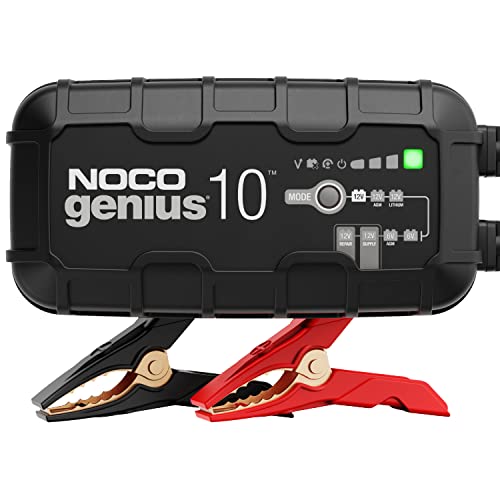
The GENIUS10 offers more power and a larger duty cycle while remaining an all-in-one charging solution. It supports 6V and 12V lead-acid and LiFePO4 batteries, with temperature compensation and desulfation features. Choose this when you have larger batteries or require faster maintenance cycles without sacrificing automatic protection.
Best for: Boats, RVs, and vehicles with bigger AGM or flooded batteries. Caution: Higher current may heat batteries faster in hot environments; ensure proper ventilation and follow temperature guidelines.
NOCO GENIUS2: 2A 6V/12V Smart Charger

Genus2 marks a balance between compact size and stronger charging, designed for lead-acid and lithium-ion batteries including AGM and deep-cycle varieties. It introduces Force Mode to bypass sensing and recharge very low-voltage batteries. This makes it a strong choice for occasional use with slightly larger or older batteries.
Who should consider it: Users needing a robust, mid-range charger that can handle low-voltage battery recovery without stepping up to higher current units. Limitation: Force Mode is not a substitute for full battery replacement when batteries are severely degraded.
Battery Tender 3 Amp Battery Charger and Maintainer

Simple, dependable, and versatile for automotive applications. This model switches between 12V and 6V as needed and maintains the battery in float once fully charged. It provides a practical option for cars, SUVs, and light-duty trucks that require consistent maintenance without advanced features.
Best for: Everyday vehicle owners who value ease-of-use and a reliable float mode. Limitation: Fewer advanced diagnostics or boosting features compared to higher-current NOCO models.
NOCO GENIUS5: 5A 6V/12V Smart Charger

The GENIUS5 sits between the smaller GENIUS1 and the higher-powered GENIUS10. It supports six- and twelve-volt batteries across lead-acid and lithium families, with temperature compensation and a built-in desulfator. It’s well-suited for mid-sized boats or larger vehicles with moderate charging needs.
Who it’s for: Users who want more charging power than 1A or 2A units but do not need the rapid replenishment of a 10A charger. Caution: It’s not as fast as higher-current chargers on very large battery banks.
Buying Guide: Key Considerations for AGM Battery Chargers
- Battery type compatibility: Ensure the charger supports AGM, Gel, SLA, VRLA, flooded, and LiFePO4 if you depend on multiple battery chemistries.
- Charging amperage: Higher amperage charges faster but may generate more heat. Match charger current to battery size and usage pattern.
- Desulfation and maintenance modes: Look for desulfation and auto-maintain/float modes to extend battery life during storage or idle periods.
- Temperature compensation: A charger with an ambient-temperature sensor prevents overcharging in heat and undercharging in cold environments.
- Low-voltage recovery: Features like Force Mode help recharge batteries that have dropped to very low voltages, but may not revive badly damaged cells.
- Ease of use and space: Compact units fit tight compartments; consider wall-mount or shelf-friendly designs for boats, RVs, and garages.
- Safety and protections: Look for overcharge, reverse polarity, short circuit, and spark-proof protections for safer operation.
Frequently Asked Questions
- What is an AGM battery maintainer and why do I need one?
– It maintains float voltage to prevent sulfation and extends battery life during long periods of inactivity. - Can I use a LiFePO4 charger on AGM batteries?
– Some chargers support both, but check the manufacturer’s compatibility; not all LiFePO4 chargers are suitable for AGM. - Is higher amperage always better for maintenance?
– Not always. Higher amperage charges faster but may cause more heat; choose based on battery size and usage. - What is desulfation and should I use it?
– Desulfation uses pulse currents to dissolve sulfate crystals on plates; helpful for aging or idle batteries but not a substitute for replacement. - Do these chargers require constant outlet power?
– Yes, standard wall outlet connection is needed to operate and to maintain float mode. - Are there any safety tips for winter storage?
– Store in a cool, dry place and use a maintenance charger to keep batteries ready; avoid damp environments and extreme temperatures.