Best Adjustable Current Sensing Relay for Safe, Precise Electrical Control
Answering common buyer needs, this guide highlights adjustable current sensing relays ideal for monitoring and controlling AC loads. The top picks suit hobbyists, small businesses, and industrial setups that require reliable, adjustable sensing ranges and fast response times. Each product is evaluated for who it’s best for, how it handles different waveforms, and practical limitations you should consider before purchase.
| Product | Sensing Range | Best For |
|---|---|---|
| Dayton 6C055 | 10A, 120VAC | Compact control panels, light automation |
| FEARLIE F006 | 0.2-50A (0.2-30A typical) | Industrial monitoring, high precision |
| CrocSee CS-TS0 | 1-50A | Universal outputs, self-powered use |
| Jadeshay M3050 | 0.2-30A | Easy-to-use, self-powered sensing |
| nodehawk N50 | 0.2-50A | Fast response, solid-state outputs |
Dayton 6C055 Current Sensing Relay

The Dayton 6C055 is a compact, adjustable current sensing relay rated at 10A with a 120VAC operation. It’s described as an AC current sensor relay with a 4-pin configuration, suitable for small automation projects and control panels. Best for users who need a straightforward, single-phase sensing relay with a simple interface. A potential limitation is the fixed 10A rating, which may not cover higher-load applications without upgrading to a higher-current model.
FEARLIE F006 AC Current Sensing Switch

The FEARLIE F006 offers an ultra-wide sensing range of 0.2-50A and precise measurement with solid-state output. It is well-suited for industrial environments that require accurate monitoring across various waveform types. It provides fast switching with a response time under 200 ms, making it effective for safety interlocks and automated equipment control. A caution: the detailed operating range may exceed basic hobbyist needs, and wiring is best handled by someone familiar with AC sensing relays.
CrocSee CS-TS0 Miniature Current Switch

The CrocSee CS-TS0 is a self-powered, normally open current sensor with a sensing range from 1 to 50A. It features 2.5A at 120/240 VAC outputs and universal solid-state outputs. It is best for setups where external power supplies are to be avoided. A potential limitation is its 1% accuracy claim, which, while solid, may not meet ultra-precise instrumentation needs in critical processes.
Jadeshay AC Current Sensing Switch M3050

The Jadeshay M3050 offers an adjustable 0.2-30A current range with self-powered operation and a visible LED status indicator. It emphasizes ease of use and fast response due to a high-power MOS tube contactless switch. Choose this if you want a straightforward, plug-and-play current sensor with clear status feedback. Limitation: some users may require a wider range than 30A for heavier loads.
nodehawk Current Sensing Relay N50
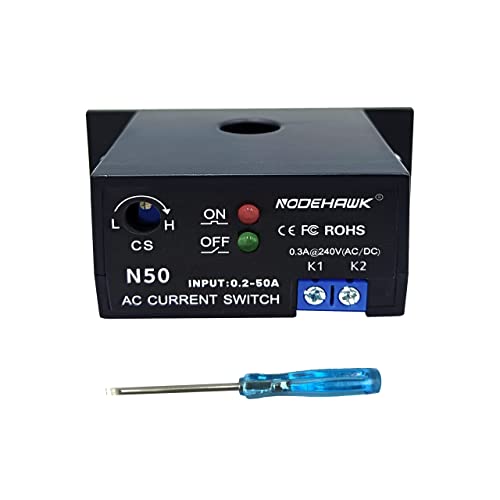
The nodehawk N50 provides a 0.2-50A sensing range with universal solid-state outputs and a fast response time of ≤200 ms. It is described as reliable for rapidly switching circuits once current is detected, making it a strong option for automation projects requiring quick protective actions. A caution: verify compatibility with existing control hardware to ensure proper output signaling and mounting space.
Buying Guide
What load range do you need?
Choose a sensor with a current range that covers your maximum load. If most operations stay below 20A, a 0.2-30A or 10A model may suffice. For larger systems, select up to 50A for headroom.
Do you need self-powered operation?
Self-powered models simplify installation by removing external power requirements. They are ideal for compact enclosures but confirm that the supply in your panel can support the sensor’s requirements.
How important is response time?
Faster response times (≤200 ms) improve safety interlocks and protective actions in automated lines. If your application tolerates slower switching, a standard 200 ms or slightly higher might be acceptable.
Which outputs are suitable?
Look for universal solid-state outputs or normally open/closed contacts that align with your control circuitry. Consider whether you need to drive a relay coil, a PLC input, or a direct load switch.
Accuracy and waveform compatibility
High accuracy (1% or better) and compatibility with various waveform types (AC, pulse, triangular) help ensure consistent readings in industrial environments. If your system experiences non-sinusoidal signals, prioritize models that advertise waveform versatility.
Space and mounting considerations
Check physical dimensions and mounting options. Some sensors use straight-through designs or compact housings that fit tight control panels. Adequate clearance around wiring is essential for safe installation.
FAQ
- What is an adjustable current sensing relay? It is a device that detects electrical current within a circuit and triggers a control output, with a user-adjustable sensing range for different loads.
- What applications are these relays best for? They suit automation panels, safety interlocks, motor control, and load monitoring in residential, commercial, and industrial contexts.
- Do these relays require external power? Some are self-powered; others may need an external supply, depending on the model.
- Which safety considerations exist? Ensure proper isolation, correct voltage ratings, and correct wiring to avoid accidental energization or coil loading issues.
- Can I mix different brands in the same system? Yes, if outputs and control logic are compatible, but verify signal levels and load requirements to avoid incompatibilities.
- How do I choose between NO and NC types? NO (normally open) closes when current is detected; NC (normally closed) opens with current. Choose based on whether you want the circuit to energize or de-energize upon sensing.