Best Acid Lead Battery Chargers for Lead-Acid Batteries
Choosing a reliable acid lead battery charger is essential for maintaining vehicles, boats, and equipment that rely on 12V or 24V lead-acid systems. This guide highlights top chargers designed to protect, restore, and optimize performance across flooded, AGM, GEL, and other lead-acid chemistries. Each pick combines safety features, smart charging, and user-friendly operation to support longevity and readiness in varying climates. Read on to compare key models, their strengths, and what to consider when buying.
Summary of chosen products:
| Product | Brand | Key Benefit | Charge Range |
|---|---|---|---|
| NoCO GENIUS1 | NOCO | All-in-one charger, maintainer, and desulfator; smart temperature compensation | 6V/12V |
| NOCO GENIUS10 | NOCO | Higher power, larger battery support; robust desulfation and protection | 6V/12V |
| YONHAN 15A Battery Charger | YONHAN | Nine-stage charging with temp compensation; supports LiFePO4 and lead-acid | 12V/24V |
| E-FAST Battery Charger 0-20A | E-FAST | All-in-one solution with seven-stage charging and comprehensive protections | 12V/24V |
| PZP 15-Amp 12V/24V | PZ.P | 9-stage charging with temp compensation; real-time monitoring | 12V/24V |
NOCO GENIUS1: 1A 6V/12V Smart Battery Charger

NOCO’s GENIUS1 represents a compact, versatile charging solution suitable for 6V and 12V lead-acid families and LiFePO4 batteries. As a charger, maintainer, trickle charger, and desulfator in one unit, it provides automatic protection against overcharging and adapts to ambient temperature to optimize charging performance. Its diminutive size makes it a fit for garages with limited space while delivering reliable maintenance cycles for motorcycles, ATVs, marine batteries, and more. Its integrated desulfator helps extend battery life in systems prone to sulfation.
Key features include automatic charge control, temperature-compensated charging, and compatibility with flooded, maintenance-free, AGM, VRLA, and LiFePO4 chemistries. The device’s smart thermal sensor adjusts the current to maintain efficiency across weather conditions, reducing risks associated with hot or cold environments. It is ideal for daily maintenance, vehicle storage, or as a year-round trickle charger for compartments with limited airflow.
Performance considerations: It supports both 6V and 12V systems, ensuring flexibility across small engines, lawn equipment, and marine starters. While it provides dependable maintenance and desulfation, users should note its lower amperage is best for keeping batteries healthy rather than rapidly charging severely depleted packs. Overall, GENIUS1 emphasizes safety, compactness, and multi-chemistry compatibility in a single package.
KITUREK 12V SLA Smart Charger Maintainer

KITUREK offers a 12V SLA-friendly automatic charger with short circuit protection and multiple safeguards. It is designed to safely charge all 12V sealed lead-acid batteries, including those used in motorcycles, ATVs, boats, and standby power systems. The unit features LED indicators to show charging status and automatic shutdown when fully charged, helping to prevent overcharging. Output voltage is around 13.8V, which aligns with typical lead-acid charging profiles for safe, steady maintenance.
Users gain a simple, protective solution for daily charging and prolonged storage. The integrated protections—overcurrent, overheating, and voltage spikes—help ensure safe operation in diverse environments. While not designed for high-amperage quick charging, it excels as a dependable maintainer that preserves battery health, reduces parasitic drain effects, and minimizes the need for manual checks during off-season storage.
YONHAN 15A Battery Charger
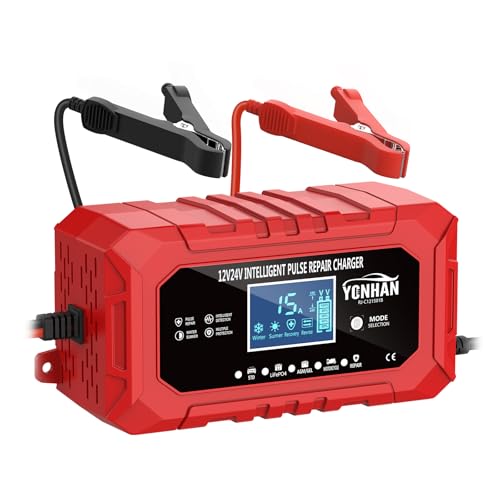
YONHAN’s 15A charger is designed for 12V and 24V lead-acid and LiFePO4 batteries, offering a nine-stage charging cycle with temperature compensation. This model supports automotive, marine, and deep-cycle applications, including trucks, boats, lawn equipment, and motorcycles. The high-efficiency pulse repair feature aims to reverse sulfation and restore battery performance, though it notes limits with completely dead cells. The charger provides robust safety through protections against reverse polarity, overcharging, overheating, and voltage or current spikes.
Operational versatility shines in temperature-adaptive charging, winter/holiday mode, and the ability to handle a wide range of battery chemistries. Users should be aware that while repair cycles can rejuvenate some aged batteries, not all dead packs respond to treatment. This charger is well-suited for mixed fleets or seasonal storage where batteries experience varying discharge levels and climate challenges.
E-FAST Battery Charger 0-20A 12/24V

E-FAST presents an all-in-one charging solution for 12V and 24V lead-acid and LiFePO4 batteries. The seven-stage charging process includes desulfation, trickle charging, constant current, constant voltage, current detection, compensation charging, and floating charging. It is designed to optimize charging behavior across assorted battery health conditions and environmental factors. The model emphasizes safety with protections against reverse polarity, overheating, overcurrent, and overvoltage, making it suitable for marine, automotive, and industrial applications where robust performance matters.
Key considerations include its higher amperage capacity, which can significantly shorten charge times on larger packs. The device’s feedback indicators help users monitor progress, though the 7-stage process can seem complex to novices. The charger’s multi-chemistry compatibility and advanced safety suite make it a compelling option for users managing varied batteries or preparing equipment for extended storage periods in colder climates.
PZP 15-Amp 12V/24V Smart Battery Charger

PZ.P’s 15A charger features a 9-stage charging process with temp compensation and an all-in-one design that maintains and repairs 12V and 24V LiFePO4 and lead-acid batteries. The color LCD provides real-time data on voltage, current, temperature, and charge status, helping users manage charging sessions with confidence. It includes a long charging cable for easier access to hard-to-reach battery compartments and a replacement guarantee to address quality concerns.
Considerations for this model include the practical balance between maintenance and repair cycles, and how effectively the 9-stage sequence adapts to different battery states. It is well-suited for vehicles, boats, and equipment that require reliable year-round maintenance, especially where visibility of chargings metrics is beneficial for ongoing battery health monitoring.
Buying Guide: Key Purchase Considerations
- Battery chemistry compatibility: Ensure the charger supports lead-acid variants (flooded, AGM, GEL) and LiFePO4 if you plan to use it on mixed fleets.
- Voltage range: Most systems here are 12V or 24V; confirm the voltages used by your equipment to avoid under or overcharging.
- Charging stages: Look for multi-stage charging (e.g., 7-stage or 9-stage) and a desulfation function for older or sulfated batteries, which helps extend life.
- Temperature compensation: Temperature-aware charging prevents overcharging in heat and undercharging in cold, improving battery longevity.
- Safety protections: Prioritize units with reverse polarity protection, overcurrent/overvoltage safeguards, short-circuit protection, and thermal regulation.
- Maintenance vs. rapid charging: If the goal is periodic maintenance for stored batteries, a lower amperage model may suffice; for fast charging of larger packs, higher amperage is beneficial.
- Display and monitoring: Real-time indicators or LCD screens help users track charging progress and battery health, which is useful for less-experienced operators.
- Installation and space: Consider the physical size and whether the unit is wall-mountable or compact enough to fit in limited spaces.
- Warranty and support: A longer warranty and responsive customer support can be important for equipment used in critical vehicles or boats.
When selecting a charger, assess your typical battery size, climate, storage duration, and whether you need a simple maintainer or a more feature-rich device with repair capabilities. For fleets or mixed-use environments, models with broad chemistry support, robust protections, and clear indicators are advantageous. Always follow the manufacturer’s instructions for safe operation and battery health optimization.