Best AC Low Pressure Gauge Sets for Accurate Refrigerant Readings
Find the right low-pressure gauge for diagnosing and charging air conditioning systems. This guide highlights five reliable picks suited for DIY enthusiasts, professional technicians, and homeowners maintaining central or window units. Each product is evaluated for compatibility, readability, and practical use, with clear pros and caveats to help you choose.
Summary Table of Selected Products
| Product | Best For | Key Benefit | Potential Limitation |
|---|---|---|---|
| Air Conditioner Refrigerant Low and High Pressure Gauge (Gohantee) | General R410A/R134A/R22 systems | Dual-scale readability with 70mm dial | Basic kit; may not include hoses |
| R134a Recharge Hose Kit with Gauge (Gohantee) | R134A charging with gauge | Integrated can tap and long hose | Includes self-sealing can tap only |
| Air Conditioner Refrigerant Pressure Gauge Set (PROSOCOOL) | Multi-refrigerant systems | Dual gauge with high visibility | Higher price tier |
| FJC 6136 R134A Low Side Gauge | Compact, lightweight setups | Simple low-side gauge option | Basic specs on limited data |
| Tigbear R134A/R1234YF/R410A Gauge Kit | Versatile recharge with multiple refrigerants | Wide usage and sealed design | Higher complexity for new users |
Air Conditioner Refrigerant Low and High Pressure Gauge 70mm

The gauge is built for R410A, R134A, and R22 refrigerants with a 70mm dial. It features a 1/8” NPT inlet connector and a clear, vivid dial for easy data reading. This makes it suitable for general diagnostics and charging tasks on common residential and commercial AC systems. Best for technicians who need a straightforward, portable gauge for multiple refrigerants.
Best for: General service on standard AC systems where multiple refrigerants are involved. Readability and basic compatibility are its strengths. Limitations: It does not specify advanced features like dual gauges, so more complex diagnostics may require additional tools.
R134a Recharge Hose Kit with Gauge
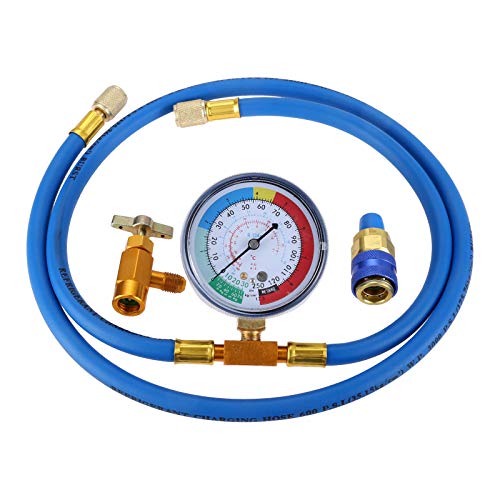
This kit includes a 51″ charging hose and a 200 PSI gauge with a self-sealing R-134a can tap and 1/2″ Acme Female R-H thread. It is designed for R134A systems in vehicles or home AC setups and helps users view pressure during charging. Best for: DIY mechanics and homeowners performing R134A top-offs or recharge tasks. Choose this if you need a built-in gauge and an extended hose. Caution: The can tap is self-sealing and works only with compatible cans; puncture cans are not suitable.
Air Conditioner Pressure Gauge Set with Dual Scale
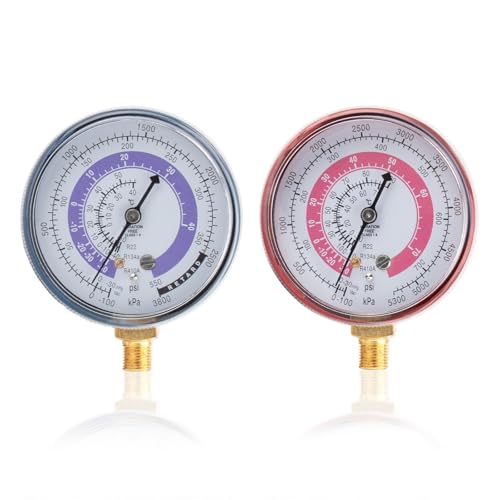
This dual-scale gauge set monitors high (red, 0-800 PSI) and low (blue, 0-500 PSI) pressures, covering R410A, R134A, and R22 systems. The gauges are 70mm with clear markings to aid quick interpretation and reduce diagnostic time. Best for: Technicians who need a robust, color-coded tool for fast, simultaneous readings. Better for: multi-refrigerant systems where quick reference helps workflow. Limitation: It may be pricier than single-gauge options, but offers comprehensive diagnostics.
FJC 6136 R134A Low Side Gauge

This low-side gauge from FJC is compact and straightforward, intended for R134A systems. While data provided focuses on package dimensions and origin, the tool offers predictable measurements for straightforward charging tasks. Best for: Budget-conscious users needing a basic, reliable low-side gauge. Limitation: Lacks details about dual-range or high-side readings, limiting diagnostics on complex systems.
R134A/R1234YF/R410A Refrigeration Gauge Kit

This versatile manifold gauge kit supports R134A, R1234YF, and R410A with 1/8″ male NPT connections and up to 800 PSI. It emphasizes broad refrigerant compatibility and a sealed design to minimize refrigerant loss during use. Best for: Technicians who work with multiple refrigerants and need a single, adaptable kit. Limitation: The setup may be more complex for beginners and requires familiarity with manifold gauge operation.
Buying Guide: Key Purchase Considerations
- Refrigerant compatibility: Ensure the gauge supports the refrigerants you service (R410A, R134A, R22, etc.).
- Gauge readability: Look for large, clearly marked dials and color-coded scales to reduce misreadings.
- Connector size and hose length: Confirm 1/8″ NPT or other adapters match your system and that hoses are long enough for comfortable use.
- Dual vs single gauge: Dual-scale sets offer simultaneous high and low readings, speeding diagnostics for multi-refrigerant systems.
- Build quality and durability: Prioritize kits with robust materials and sealed designs to prevent leaks and withstand regular use.
- Can tap compatibility: If using self-sealing cans, verify the tap threading and compatibility to avoid leaks or equipment damage.
- Portability and storage: For technicians on the go, a compact gauge with included case is advantageous.
Frequently Asked Questions
- What is the difference between a single and dual gauge set? Answer: A single gauge measures one side (low or high), while a dual gauge set measures both sides simultaneously, offering quicker diagnostics for multi-refrigerant systems.
- Which refrigerants require R134A readings? Answer: R134A is common in many household and automotive systems; gauges supporting R134A help with accurate charging and diagnostics.
- Why is a self-sealing can tap important? Answer: Self-sealing taps reduce the risk of refrigerant leaks and make charging cleaner and safer when using canned refrigerants.
- Are these gauges suitable for professional HVAC technicians? Answer: Yes, the selected sets include features like clear dials and robust construction that assist professional diagnostics, while remaining accessible to advanced DIY users.
- What should I consider if I work with multiple refrigerants? Answer: Choose a gauge kit that supports all refrigerants you service, ideally with dual readings and robust compatibility to simplify workflows.
- Is a longer hose beneficial? Answer: Yes, longer hoses provide flexibility to work in tight or cramped spaces without repositioning the system.