Best AC Fan Motor Control Solutions for Refreshing Airflow and Precise Speed
Answering the demand for reliable, user-friendly AC motor speed control, this guide highlights select AC fan motor controllers and related accessories. These options are best for DIY projects, shop tools, duct and exhaust fans, and automotive blower or HVAC components using brushed AC motors. Each pick is evaluated for compatibility, ease of use, and practical limitations to help you choose the right controller or switch for your setup. The top picks below are ideal for hands-on users who want precise voltage-based speed control and built-in protection.
| Product | Best For | Key Benefit |
|---|---|---|
| CDMALL AC Motor Speed Controller | Inline duct and exhaust fans, routers | Real-time LED voltage display, overload protection |
| KB Electronics 8811007 | Standard electrical boxes, fixed-speed control | UL/CSA approved, simple fixed-amp control |
| IGEYAPA AC Motor Speed Controller | General 120V brushed motors | Overload/overvoltage protection, clear LED readout |
| ReeMoo AC Motor Speed Controller | Brushed motors like routers and drills | Resettable overload protection, LED voltage display |
| UCCKEYI AC Blower Motor Switch | Vehicle blower motors | Interchangeable part, simple blower control |
CDMALL AC Motor Speed Controller For Brushed Motors
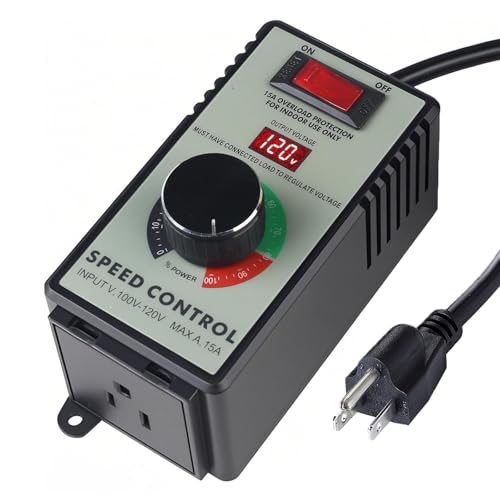
Best for: tight control of small to mid‑size brushed AC motors such as inline duct fans, exhaust fans, ceiling fans, routers, drills, and incandescent lighting projects. This controller reduces voltage to slow or speed up the motor, delivering a full 0–120V range with a real-time LED display so you can dial in exact speed. The built-in 15A circuit breaker provides electronic overload protection, resetting with a switch instead of hunting for fuses. Practical limit: not compatible with brushless motors, DC motors, or appliances with circuit boards. Recommended working current is within 10A for extended use to avoid nuisance trips.
Why this was selected: clear voltage readout helps repeat precise speeds across multiple projects, and the overload protection enhances safety during long runs. The device supports a broad range of common brushed motors and simple resistive loads, making it a versatile option for workshop tasks and home projects.
KB Electronics 8811007 Solid State Variable Speed AC Electric Motor Control

Best for: projects that fit a standard 2″ x 4″ electrical wall box and require a fixed-speed, UL & CSA approved solution. With a 6.0 A max at 115V, this controller is suited for lighter-duty brushed motors where a simple, reliable, built-in protection profile is needed. Not suitable for capacitor-start or capacitor-run motors. Caution: it’s a fixed‑speed device rather than a variable control, so adjust expectations if your application needs frequent speed changes.
Why this was selected: its compact, industry-standard form and safety certifications make it a straightforward choice for controlled, fixed-speed applications in small mechanical setups or educational projects where space is limited and regulatory compliance matters.
TadaMark Front HVAC Blower Motor Assembly

Best for: automotive HVAC applications, particularly Toyota Camry and Sienna models, where blower motor replacement is needed to restore airflow. This is a complete blower motor assembly rather than a speed controller. It’s selected for readers who are troubleshooting blower performance in vehicles and might need a full replacement rather than a controller. Limitation: not a speed controller, so use when you specifically need motor replacement rather than voltage-based speed control.
Why this was selected: it addresses a common failure point in vehicle HVAC systems and provides a practical restoration path when a controller alone cannot fix airflow issues.
IGEYAPA AC Motor Speed Controller 100V-120V 15A

Best for: a broad range of 120V brushed motors with a need for precise speed control and safety protections. It supports up to 15A peak, with a rated 10A continuous current, and features an LED voltage readout and protective features like surge and RC absorption. Use this when you require a visible voltage reference and robust overload protection for tools such as routers and fans. Limitation: for brushed motors only; not suited for DC or brushless systems.
Why this was selected: the combination of a real-time voltage display, clear knob control, and multi-protection design makes it a strong all-around controller for hobby and semi-professional projects requiring repeatable speeds.
ReeMoo AC Motor Speed Controller For Brushed Motors

Best for: brushed motors such as routers, drills, duct fans, and small woodworking tools. This controller provides a real-time LED voltage display and a resettable overload protection mechanism, which helps prevent damage during startup surges typical of inductive loads. Caution: startup current can be several times the rated current, so monitor load to avoid tripping the 15A breaker. It’s well-suited for precise trips back to the selected speed and repeatable results.
Why this was selected: the combination of a clear voltage readout, safety features, and a compact design makes it a reliable choice for workshop gear and hobbyist projects where speed accuracy matters.
UCCKEYI AC Blower Motor Switch

Best for: automotive applications needing a dedicated blower motor switch for the HVAC system. This is a straightforward replacement part that allows direct control of the blower motor, rather than electronic speed modulation. Useful when a vehicle’s blower behavior is inconsistent due to a switch issue rather than motor speed variation.
Why this was selected: it provides a practical solution for vehicle HVAC owners who need a robust, interchangeable switch to restore blower operation. Limitation: not a variable speed controller for fine-tuned airflow; it’s a switch-based control option.
Buying Guide: Key Considerations For AC Motor Speed Control
- Motor type compatibility: Most controllers listed here are for brushed AC motors. Do not use with brushless, DC, or circuit-board-based devices unless the manufacturer specifies compatibility.
- Voltage and current ratings: Match the controller’s input voltage (typically 110–120V) and its maximum current (A) to your motor’s draw, including startup surges. Oversizing can waste energy; undersizing can trip breakers.
- Protection features: Look for electronic overload protection, resettable breakers, surge protection, and RC absorption for inductive loads to protect both controller and motor.
- Display and adjustability: LED voltage displays help replicate precise speeds. A rheostat or knob that offers low/medium/high settings is helpful for repeatable tasks like routing or sanding.
- Form factor and installation: Wall-box controllers fit in standard electrical cavities; ensure your enclosure and wiring can accommodate the unit. For vehicles, confirm compatibility with the HVAC blower system and mounting space.
- Operational caveats: Start-up current is often higher than running current for brushed motors; design or use a controller that can handle peak loads or has a recommended caution for continuous use.
- Limitations of non-controller parts: Replacement blower motors or complete assemblies are necessary when a motor itself fails, not when a controller is the issue.
Frequently Asked Questions
- What is the main purpose of an AC motor speed controller?
- Can I use a DC motor controller on an AC motor?
- Why does startup current matter with brushed motors?
- Is an LED voltage display essential?
- Are these controllers suitable for automotive use?
- What is the advantage of a resettable overload protector?
To regulate the voltage delivered to a brushed AC motor, allowing you to vary speed and torque for tasks like ventilation, routing, or polishing.
No. Controllers designed for DC or brushless motors are not compatible with brushed AC motors and may cause damage or unsafe operation.
Brushed motors draw a surge current higher than running current at startup, which can trip breakers or overwhelm a controller. Choose a unit rated for higher peak current if needed.
It is helpful for repeatable speed settings and troubleshooting, but not strictly required. It provides immediate feedback on the speed setting.
Some are designed for automotive HVAC blower applications, but always verify compatibility with your vehicle’s electrical system and any OEM specifications before installation.
It eliminates the need to replace fuses after overload events and allows quick restoration of operation, reducing downtime.