Best Clamp Meter for AC/DC Testing: Top 5 Picks
When diagnosing electrical systems, a reliable AC/DC clamp meter is essential. This article highlights five standout models that balance accuracy, safety features, and ease of use for professionals and DIY enthusiasts alike. Each product section includes key capabilities, making it easier to compare at a glance and choose the right tool for automotive, residential, or commercial work.
| Product | Brand | Notable Feature |
|---|---|---|
| KAIWEETS Digital Clamp Meter | KAIWEETS | True-RMS, D-shaped jaw |
| AstroAI Digital Clamp Meter | AstroAI | NCV detection, backlit display |
| Klein Tools CL490 AC/DC Clamp Meter | KLEIN TOOLS | Dual displays, TRMS, NCVT |
| Fluke 325 True-RMS Clamp Meter | Fluke | High accuracy, wide measurement range |
| Klein Tools CL390 AC/DC Clamp Meter | KLEIN TOOLS | Compact, wide range |
Note: All products listed support AC/DC current and voltage measurements, with varying features like NCV detection, backlit displays, and dual screens to aid visibility in dim environments. Safety ratings and Jaw design differ by model, so choose based on your primary use, space constraints, and the required measurement capabilities.
KAIWEETS Digital Clamp Meter

The KAIWEETS clamp meter offers TRUE-RMS measurements for AC and DC current and voltage, plus temperature via a thermocouple, capacitance, frequency, resistance, continuity, diode tests, and non-contact voltage (NCV) detection. The D-shaped jaw opens up to 1.1 inches, enabling secure clamping around various cables. It includes audible and visual alarms for voltage detection, making it suitable for electrical troubleshooting in homes, automotive, solar installations, and industrial settings. This model suits electricians seeking a compact tool with versatile testing options.
AstroAI Digital Clamp Meter
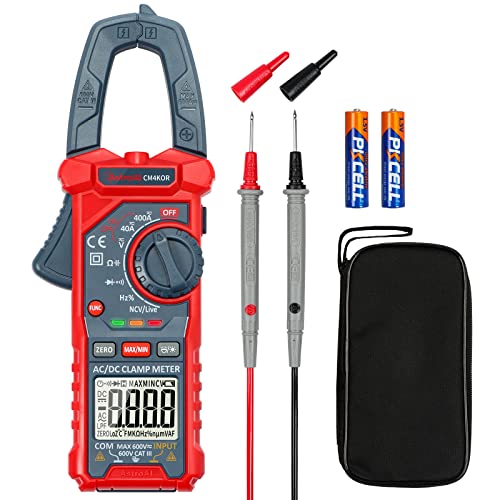
AstroAI’s clamp meter covers AC/DC current and voltage, plus resistance, capacitance, frequency, and continuity tests. It features non-contact voltage testing with audible and visual alarms, a backlit LCD screen, and a flashlight for dark work areas. The device supports data hold, MAX/MIN functions, and auto power-off after 15 minutes to conserve battery. A low-battery indicator and a zero function help improve reading accuracy, making this model a practical option for both fieldwork and shop environments.
Klein Tools CL490 AC/DC Clamp Meter

The CL490 from Klein Tools features a high-visibility dual display and versatile measurement capabilities, including AC/DC current and NCVT via the clamp, along with AC/DC voltage, resistance, continuity, frequency, and more via test leads. It provides temperature readings with a thermocouple and emphasizes backlit reverse-contrast LCD for easy viewing in challenging lighting conditions. This model is well-suited for professional electricians who need a robust, feature-rich meter for complex electrical systems.
Fluke 325 True-RMS Clamp Meter

Fluke’s 325 True-RMS clamp meter measures AC current up to 400 A, AC/DC voltage up to 600 V, and resistance up to 4 kΩ. It delivers accurate readings on linear and non-linear loads thanks to True RMS sensing. The jaw opening accommodates a conductor up to 30 mm, enabling non-intrusive current measurement. Fluke is known for precision and durability, making the 325 a go-to choice for professionals who require reliable performance in diverse environments.
Klein Tools CL390 AC/DC Clamp Meter

The CL390 provides a compact, versatile option with AC/DC current and NCVT testing through the clamp, plus measurement of AC/DC voltage, resistance, continuity, and temperature via a thermocouple. Its non-contact voltage testing capability simplifies quick checks in the field. The device uses a high-visibility reverse-contrast display to ensure readable data in varied lighting conditions, making it an appealing choice for technicians who need a balance of size and capability.
Buying Guide
- True RMS vs. non-True RMS: True RMS meters provide more accurate readings for non-linear loads (such as variable speed drives and modern electronics). If you work with non-linear loads, prioritize True RMS models like several in the list.
- Clamp jaw size and design: A larger jaw opens more easily around thick conductors, while a compact jaw helps in tight spaces. D-shaped jaws improve accessibility around bundles of wires, as seen on some KAIWEETS models.
- Non-contact voltage (NCV) detection: NCV is a safety feature that helps identify live wires without contact. Look for audible alarms or visual indicators to confirm voltage presence.
- Display and visibility: Dual displays or backlit/reverse-contrast LCDs enhance readability in dark or cluttered environments. A secondary display can be valuable for cross-checking measurements quickly.
- Measurement breadth: Consider which tests you need—current, voltage, resistance, capacitance, frequency, diode, continuity, temperature, and live-wire testing. Some models include thermocouples for temperature measurement, while others offer NCV as a core feature.
- Safety ratings and form factor: For residential work, select meters with appropriate CAT ratings and compact designs for easy handling in confined spaces.
- Battery life and power management: Auto shut-off features extend battery life, which is important for field use. Check whether batteries are included or require separate purchase.
- Durability and warranty: Higher-end brands like Fluke and Klein Tools typically offer robust builds and longer warranties, which may justify higher upfront costs for professional use.
Choosing the right AC/DC clamp meter depends on your typical tasks, the environments you work in, and the level of measurement detail you require. This guide highlights models suitable for electricians, technicians, and serious DIYers who need reliable readings, safety features, and ease of use in a range of applications—from home electrical panels to automotive diagnostics and industrial settings.