Best AC Current Sensor Switches for Quick, Reliable Power Monitoring
Discover top AC current sensing switches designed to monitor and control electrical loads with accuracy and speed. This guide highlights five reliable options, covering ranges from 0.2 to 50A, with self-powered operation and fast response times. Each product section includes practical applications, key features, and installation considerations to help you choose the right sensor for industrial automation, safety interlocks, and energy management.
Summary Table of Chosen Products
| Product | Brand | Current Range | Output | Notes |
|---|---|---|---|---|
| Current Sensing Relay AC Current Sensing Switch 0-30A Normally Open | nodehawk | 0-30 A | Normally Open | High-speed millisecond response; isolation up to 2000V |
| CrocSee Miniature Current Switch, CS-TS0 | CrocSee | 1-50 A | Normally Open | Universal solid-state outputs; self-powered |
| FEARLIE Current Sensing Switch, F007 | FEARLIE | 0.2-30 A | Normally Closed | Accuracy better than 1%; fast <200 ms |
| AC Current Sensing Switch 0.2~30A Self-Powered | YWBL-WH | 0.2-30 A | Normally Open | Self-powered; no external supply |
| Current Sensing Relay 0-30A N30 | nodehawk | 0.2-30 A | Universal Outputs | Fast response ≤200 ms |
Current Sensing Relay AC Current Sensing Switch 0-30A

The M-3050 model uses mutual inductance to sense AC current, providing isolation and a switch output suitable for controlling lamps, buzzers, relays, microcontrollers, and other power loads. It is self-powered (no external supply) and supports 0-30A input with a 0.3A@240V AC/DC rated load. The device offers millisecond-level response, low hysteresis, and isolation up to 2000V, enabling reliable monitoring in challenging environments.
CrocSee CS-TS0: 1-50A Normally Open Amp Sensor Relay

The CrocSee CS-TS0 offers a universal, solid-state output with a sensing range from 1 to 50 amps and self-powered operation. In a 240V circuit, only one 120V hot line needs to pass through. This makes it a versatile choice for a variety of AC monitoring tasks where quick, reliable current detection is required for automation and protection schemes.
FEARLIE F007: 0.2-30A NC Current Sensing Switch

FEARLIE F007 provides a tight sensing band from 0.2 to 30A with solid-state output and precision better than 1%. It accommodates various waveforms, including AC, and features a normally closed contact with a fast response time of up to 200 ms. This sensor is well-suited for safety interlocks and scenarios requiring immediate disconnection upon current presence.
AC Current Sensing Switch 0.2~30A Self-Powered

This self-powered switch relies on electromagnetic mutual induction to sense AC current, eliminating the need for an external power source. It covers a broad utility range for monitoring and controlling diverse industrial equipment, including facility automation, alarms, and process controls. It emphasizes straightforward installation and energy-efficient operation.
Current Sensing Relay 0-30A N30
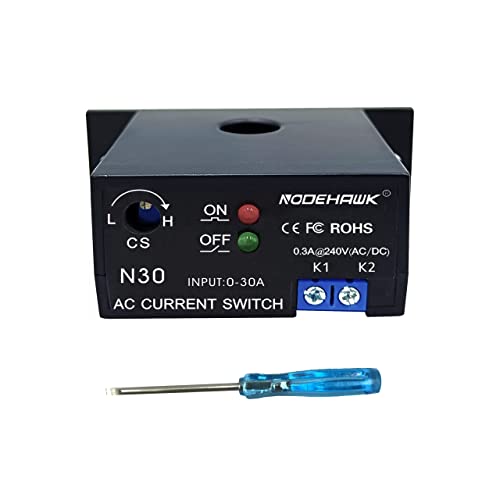
The N30 variant from nodehawk provides universal outputs with a 0.2-30A sensing range and a 0.3A@240V AC/DC rated load. It emphasizes fast switching, with a response time of ≤200 ms, making it suitable for safety-critical automation and protection systems where rapid response is essential.
Buying Guide
Key considerations when choosing an AC current sensor switch include sensing range, output type, power requirements, response time, isolation, and installation practicality. The following perspectives help cover common use cases and constraints:
- Application fit: For simple on/off control of devices like lights or alarms, a normally open output with a 0.2-30 A range is often sufficient. For safety interlocks or fail-close protections, a normally closed variant can be preferable.
- Power supply: Self-powered (no external supply) designs simplify installation and reduce cable clutter, but ensure the sensing range and output type align with your control circuitry.
- Response time and hysteresis: Millisecond-level response is important for protection and fast control loops. Low hysteresis (under 1%) improves precision in fluctuating loads.
- Electrical isolation: High isolation voltage (up to 2000V in several models) minimizes the risk of interference between the sensed current path and control electronics.
- Accuracy and waveform compatibility: Sensors that specify accuracy under varying waveforms (AC, pulsed, or triangular) provide reliability in non-sinusoidal environments.
- Installation considerations: Through-hole vs. surface-mount, wiring configuration (one hot line vs. full current path), and compatible load ratings affect ease of deployment.
- Availability and support: Choose brands with clear specifications, documentation, and compatibility with your automation platforms or microcontrollers.
When selecting among the five highlighted options, consider whether you prioritize ultra-fast response (≤200 ms), higher current range (up to 50 A), or a particular output style (NO vs NC, universal outputs). Also assess the environment—industrial settings may demand stronger isolation and robust connectors, while hobbyist projects might favor compact, self-powered units that are easy to wire.