Best AC Bench Power Supplies for Precise Lab Powering and Testing
For electronics hobbyists, students, and engineers, a reliable AC bench power supply is a foundational tool. The right model delivers adjustable voltage and current with protection, accuracy, and durable construction. This guide highlights five strong options that balance performance, safety features, and value. Each product section provides a quick snapshot, an image, and key features to help you compare at a glance. Use the buying guide at the end to consider what matters most for your lab setup.
| Product | Brand | Top Feature |
|---|---|---|
| SPD3303X-E Triple Output Power Supply | Siglent | Independent outputs with isolation |
| AC110V Bench Power Supply | Mefape | 0-30V, 0-20A, high precision |
| VEVOR 2000VA Auto Variable Voltage Transformer | VEVOR | 0-130V output, high power capacity |
| Beleeb 20Amp Variable Transformer | Beleeb | 0-130V, 20A continuous |
| Jesverty DC Power Supply Variable | 0-30V, 0-10A with CV/CC operation |
Siglent SPD3303X-E Triple Output Power Supply
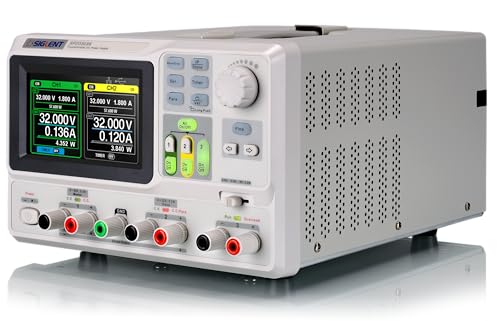
The Siglent SPD3303X-E provides three independent and isolated outputs with a combined power capacity of 220W. Each channel can be controlled individually or configured in series or parallel modes. Output voltages include 32V/3.2A for two channels and 2.5V/3.3V/5V/3.2A for the third channel, enabling precise multi-rail testing. This unit supports CV and CC modes and offers flexible operation for lab work, education, and electronics prototyping. The compact design makes it suitable for desktop use in small labs.
AC110V Bench Power Supply By Mefape

The Mefape AC110V bench supply offers a variable voltage range from 0 to 30V and a current range from 0 to 20A. It features coarse and fine adjustments for high-precision regulation, along with a switchable constant voltage/constant current mode. This model is designed for stable, repeatable lab performance, with solid regulation suited for precise device testing, charging experiments, and experimental rigs that require dependable DC output control from an AC source.
VEVOR 2000VA Auto Variable Voltage Transformer

The VEVOR adjustable transformer delivers up to 2000VA with an 0-130V output and a 15.3A maximum current. It is designed for precise voltage control in home, office, or light industrial environments. Built-in fuses, a thermal control switch, and a resettable overload protector provide safety during testing and equipment operation. It does not convert AC to DC; instead, it offers a safe, continuously adjustable AC output to power a wide range of devices that require stable AC input for testing, warm-up cycling, or fieldwork.
Beleeb 20Amp Variable Transformer

The Beleeb variable transformer offers 0-130V output with a robust 20A continuous rating (16A continuous operation under real conditions). It uses an AC input and an AC output, without converting to DC, preserving the 60Hz cycle rate of the mains. This model is suited for bench experiments that require a high-current adjustable AC source to power motors, heaters, or transformers during testing or development.
Jesverty DC Power Supply Variable

The Jesverty SPS-3010 is a variable DC power supply with 0-30V and 0-10A ratings. It features a four-digit LED display for precise voltage, current, and power readings, and it automatically switches between constant voltage (CV) and constant current (CC) modes as the load changes. The unit also includes a 5V/2A USB port for convenient device charging or data logging during experiments, making it a practical choice for electronics labs and students learning power electronics principles.
Buying Guide — Key Purchase Considerations For AC Bench Power Supplies
When selecting an AC bench power supply, buyers should weigh several factors to match their needs. Voltage range and current capability determine what devices you can test or power. Independent channels and isolation improve versatility for multi-device setups and precision experiments. Regulation quality matters for repeatable results, especially in lab environments, so examine regulation accuracy, voltage spikes, and noise performance. Safety features like over-voltage protection, fuse protection, thermal cutoffs, and overload protection protect both equipment and operators.
Control interface and readouts influence usability. Look for clear displays (CV/CC indicators, real-time voltage/current readouts), precise coarse and fine adjustment knobs, and dual displays if needed for monitoring multiple rails. In addition, consider the enclosure quality, heat management, and build robustness for long-term lab use. If you need high current or higher power for motors, heaters, or large transformers, prioritize models with higher VA or W ratings and sturdy connectors. Finally, assess size and portability for desktop setups or fieldwork, and verify available accessories like plug adapters or tip sets.
For testing multiple devices, three considerations stand out: channel independence, protection schemes, and the ability to configure outputs in series or parallel. Devices with independently adjustable outputs and isolation enable safer, simultaneous testing of different circuits. Series/parallel configuration expands the available voltage and current combinations for complex lab scenarios. Compare units to balance price, features, and reliability to ensure your choice remains useful as your experiments evolve.