Best AC Backup Power Supplies for Home and Office
Answering your search for reliable AC backup power starts with selecting a compact, dependable UPS or portable power station. This guide highlights five top options ideal for keeping essential devices running during outages. Best for home offices, small workspaces, and essential networking gear, these picks balance battery life, outlets, and surge protection. Each product section explains who it’s best for, why it was chosen, and a practical caveat to consider.
| Product | Best For | Main Benefit |
|---|---|---|
| APC BE425M | Small routers and modems | Compact battery backup with multiple outlets |
| APC BE600M1 | Home office essentials | Solid balance of runtime and protection |
| CyberPower CP1500PFCLCD | PCs and workstations | Pure sine wave, adjustable AVR |
| EF ECOFLOW Delta 2 | Expanded home backup and camping | High capacity and fast charging |
| APC BX1500M | Full computer setups | High runtime with multiple protected outlets |
APC Back-UPS 425VA / 255W UPS Battery Backup Surge Protector

The APC BE425M provides short‑term battery power to maintain internet connectivity during outages. It’s best for low‑power devices such as routers, modems, VoIP phones, and small home-office electronics. It includes six outlets—four with battery backup plus surge protection and two surge-only outlets—protecting equipment from power spikes.
Best for: A buyer needing compact protection for essential networking gear in a small office or apartment. Avoid this if you require long runtime or power-hungry devices.
APC UPS Battery Backup 600VA / 330W, 7 Outlets
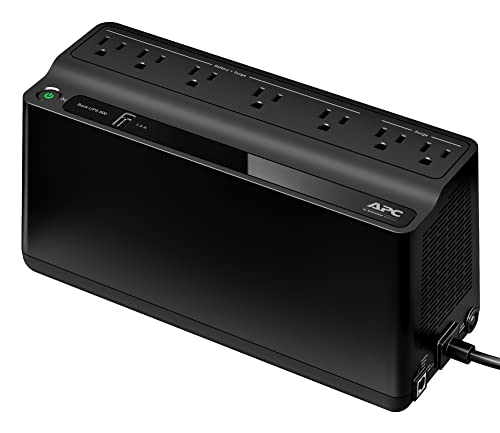
This BE600M1 supports computers, Wi-Fi, and routers with up to ~23 minutes of runtime at 100W. It combines full battery backup on multiple outlets with surge protection, and two surge-only outlets for less-critical gear. It’s a practical choice for a small home office that needs a safe shutdown option and protection during brief outages.
Best for: Small workstations or home offices seeking reliable, compact backup power. Caution: runtime varies by load; heavier equipment will shorten backup time.
CyberPower CP1500PFCLCD PFC Sinewave UPS

The CP1500PFCLCD delivers 1500VA/1000W with a pure sine wave output, ideal for active PFC power supplies and sensitive electronics. It features 12 outlets (six battery backup and surge protected; six surge protected), a color LCD panel, and USB charging ports. The device is well-suited for desktops, workstations, and network gear that demand stable power during outages.
Best for: Users with mid-to-high power computers and peripherals who need clean power and an informative display. Caution: larger footprint than basic models; price and complexity are higher than entry-level units.
EF ECOFLOW Delta 2 Portable Power Station

The Delta 2 provides 1024Wh with 1800W AC output and 15 outlets, offering robust home backup power and outdoor flexibility. It can expand capacity up to 3kWh with additional batteries, supports fast AC charging, and includes multiple USB ports. It’s suitable for home backup, camping, or RV use and can power most common appliances on demand.
Best for: Home users seeking a high-capacity, versatile power station for extended outages or off-grid scenarios. Caution: heavier and more expensive than standard UPS units; best if you need mobility and higher wattage.
APC UPS Back-UPS Pro 1500VA

The BX1500M stands out for higher runtime and protection across ten outlets (five back-up and five surge-only), with AVR to stabilize voltage. It’s well-suited for computers, Wi-Fi routers, NAS devices, and other essential office electronics during outages. A practical pick for users needing consistent power during longer interruptions.
Best for: Medium-sized home networks and computer setups that require more outlets and better protection. Caution: bulky relative to compact desk models; ensure your space accommodates it.
Buying Guide: Key Purchase Considerations
- Runtime needs: Estimate total wattage of devices and desired outage time. Higher-capacity models support longer runs.
- Power quality: For modern PCs with active PFC or sensitive electronics, consider pure sine wave output for cleaner, safer power.
- Outlet configuration: Count battery-backed and surge-only outlets to fit your gear mix and location.
- Expandability: If you anticipate growing power needs, look for units with higher VA/W ratings or expandable modules.
- Portability vs. capacity: Portable power stations offer mobility and AC output, but with heavier weight and different charging considerations—choose based on use case (home backup vs. outdoor).
- Protection features: Surge protection, coax/ethernet surge, temperature monitoring, and safe shutdown capabilities help minimize risk.
FAQ
- What’s the difference between a UPS and a portable power station?
A UPS provides immediate battery backup with power conditioning for electronics during outages, while a portable power station is a broader power source that can be used for both home backup and outdoor needs with higher capacity. - How many outlets should I need?
Count devices that must stay powered during an outage (modem, router, PC, NAS) and choose a model with at least that many battery-backed outlets plus some surge-only outlets for non-critical gear. - Is pure sine wave necessary?
Yes, for equipment with active PFC or sensitive electronics, a pure sine wave provides cleaner, more stable power and reduces risk of damage. - Can these units protect against power surges?
Most include surge protection; ensure you have separate surge-only outlets for less critical devices when needed. - How do I size a UPS for my setup?
Add up the running wattage of essential devices, then choose a unit with a VA rating and watt capacity that provides the desired runtime at that load. - Do these units require maintenance?
Battery life degrades over time. Plan for periodic battery replacement and occasional testing to ensure reliability during an outage.