Best AC Automatic Voltage Regulator for Stable Power Supply in the U.S.
Looking for an AC automatic voltage regulator (AVR) that protects your valuable electronics from fluctuating mains power? This guide compares five top options, explains who each is best for, and highlights strengths and limitations. The selections cover heavy-duty transformers, dedicated AVR units for sensitive equipment, and versatile auto-transformers suitable for home and small office use. Ideal buyers range from home theater enthusiasts to small business owners needing steady voltage and EMI/RFI control. A quick summary table follows to help you compare at a glance.
| Product | Best For | Key Advantage | Notable Consideration |
|---|---|---|---|
| Seven Star AR 5000W | Heavy appliances, regional voltage swings | Built-in step up/down transformer | Higher wattage, larger footprint |
| Nippon America AR-1000 | Smaller devices, cost-conscious setups | Delay output circuit for longevity | Lower capacity |
| TRIPP LITE LS606M | Home theater, computers, printers | EMI/RFI filter, six outlets, surge protection | Limited to 600W |
| SICWEDIM 6800W (20000W model) | High-power household use (refrigerators, A/C) | High load capacity, LCD display | Size and weight considerations |
| Beleeb 2000VA | General用途, hobby electronics | 0–130V adjustable output | Auto transformer, not a true AVR in all cases |
Seven Star AR 5000W Heavy Duty Voltage Regulator / Stabilizer
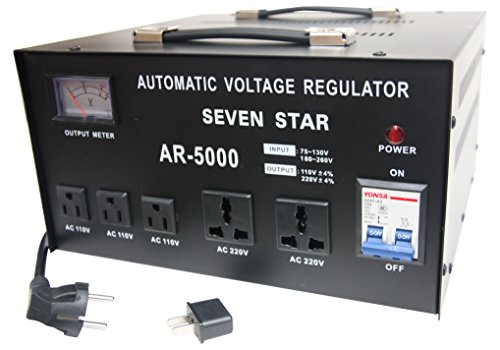
The Seven Star AR 5000W is a heavy-duty voltage stabilizer with a built-in step up/step down transformer. It can convert 110/120V to 220/240V or vice versa and supports 50Hz/60Hz input. Output regulation targets AC 110V ±4% or AC 220V ±4%. A front meter shows exact output voltage, aiding precise monitoring. Best for homes or small facilities in regions with unstable mains and for equipment that requires a robust, constant supply.
- Best for high-wattage appliances and tools in areas with voltage fluctuations
- Keeps devices protected against under/overvoltage by stabilizing supply
- CE certified for broader assurance of safety
Limitations: The unit is comparatively bulky due to its 5000W rating, and installation may require a dedicated circuit depending on your total load. Suitable for individuals needing strong, consistent power for heavy loads.
Nippon America AC Automatic Voltage Regulator (AR-1000)

The Nippon America AR-1000 provides up to 1000 watts of capacity with a focus on protecting electronics during voltage swings. It features a delay output circuit to reduce stress on the transformer from frequent switching and a clear output voltage display for easy monitoring. This AVR is well-suited for desktops, gaming rigs, routers, and other single-phase devices requiring steady voltage.
- Best for mid-range loads and devices sensitive to power dips
- Delay output helps extend transformer life
- Display aids safety and precise operation
Limitation: Capacity tops at 1000W, so larger appliances or multi-device setups may require a higher-capacity unit or distribution approach.
TRIPP LITE LS606M Power Conditioner

The TRIPP LITE LS606M is a compact 600W power conditioner with six outlets, EMI/RFI filtering, and surge protection. It corrects undervoltage and overvoltage to stabilize output, making it ideal for computers, home theater gear, routers, and other electronics sensitive to line noise. A practical pick for small offices or home setups that require clean power across multiple devices.
- Best for sensitive electronics needing EMI/RFI filtration
- Includes surge protection and multiple outlets
- 600W capacity makes it ideal for modest loads
Limitation: The 600W rating may be insufficient for high-wattage appliances or power-hungry equipment running simultaneously.
SICWEDIM Voltage Stabilizer 6800W / 20000W (High-Power Model)

The SICWEDIM stabilizer is a high-power single-phase unit designed for heavy domestic loads such as refrigerators and air conditioners. It features a 8-second delay, an LCD display, and copper output wiring for efficiency. It supports input 120-280V and outputs 220V ±5%, delivering reliable stabilization for large appliances that demand steady voltage.
- Best for high-load home appliances needing robust stabilization
- LCD display and copper wiring support durability and clarity
- Large footprint; consider space and installation needs
Limitation: Higher wattage units can be bulkier and heavier, requiring secure mounting or dedicated space.
Beleeb 20A Variable Transformer Auto AC Regulator

The Beleeb 20Amp VAR Auto Transformer is a flexible option for controlled AC output, delivering 0–130V with a maximum 2000VA capacity. It accepts 110V input and provides an adjustable AC output without converting AC to DC. While not a full AVR in some scenarios, it’s ideal for skilled users needing precise voltage adjustments for test setups, hobby electronics, or temporary power conditioning.
- Best for precise voltage tweaking in controlled environments
- High continuous current capability (20A)
- Not a full AVR for all sensitive electronics—use where linear output is sufficient
Limitation: This unit does not convert AC to DC and does not inherently regulate voltage spikes or dips the way AVR circuits do.
Buying Guide: Key Considerations for Choosing an AVR
What capacity do you need?
Match wattage to your total load. For single devices like a refrigerator or a high-demand PC setup, choose a unit with more headroom than the combined load of your devices to avoid overheating and voltage drops.
What type fits your needs?
AVRs with built-in transformers offer automatic voltage regulation and voltage conversion between 110/120V and 220/240V. Variable transformers (VARS) provide precise output but may not regulate transient surges as effectively as true AVRs. For sensitive electronics, prioritize EMI/RFI filtering and surge protection.
How important are displays and protection features?
Outlets, LCD meters, delay circuits, and copper windings boost reliability. Look for devices with protection against overvoltage, undervoltage, overcurrent, and temperature, plus a display to easily monitor output.
What about installation considerations?
Some units are wall-mountable, others are free-standing. Consider space, ventilation, and whether you need hardwired or plug-in operation. Ensure compatibility with your voltage standard (120V in the U.S.) and the frequency (50/60Hz).
What is the best pick for you?
- Heavy-duty, multi-appliance needs: Seven Star AR 5000W
- Compact, cost-effective protection for mid-range loads: Nippon America AR-1000 or TRIPP LITE LS606M
- High-power households with large appliances: SICWEDIM 6800W model
- Adjustable output for testing or hobby electronics: Beleeb VAR
FAQ: Quick Answers for Buyers
- What is an AVR and when do I need one?
An AVR stabilizes voltage to protect devices from fluctuations and surges. Use one when your mains supply is unstable or you rely on sensitive electronics.
- Should I choose a transformer-based AVR or a digital regulator?
Transformer-based AVRs provide robust regulation and voltage conversion; digital regulators may offer advanced protections but can be more limited in high-load scenarios.
- How do I calculate the right wattage?
Add up the wattage of all devices you plan to run simultaneously and choose an AVR rated higher than that total by a safe margin (20-25%).
- Is EMI/RFI filtering important for home theaters?
Yes. EMI/RFI filters minimize noise that can affect audio and video clarity and equipment performance.
- Can I install an AVR myself?
Some plug-in models are DIY-friendly, but high-wattage or wall-mounted units may require professional installation, especially if wiring to a dedicated circuit is necessary.
- Are there safety certifications I should look for?
CE or other recognized safety certifications indicate adherence to basic safety standards. Always follow the manufacturer’s installation guidelines.