Best 9V Daisy Chain Cable Options for Guitar Pedals
Finding the right 9V daisy chain cable is essential for clean power delivery to multiple guitar pedals. The cables below are designed to split a single power source into several outputs, helping you keep your pedalboard organized and free from power glitches. Below you’ll find five reliable options from well-known brands, each with practical details to help you compare features like plug design, wire gauge, and overall length. Use the quick-summary table to skim key points, then dive into each product’s specifics.
| Product | Brand | Key Feature |
|---|---|---|
| SATUY 2Pcs Guitar Pedal Effect Power Cable | SATUY | 3-plug and 2-plug splitters; solid copper core |
| Godtone 3 Ways Daisy Chain | Godtone | 3 outputs; 26AWG copper; compact spacing |
| MEETOOT Daisy Chain 1 to 2 | MEETOOT | 1 to 2 chain; PVC housing; 60 cm total |
| Psiriol Daisy Chain 1-to-2 | Psiriol | Dual-plug design; high-quality copper core |
| JOYO DC 9V 1.2A with 5 Way Daisy Chain | JOYO | 5-way chain; tip negative; broad compatibility |
SATUY 3-Way and 2-Way Daisy Chain Cable

The SATUY cable set provides both 3-plug and 2-plug configurations, enabling a single power source to feed three or two pedals simultaneously. Its design emphasizes a resilient tuning-fork shaped male connector grip and a robust 5521 terminal head at the female end for stable current transmission. Built with a PVC-encased core and oxygen-free copper conductors, the cable aims to deliver clean, low-noise power while resisting wear. This versatility is particularly useful for compact boards that require flexible power distribution.
Godtone 3-Way Daisy Chain For Pedals

The Godtone daisy chain is designed to accommodate three pedals from a single 9V supply. It uses a 26AWG oxygen-free copper core to help reduce resistance and minimize noise in the power line. The maximum distance between each plug remains compact at about 0.82 feet, which helps keep pedal boards tidy while maintaining solid connectivity. This cable is suitable for standard 9V pedals that require reliable, low-impedance power distribution, especially on small to mid-sized boards where space is at a premium.
MEETOOT Daisy Chain 1 to 2

MEETOOT’s 1-to-2 daisy chain offers a practical solution for powering two effects from a single 9V supply. The inner copper core provides good conductivity for stable operation, while the PVC housing keeps the cable lightweight and durable for daily practice or gigging. The total length is 60 cm (23.62 inches), with a 30 cm (11.81 inch) spacing between connectors. This arrangement makes it easy to place pedals across a small to medium pedalboard without crowding power adapters.
Psiriol 1-to-2 Guitar Pedal Power Cable

Psiriol’s 1-to-2 daisy chain uses a high-quality copper core to ensure stable, noise-free transmission. The dual-plug design expands a single power output to power two effects simultaneously, a practical choice for musicians who want to keep a clean, compact pedalboard. The black cable design features a universal connector, making it compatible with a broad range of 9V DC power adapters. This simplicity makes it a solid choice for practice rigs or evolving pedalboards.
JOYO DC 9V 4-Way Daisy Chain Cable

JOYO’s 4-way daisy chain is designed to power four pedals from a single 9V supply, with an AC wall charger included for easy setup. The design supports a typical 9V DC output with a maximum current of 800mA, reaching up to 1A total with the included accessories. The tip-negative design is standard for many guitar effect pedals, and the cable length offers enough reach to place pedals across a standard pedalboard. This option suits players with multiple compact pedals that require simultaneous powering without extra adapters.
JOYO 5-Way Daisy Chain With Reverse Polarity
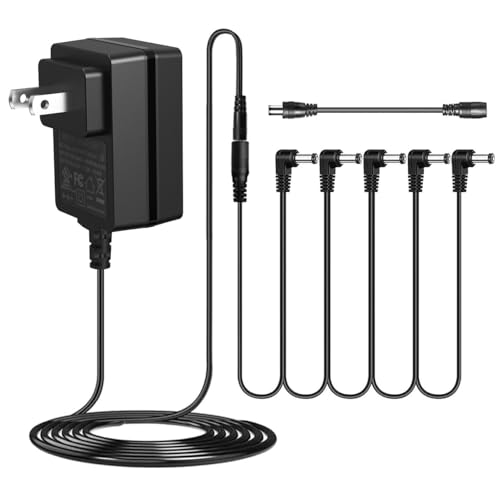
JOYO’s 5-way daisy chain expands 9V power to five pedals, with a polarity converter included to handle different pedal requirements. The reverse polarity cable support increases compatibility with pedals that require non-standard connections, making it a versatile choice for larger boards or setups with diverse pedal types. The design emphasizes reliability for stage use, providing solid current distribution and reduced crosstalk between connected effects.
Cheerock 1-to-2 Guitar Pedal Power Cable

Cheerock’s 1-to-2 daisy chain is built around high-quality copper core material to ensure durability and long-term use. The cable is designed for standard 9V DC pedals and aims to deliver solid performance at a reasonable price. While the product emphasizes reliability and everyday practicality, potential buyers should verify the exact spacing and connector compatibility with their particular pedal model to ensure a perfect fit.
Buying Guide: Key Purchase Considerations For 9V Daisy Chains
- Current capacity and compatibility: Check the total current rating (mA or A) to ensure it meets the combined demand of all pedals on your board. Some daisy chains are built for higher or lower total current, and pedal requirements can vary.
- Connector design and polarity: Most pedals use tip-negative 9V power. If you have pedals with reverse polarity needs, consider chains that include polarity adapters or reverse polarity cables.
- Wire gauge and isolation: A thicker gauge (like 26AWG) can reduce voltage drop and noise, especially on longer runs or busy boards. Look for oxygen-free copper cores for clean transmission and good shielding to minimize noise.
- Cable length and pedal spacing: Measure your board layout. Longer cables provide flexibility but can introduce more resistance. Choose a configuration that minimizes cable clutter while maintaining reliable connections.
- Durability and build quality: PVC housing, robust connectors, and strain relief contribute to longevity on stage or practice sessions. Smooth exteriors help with cable management on crowded boards.
- Ease of use and expansion: If you anticipate adding more pedals, a daisy chain with more outlets or modular options can simplify future upgrades.
- Brand reliability and warranty: Reputable brands often offer better consistency in performance and customer support, which can be valuable for gear that’s central to your signal chain.
In summary, the options above span a range of needs—from compact 2- and 3-outlet configurations to larger 4- and 5-outlet solutions, with various wiring and polarity considerations. When selecting, align current requirements, pedal compatibility, and board layout to maintain clean, reliable power delivery across your entire pedal setup.