Best 8-Circuit Transfer Switches for Reliable Home Power
Finding the right transfer switch for 8-circuit power needs helps protect your home during outages while keeping essential loads running. This guide compares top 8-circuit options, highlighting who each product is best for and why. The list includes both manual and automatic switches, indoor and outdoor models, and systems designed for generators up to 7500 running watts or more. Use this to identify the best fit for a small home, a seasonal cabin, or a worksite with predictable outages.
| Product | Circuits | Power Capacity | Best For |
|---|---|---|---|
| Westinghouse 30 Amp Transfer Switch Kit | 8 Circuits | Up to 7500 running watts | Homeowners needing 8 circuits with solid durability |
| Nature’s Generator Manual Transfer Switch 12-Circuits | 12 Circuits | 120/240V, 30A | Manual control with higher circuit count |
| Generac HomeLink 30-Amp | 8-10 Circuits | Indoor pre-wired panel | Upgradable to automatic with easy operation |
| Connecticut Electric EmerGen 6-Circuit | 6 Circuits | Up to 7500 Watts | Compact, durable indoor/outdoor use |
| Nature’s Generator 8-Circuit Automatic 30A | 8 Circuits | 120/240V, automatic | Pre-wired ease with automatic switching |
Westinghouse 30 Amp Transfer Switch Kit with 8 Circuits

- 8 total circuits: 6x 15A and 2x 20A, enabling a variety of home loads.
- Compatible with generators up to 7500 running watts for strong load handling.
- Durable powder-coated steel enclosure and tin-coated copper wiring for corrosion resistance.
Best for: Homeowners who want a robust, mid-range option that covers essential loads without complexity. Limitations: May require professional installation for some setups and is not automatic.
Nature’s Generator Transfer Switch 6 Circuits 120V 30A (Indoor)

- Manual power switching for secure control of generator connection.
- Rated for 30A at 120V, supports up to 6 circuits to cover core loads.
- Compatibility with AFCI/GFCI breakers for added protection.
Best for: Small homes or cabins needing controlled, non-automatic transfer with clear circuit management. Limitations: Fewer circuits than 8-circuit options.
Generac HomeLink 30-Amp Transfer Switch
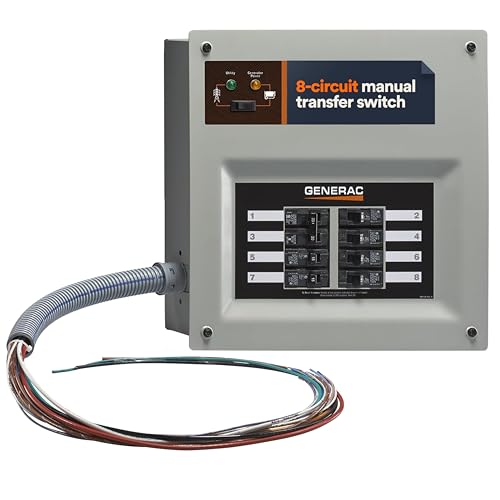
- 8-10 circuits with upgrade path to automatic standby capability via HomeLink kit.
- Electronic rocker switch enables quick one-button generator-to-load switching.
- Indoor pre-wired panel designed for straightforward installation.
Best for: Homeowners planning future automation or upgrades while needing reliable manual operation today. Limitations: Upgrade path adds complexity and may require additional components.
Connecticut Electric EmerGen 30Amp 6-Circuit

- Reliable power transfer between utility and generator with double-throw safety features.
- Powder-coated steel enclosure supports indoor or outdoor use, built for durability.
- Backfeeding protection via double-throw switches for added safety.
Best for: Users needing a compact, durable 6-circuit option with solid safety features. Limitations: Fewer circuits than 8-circuit models; may require plan adjustments for larger loads.
DSGSANO 50A Pro/Tran2 10-Circuit

- Supports up to 10 circuits with 50A capacity at 240V.
- Manual transfer with clearly marked wires and terminals.
- Suitable for whole-house backup or RV/off-grid use where higher circuit counts are needed.
Best for: Alternative when you need more circuits and higher amperage in a manual solution. Limitations: Higher amperage requires careful setup and electrical knowledge.
Nature’s Generator Automatic 8-Circuit 30A

- Pre-wired design for easy installation and quick setup.
- 8 independent circuits with 30A at 120/240V for precise power distribution.
- Automatic switching provides continuous power without manual intervention.
Best for: Users seeking automatic operation with a straightforward installation. Limitations: Automatic systems may require more space and initial configuration.
Buying Guide: Key Considerations For 8-Circuit Transfer Switches
- Number of circuits: Choose a model that matches or exceeds your essential-load count to avoid overloading. An 8-circuit option covers most homes, while 10- to 12-circuit models offer headroom for more devices.
- Manual vs. automatic: Manual switches provide simple operation and reliability but require manual intervention during an outage. Automatic switches switch seamlessly, offering convenience and continuous power but may be more complex to install.
- Power capacity: Ensure the transfer switch supports the generator’s running watts and your critical loads. Common targets are 7500 watts or more for home use, with 30A rated circuits for typical essential appliances.
- Enclosure and installation: Indoor vs. outdoor ratings, enclosure durability, and the ease of mounting influence long-term performance. Powder-coated steel enclosures tend to withstand harsher environments.
- Safety features: Look for backfeeding protection, proper interlocks, and compliant wiring practices to minimize risk during outages and re-energizing.
- Compatibility: Some systems are pre-wired for specific generators or upgrade paths. Consider future expansion, especially if you plan to add automatic operation later.
FAQ
- What is the main difference between manual and automatic transfer switches? Answer: Manual switches require you to manually select and connect circuits during an outage, while automatic switches detect power loss and switch without intervention.
- Can I install a transfer switch myself? Answer: Some models are designed for DIY installation with clear instructions, but many setups require a licensed electrician to ensure safe, code-compliant wiring.
- How many circuits should I choose for a typical home? Answer: Eight circuits cover most essential loads; consider adding more circuits if you have additional high-priority devices or future expansion plans.
- Are outdoor-rated transfer switches important? Answer: Yes, if the unit is installed outdoors; outdoor-rated enclosures resist weather and corrosion better than indoor-only models.
- Is it better to buy a switch with an upgrade path to automatic later? Answer: If you anticipate upgrading, an option with a future upgrade path provides flexibility without replacing the entire system.
- Do transfer switches protect against backfeeding? Answer: Yes, many models include backfeeding protection to prevent power from flowing back into the utility lines.