Best 7500 Watt Solar System Options for Home Backup and Off‑Grid Power
Direct answer: For a robust 7500 watt capability, look for hybrid or high‑capacity off‑grid kits that offer strong inverter output, multiple MPPTs, and sizable battery storage. The top 5 products below are chosen for scalability, reliability, and versatility—suitable for homeowners seeking reliable backup power, whole‑house support, or off‑grid independence. Each product is best for specific use cases, from heavy loads to modular expansion.
Summary of chosen products
- 12000W Hybrid Solar Inverter 48V (vuicci) – Best for grid‑tied or off‑grid backup with high AC output and dual MPPT for flexible solar input.
- ECO WORTHY 10000W Off‑Grid System – Best for larger homes seeking a complete 10kW solution with integrated battery storage.
- ECO-WORTHY 9.36KWH Off‑Grid System (AUECOOR) – Best for reliable off‑grid power with substantial lithium storage and WiFi monitoring.
- OLONETO 4000W/6000W Complete Inverter Kit – Best as a compact, portable solution for RVs, cabins, and small off‑grid setups.
- [Ultra] ECO-WORTHY 1200W System – Best as a lightweight, expandable starter kit for travelers or tiny off‑grid deployments.
12000W Hybrid Solar Inverter 48V With WiFi

Best for: Homes needing a powerful, flexible inverter that can run heavy loads or act as a reliable backup during outages. The unit supports grid‑tie, off‑grid, and hybrid configurations with a pure sine wave output. It includes dual MPPT inputs for up to 15000W PV input and 200A battery charging.
Why selected: It combines high continuous power (12KW) with split‑phase 120V/240V capability, making it suitable for larger households and workshop gear. The dual MPPT design enhances solar harvest, especially on partial shade or multi‑angle roof layouts. The UL1741 safety rating supports compliant installations.
Caution: The product is designed for larger systems; ensure your battery bank and wiring gauge are sized for 200A charging and 12kW output to avoid overloads.
ECO WORTHY 10000W Off‑Grid System

Best for: Households seeking a complete, scalable off‑grid setup with substantial storage and practical monitoring features. The package includes a 10kW inverter, 5 × 590W panels (2950W PV) and a 48V 314Ah battery offering 16.1 kWh of storage.
Why selected: The 10kW continuous capability supports common appliances with a split‑phase output, plus a smart display and Wi‑Fi/Bluetooth monitoring. It’s designed for straightforward setup and reliable home backup power with expandable parallel options (up to six units in some configurations).
Caution: The system is large; ensure adequate space, proper mounting, and a robust electrical plan for parallel operation and battery management compatibility.
ECO-WORTHY 9.36KWH Off‑Grid System

Best for: Off‑grid users who need a compact, robust power package with decent storage and monitoring capabilities. It includes a 12kW split‑phase inverter, 30.72 kWh energy storage, and a 6x LiFePO4 battery array.
Why selected: The large energy storage makes it ideal for outages, while WiFi/PC connectivity enables remote monitoring. It supports split‑phase operation and can handle essential load shedding through MPPT efficiency benefits.
Caution: System size is substantial for smaller properties; verify local code compliance and space for batteries and inverter installation.
OLONETO 4000W/6000W Complete Solar Inverter Kit

Best for: Portable or small‑to‑medium off‑grid setups, including cabins, RVs, or remote workspaces. The kit offers 4000W/6000W surge power with a 50A controller and a compact solar panel package.
Why selected: It provides an affordable entry into higher wattage off‑grid capacity with a practical balance of inverter power, control, and portability. It’s a good stepping stone toward larger systems.
Caution: The continuous load is limited compared to bigger kits; plan loads accordingly and consider future expansion if power demand grows.
[Ultra] ECO-WORTHY 1200W System
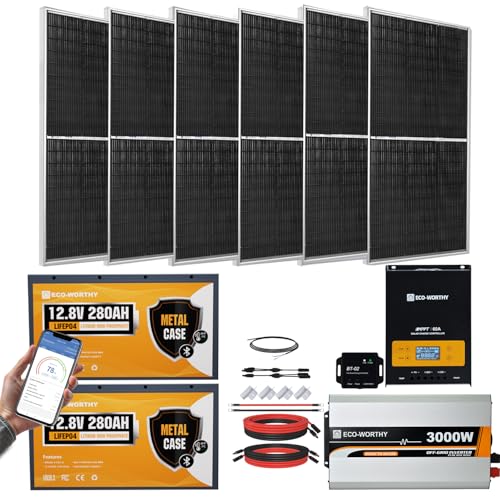
Best for: Lightweight off‑grid travelers or emergency kits where compact size matters. This ultra‑compact kit provides basic off‑grid capability with LiFePO4 storage.
Why selected: It is the most portable option among the five, suitable for temporary setups, RV trips, or small back‑up loads when space is extremely limited.
Caution: Size and wattage limit the range of appliances you can power; not suitable for whole‑home backup on larger residences.
Buying Guide
Choosing the right 7500 watt system involves evaluating inverter power, battery storage, solar input efficiency, and expansion potential. Consider these questions and answers to guide your decision.
- What is my peak load, and can the inverter handle it? Look for inverters with continuous power well above your typical peak load and with surge capability for motors and heating elements.
- Do I need split‑phase (120V/240V) output? Split‑phase is essential for powering whole houses and many appliances; confirm the system supports 120V/240V outputs as needed.
- What kind of batteries and BMS are included? LiFePO4 batteries offer longevity and safety; ensure a compatible Battery Management System and clear monitoring interfaces.
- Is WiFi or Bluetooth monitoring important to me? Remote monitoring helps track performance, battery state, and energy production, especially for off‑grid living.
- Can the system scale later? If you anticipate growing power needs, choose units with MPPT enhancements, modular inverters, and parallel operation options.
- How much solar input do I need? Dual MPPT designs can maximize harvest from multi‑angle roofs or partial shading; verify PV input limits align with your roof size.
Frequently Asked Questions
- What distinguishes a hybrid inverter from a pure off‑grid inverter? A hybrid can manage grid power, battery storage, and solar input, enabling backup and grid support in one unit.
- Is 7500 watts enough for a typical home? For many homes, 7.5kW of inverter rating plus adequate battery storage can cover essential loads and some modern appliances, but check your specific electrical plan.
- Do these kits require professional installation? For safety and code compliance, professional installation is recommended, especially for high‑power systems and grid interactions.
- Can multiple kits be paralleled? Some kits support parallel operation to increase total capacity; verify compatibility and required hardware with the manufacturer.
- What maintenance is involved? Regular inspection of batteries, wiring, and connections is advised; monitoring software can alert you to anomalies.
- Are these systems compliant with safety standards? Look for UL1741 or equivalent listings and follow local electrical codes during installation.